

The clonal origins of individual metastases, whether seeded directly from the primary tumor or from established metastases, determine whether a single metastatic biopsy captures the clonal diversity present at the time of treatment, and whether resistance mechanisms detected in one lesion apply elsewhere in the metastatic compartment. Autopsy-linked multiregion sequencing resolves these routes at a spatial and temporal resolution unavailable from clinical sampling./p>
Hessey and colleagues analyzed 501 longitudinally collected primary and metastatic tumor samples from 24 patients with NSCLC enrolled in the TRACERx lung study and PEACE autopsy programme, using high-depth whole-exome sequencing with multiregion primary sampling, premortem metastasis sampling, and autopsy sampling. DNA sequencing covered approximately 70% of metastases radiologically detected before death. Phylogenetic reconstruction was used to infer clonal origin, migration routes, and timing of metastatic events from diagnosis to autopsy.
Metastatic genomes diverged substantially from their inferred primary tumor ancestors, with additional driver alterations and genome doubling events acquired after dissemination. In 62.5% of patients, multiple primary tumor subclones disseminated independently, each founding a distinct metastasis. More than half of sampled metastases were seeded by other metastases rather than directly from the primary tumor. The duration a metastasis existed in situ correlated with its likelihood of seeding further metastases. Most metastatic migrations remained within the same anatomical cavity. The minority of subclones that exited the thorax were enriched for somatic copy-number alterations, consistent with a role for chromosomal instability in facilitating wider anatomical dissemination.
Direct clinical application to GU oncology requires equivalent sampling studies in urothelial, renal, and prostate tumors. This study's contribution is architectural: it establishes what autopsy-linked multiregion sequencing reveals about metastatic dissemination that single-timepoint clinical biopsies cannot. The same sampling approach, multiregion primary sampling combined with autopsy-linked metastatic sequencing, could test whether urothelial cancer metastases arise from parallel primary-tumor subclones, late-selected resistant clones, or established metastatic deposits. Knowing which source dominates would change how ctDNA panels are designed, which biopsy sites are prioritized at progression, and whether resistance mechanisms identified in one lesion can be assumed to generalize across the metastatic compartment. The enrichment of chromosomal instability in extrathoracic-spreading clones is consistent with a broader model in which structural genomic plasticity, not point mutations alone, governs metastatic competence and the transition from locoregional to systemic dissemination.
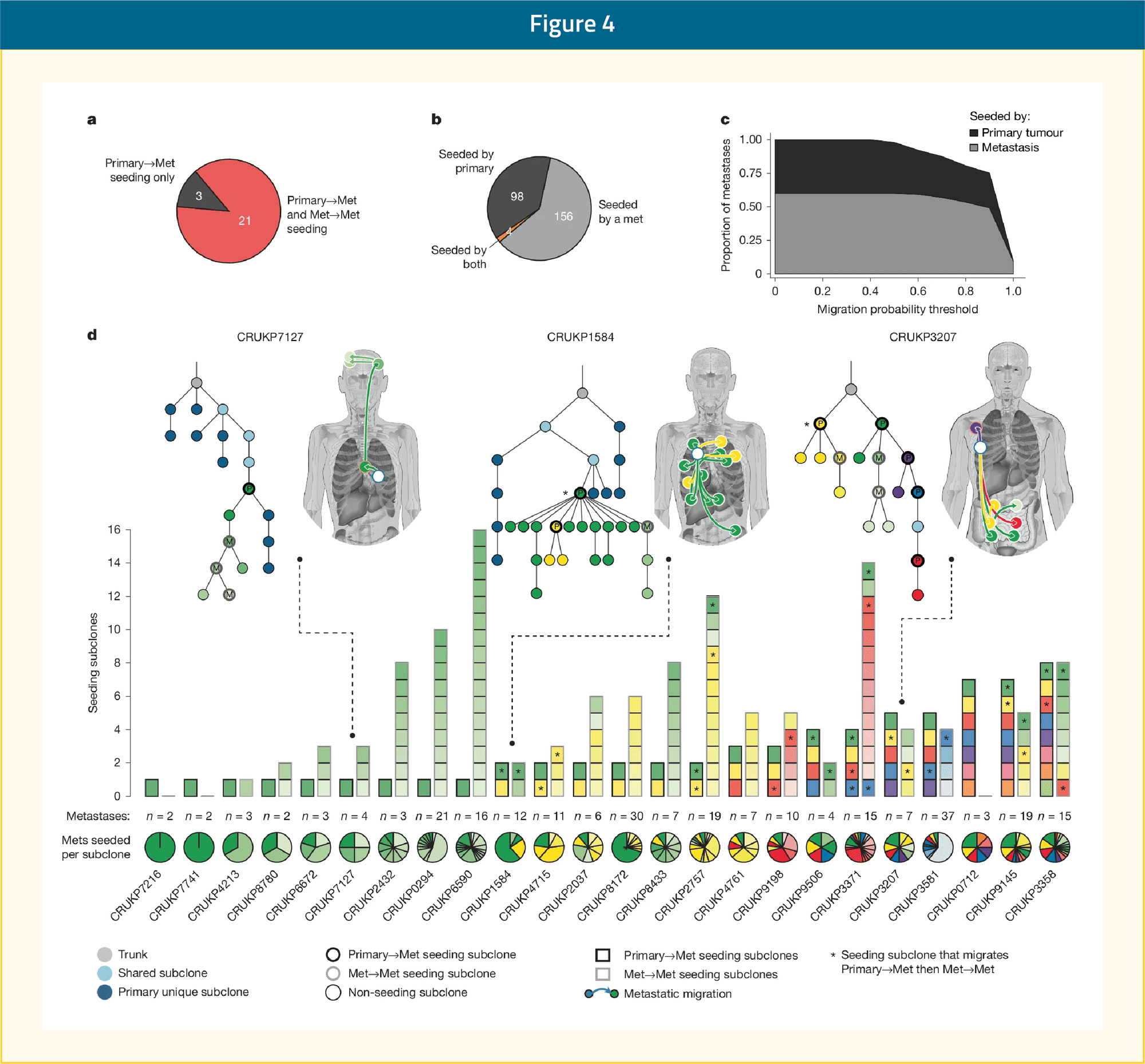 Hessey, S., Bunkum, A., Huebner, A. et al. Evolutionary characterization of lung cancer metastasis. Nature 653, 911–922 (2026). https://doi.org/10.1038/s41586-026-10428-4. Used with permission under the following Creative Commons License: https://creativecommons.org/licenses/by/4.0/