

AR blockade upregulates PSMA receptor expression in mCRPC. Baseline PSMA PET selects patients based on pretreatment target expression.
Day-15 PSMA PET after AR-targeted therapy functions as a pharmacodynamic imaging readout of induced or increasing PSMA expression, a distinct biological question from baseline eligibility. The main ENZA-p trial demonstrated that adding Lu-PSMA-617 to enzalutamide improved PSA-PFS in poor-risk, PSMA-positive mCRPC. This prespecified substudy asked whether early serial PSMA change stratifies the magnitude of that benefit.
ENZA-p randomized 162 patients with poor-risk mCRPC and significant ⁶⁸Ga-PSMA PET avidity (SUVmax >15 at one site, or >10 at sites ≥10 mm) 1:1 to enzalutamide alone or enzalutamide plus Lu-PSMA-617. ⁶⁸Ga-PSMA PET-CT was performed at baseline and on day 15 of enzalutamide treatment, with SUV mean quantified at both timepoints. The substudy evaluated early SUV mean change in relation to PSA-PFS, 50% PSA-decline rate, and overall survival (NCT04419402). 154 of 160 treated participants (96%) had a day-15 PSMA PET-CT.
SUV mean increased in 105 of 154 participants (68%) at day 15. Among patients with increasing SUV mean, median PSA-PFS was 5.8 months (95% CI 4.0–8.7) with enzalutamide versus 13.1 months (95% CI 10.5–17.0) with enzalutamide plus Lu-PSMA-617 (HR 0.38; 95% CI 0.25–0.58; P<0.001). Among patients with decreasing SUV mean, median PSA-PFS was 12.5 months (95% CI 3.2–23.6) with enzalutamide versus 13.3 months (95% CI 9.6–22.2) with enzalutamide plus Lu-PSMA-617 (HR 0.80; 95% CI 0.42–1.53; P=0.5). The interaction P-value for SUV mean direction by treatment arm was 0.055.
Early PSMA upregulation at day 15 occurred in 68% of patients. In that subgroup, enzalutamide alone produced a median PSA-PFS of 5.8 months; Lu-PSMA-617 addition extended it to 13.1 months (HR 0.38). The interaction P of 0.055 does not meet a conventional threshold; the substudy was not independently powered for this analysis. The result supports prospective testing of day-15 PSMA upregulation as a pre-specified selection criterion for Lu-PSMA-617 addition, not as a current treatment rule. The evidence warrants a prospectively powered trial in which day-15 PSMA upregulation is the primary eligibility criterion for Lu-PSMA-617 addition, not a post-hoc stratification variable.
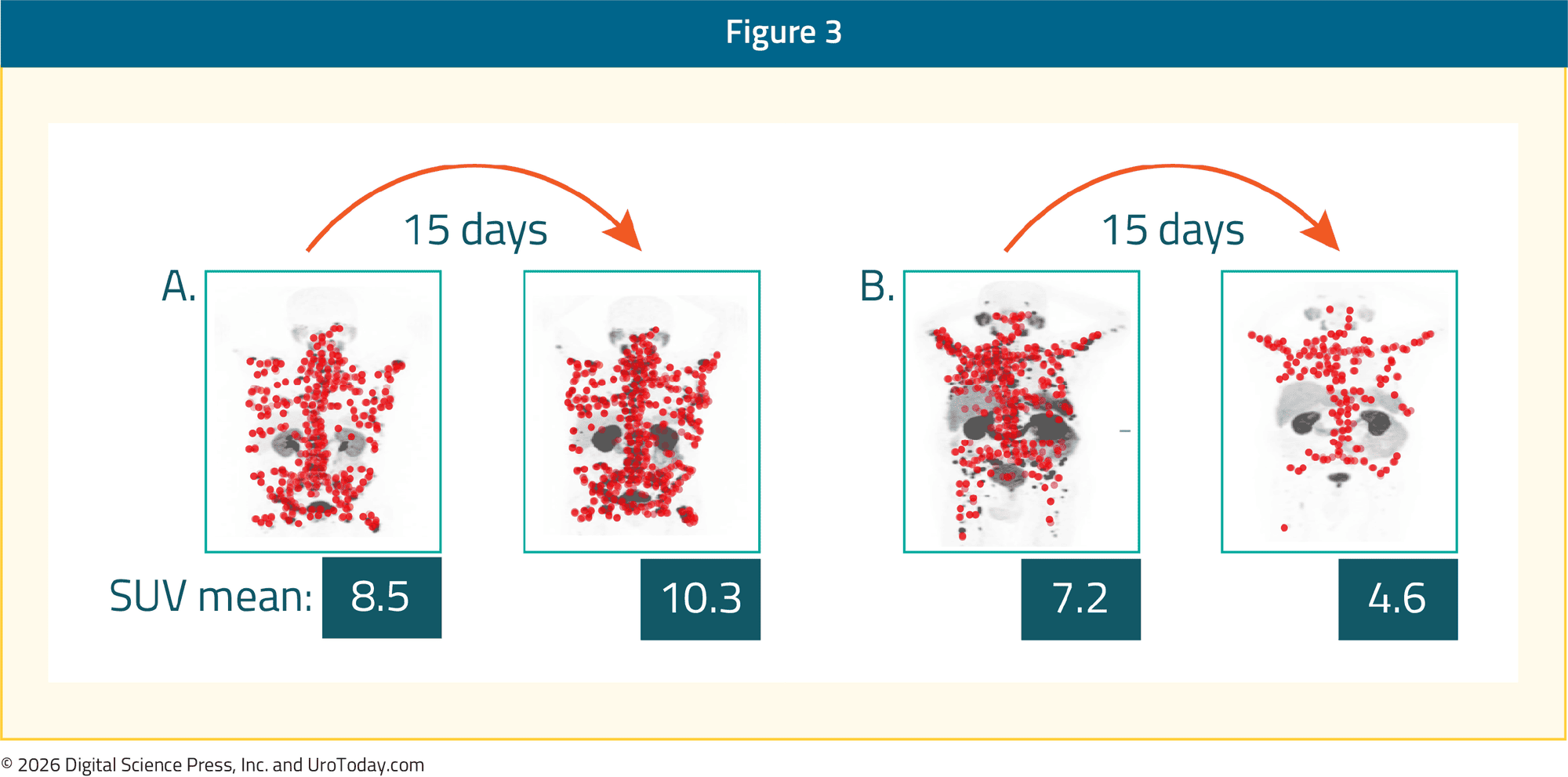 Paired PSMA PET imaging and quantitative SUV mean change after enzalutamide exposure in ENZA-p. The panel illustrates day-15 PSMA upregulation as a pharmacodynamic readout after AR blockade. Emmett et al. Nature Cancer, 2026. PSMA PET day-15 figure. DOI: 10.1038/s43018-026-01140-3