

Boosting intake of dietary phytochemicals with a fortified blend of 6 whole foods, now known as YourPhyto, not only significantly slowed PSA progression to a higher degree than previously reported,1 but improved urinary symptoms and erectile function.

This is also the World’s first double blind RCT to show that men randomised to additional intake of a capsule containing 5 lactobacillus probiotics, now known as Yourgutplus, further reduced PSA progression, improved markers of inflammation and grip strength, both known to be biomarkers of longevity. This trial provides practical dietary guidance for men with prostate cancer, and if confirmed with longer follow-up, could reassure men to remain on active surveillance for longer, avoiding the toxicities of more radical treatments.

Background:
The “gut-prostate axis” is increasingly being recognised in prostate cancer (PCa) incidence through its influence on inflammation.2,3,4 Lower levels of gut Lactobacillus strains and antibiotic use have been linked to a higher rate, treatment resistance, and biochemical recurrence.5,6 Previous clinical studies have shown that a blend of green tea, pomegranate, turmeric, and broccoli slowed Prostatic Specific Antigen (PSA) progression.1 Since then, beneficial evidence for cranberry and ginger have been reported, and technological advances in fortification and standardisation of candidate phytochemical levels have evolved.7,8 In addition to their effect on inflammation, oxidative stress, and immune surveillance, phytochemicals are also potent prebiotics that work in synergy with lactobacillus probiotics.3 Laboratory studies have already shown that manipulating gut bacteria can slow prostate cancer progression.10 Until now, no clinical trial has evaluated the combination of phytochemical-rich foods and probiotics in men with PCa, hence the rationale for this study.
Methods:
All 212 men, with indolent but PSA progressing PCa (average age 74.5 years), were managed with active surveillance (AS). No men were taking androgen deprivation therapy and had stopped any other over-the-counter supplements. Baseline demographics, including age, Gleason grade, body mass index, and ethnicity, were similar in both randomised arms.
A novel feature of the phytochemical-rich supplement (PRS) specifically designed for this study is that it uniquely contains both whole purified foods and concentrated extracts from the same food. This ensures a wide spectrum of synergistically acting natural elements from the whole plant, but also boosts levels of the candidate phytochemicals thought to be responsible for the health benefits. Men were then randomised (1:1) to receive either a placebo (P) or the Probiotic blend (PB) of 5 lactobacillus probiotics, for 16 weeks. This probiotic has a good safety record as it was previously evaluated in the UK national COVID intervention study.10 Another novel feature of this lactobacillus blend is that it has a delayed-release capsule, contains a good quantity of inulin, and contains vitamin D, which also acts as a prebiotics. Synergistically, in return, probiotics are known to encourage vitamin absorption.11
Results: PSA and changes on MRI:
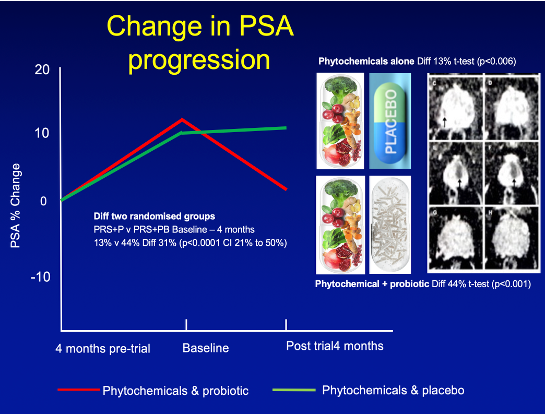
PSA progression slowed by 44% in the combined arm (P<0.001) and 13% in the PFS alone arm (p<0.01).
There was a 31% difference in PSA progression between the randomised arms (P<0.01).
In men whose second MRI reported progression, the PSA rate increased 6%. In men whose MRI reported regression, the rate decreased by 51%. This significant difference confirmed no PSA masking (p=0.02). Changes on MRI favored the combined group, showing regression in 6.7%, and progression in 7.8% vs regression in 0% and progression in 18% (OR 1.86).
Results: Urological symptoms from baseline to 4 months:
In all men, the mean Prostate Symptom Score improved by 25% (p < 0.001, 95% CI –4.93 to –2.17).
The mean International Index of Erectile Function improvement by 11% (p < 0.001, 95% CI –1.8 to –4.0)
Results: Markers of longevity
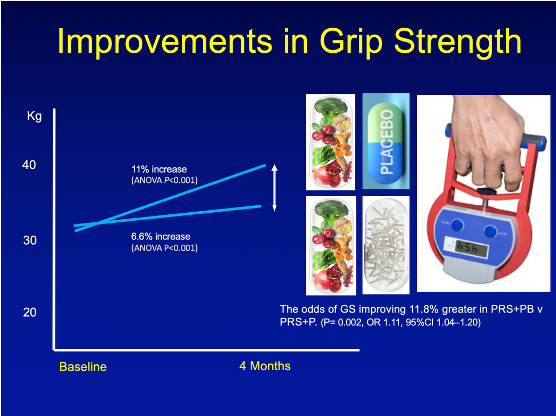
Grip Strength improved significantly more in the combined arm 2.5 v 4.4 Kg (1.9, p<0.01, 95% CI: 0.8 to 3.0).
Systemic inflammation, measured by neutrophil to lymphocyte ratio, improved more in the combined arm +0.39 v -0.41 (0.8, p=0.04, 95% CI:0.03-1.53).
Other measures: Adverse events were low and similar in both arms. Serum testosterone, taken to exclude a phytoestrogen effect, actually showed a marginal, statistically significant, higher level in the combined arm 13.02 v 14.75 ng/l (1.73 ng/l, p=0.046, 95% CI 0.23 to 3.33). Vitamin D levels were higher in the combined group 82.4 v 65.9 nmol/l (16.6, p<0.02 CI 14.1 to 18.2).
Conclusions and next steps:
This new, fortified phytochemical-rich food supplement slowed PSA progression, improved urological symptoms, findings that were welcomed by men on AS. The PSA effect was enhanced by the intake of an additional lactobacillus complex, an intervention aiming to improve gut health. As people age, grip strength falls and systemic inflammation increases, so the finding that this combination reversed this decline has important implications for longevity research.12,13 These conclusions, however, were relevant to these specific formulations, and although similar benefits with other phytochemical blends and probiotics are certainly possible, caution should be used when extrapolating these results to other nutraceuticals that have not undergone a clinical analysis. These findings have encouraged our research group to obtain longer-term data and design more microbiome-related studies in people with different cancers, at different stages, and on systemic treatments.
Disclaimer:
There are no intellectual patent issues related to these supplements, which were donated free of charge for this trial and are classified as foods. There is no intention to apply for medical licences. The authors have no financial connection to these over-the-counter products now known as YourPhyto and Yourgutplus.
Written by: Robert J. Thomas,1 Stacey A. Kenfield,2 Madeleine Williams,3 Robert U. Newton,4 Jeffrey Aldous,5 Anita Mitra,6 Zahoor Fazili7
- Addenbrooke's Hospital, Cambridge, UK; Bedford Hospital, Bedford, UK; Cambridge University Hospitals, Cambridge, UK; NHS Trusts, UK.
- Department of Urology, University of California, San Francisco (UCSF), San Francisco, CA, USA; Department of Epidemiology & Biostatistics, University of California, San Francisco (UCSF), San Francisco, CA, USA.
- The Primrose Research Unit, Bedford Hospital, Bedford, UK.
- Exercise Medicine Research Institute, Edith Cowan University, Perth, Western Australia, Australia.
- Institute for Sport and Physical Activity Research (ISPAR), University of Bedfordshire, Bedford, UK.
- University College London Hospital, London, UK.
- Bedfordshire Hospital Trusts, The Department of Urology, Bedford Hospital, Bedford, UK.
- R. Thomas, M. Williams, P. Bellamy, et al. A double-blind, placebo-controlled randomised trial evaluating the effect of a polyphenol-rich whole food supplement on PSA progression in men with prostate cancer. Prostate Cancer Prostatic Dis, 17 (2014), pp. 180-186
- K. Fujita, M. Matsushita, M.A. De Velasco, et al. The gut-prostate axis: a new perspective of prostate cancer biology through the gut microbiome. Cancers (Basel), 15 (2023), p. 1375.
- R. Thomas, M. Williams, J. Aldous, et al. Multiple biological mechanisms for the potential influence of phytochemicals on physical activity performance: a narrative review Nutraceuticals, 3 (2023), pp. 353-365
- C.A .Reichard, B.D. Naelitz, Z. Wang et al. Gut Microbiome-Dependent Metabolic Pathways and Risk of Lethal Prostate Cancer: Prospective Analysis of a PLCO Cancer Screening Trial Cohort. Cancer Epidemiol Biomarkers Prev. 31 (2021); 1:192-199.
- N. Pernigoni, E. Zagato, A. Calcinotto, et al. Commensal bacteria promote endocrine resistance in prostate cancer through androgen biosynthesis Science, 374 (2021), pp. 216-224
- J.H. Kim, H. Seo, S. Kim, et al. Biochemical recurrence in prostate cancer is associated with the composition of Lactobacillus: microbiome analysis of prostatic tissue Int J Mol Sci, 24 (2023), p. 10423
- V. Student, A. Vidlar, J. Bouchal, et al. Cranberry intervention in patients with prostate cancer prior to radical prostatectomy: clinical, pathological and laboratory findings Biomed Pap Med Fac Univ Palacky Olomouc Czech Repub, 160 (2016), pp. 559-565
- J. Zagórska, K. Pietrzak, W. Kukula-Koch, et al. Influence of diet on the bioavailability of active components from Zingiber officinale, using an in vitro digestion model Foods, 12 (2023), p. 3897
- S. Terrisse, A.G. Goubet, K. Ueda, et al. Immune system and intestinal microbiota determine efficacy of androgen deprivation therapy against prostate cancer J Immunother Cancer, 10 (2022), Article e004191
- R. Thomas, M. Williams, J. Aldous, et al. A randomised, double-blind, placebo-controlled trial evaluating concentrated phytochemical-rich nutritional capsule in addition to a probiotic capsule on clinical outcomes among individuals with COVID-19 COVID, 2 (2022), pp. 433-449
- N. Naderpoor, A. Mousa, L.F. Gomez Arango, et al. Effect of vitamin D supplementation on faecal microbiota: a randomised clinical trial Nutrients, 11 (2019), p. 2888
- Bohannon RW. Grip strength: an indispensable biomarker for older adults. Clin Interv Aging (2019);14: 1681–91.
- Li, X., Li, C., Zhang, W. et al. Inflammation and aging: signaling pathways and intervention therapies. Sig Transduct Target Ther 8, (2023). 239
Related Content:
Gut Microbiome and Prostate Cancer: How Diet Impacts Disease Progression - Robert Thomas