

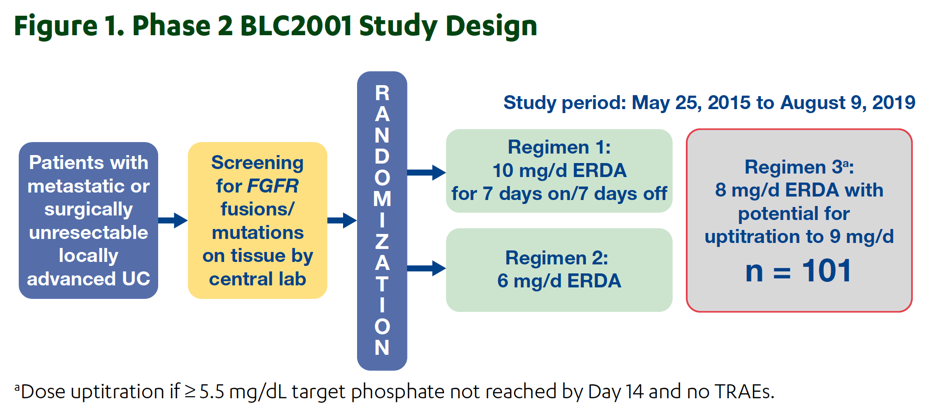
Duration of response, progression-free survival, and overall survival were assessed by FGFR alteration (mutations and/or fusions were analyzed as present or absent), primary tumor location (upper vs lower tract), presence of visceral metastases, prior chemotherapy, and prior immunotherapy among 101 patients receiving the established erdafitinib dosage (8 mg/d continuous in 28-day cycles with uptitration to 9 mg/d if a protocol-defined target serum phosphate level was not reached and no treatment-related adverse events were observed). The trial schema for BLC2001 is as follows:
The median follow-up for this updated analysis was 24 months (IQR 22.7-26.6). Most patients (69%) were FGFR mutation positive/fusion negative, 25% were FGFR mutation negative/fusion positive, and 6% were FGFR mutation positive/fusion positive. Median duration of response was not impacted by FGFR alteration type. For FGFR mutation positive/fusion negative patients, the median PFS was 5.6 months and median OS was 12.0 months. For FGFR mutation negative/fusion positive patients, the median PFS was 2.8 months and median OS was 10.3 months. Most patients had primary tumors in the lower tract (75%), and most (77%) had visceral metastases. Duration of response, PFS, and OS were similar regardless of primary tumor location or presence of visceral metastases. Most patients (88%) had prior chemotherapy; median duration of response, PFS, and OS were shorter for patients with prior chemotherapy versus those without prior chemotherapy. Additionally, 24% of patients had prior immunotherapy; duration of response, PFS, and OS were similar regardless of prior IO. As follows is a forest plot of duration of response, PFS, and OS by subgroup: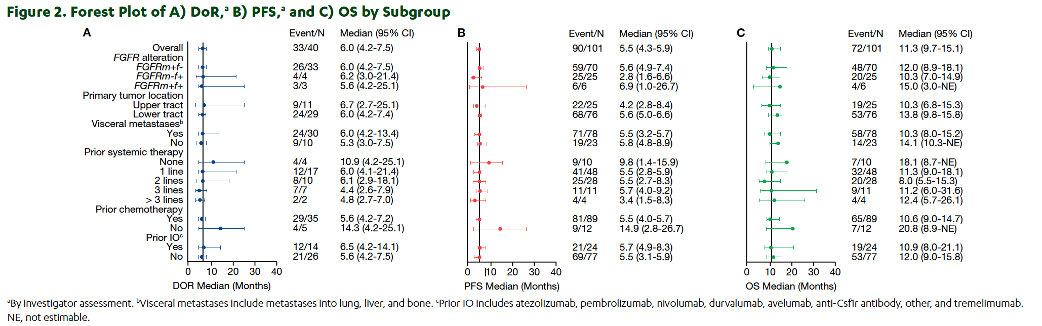
Dr. Necchi concluded this updated analysis of the BLC2001 trial with the following take-home messages:
- Patients with locally advanced or metastatic urothelial carcinoma derived benefit from erdafitinib regardless of FGFR alteration type, tumor location, presence of visceral metastases, or prior treatment with immunotherapy
- Clinically meaningful treatment benefit with erdafitinib was observed in patients regardless of prior chemotherapy
- All comparisons are exploratory in this nonrandomized trial and will be further investigated in confirmatory studies: (i) As monotherapy versus immune checkpoint inhibitor or chemotherapy in the THOR phase 3 randomized controlled trial; (ii) Combined with the PD-1 inhibitor cetrelimab in the phase 1/2 randomized noncontrolled NORSE study, including investigation in the first-line cisplatin-ineligible metastatic urothelial carcinoma setting
Presented by: Andrea Necchi, MD, Medical Oncology, Fondazione IRCCS Istituto Nazionale dei Tumori, Milan, Italy
Written by: Zachary Klaassen, MD, MSc – Assistant Professor of Urology, Georgia Cancer Center, Augusta University/Medical College of Georgia, Twitter: @zklaassen_md at the European Society for Medical Oncology Virtual Congress, ESMO Virtual Congress 2020 #ESMO20, 18 Sept - 21 Sept 2020
Related Content:
ASCO 2020: Erdafitinib in Locally Advanced or Metastatic Urothelial Carcinoma: Long-Term Outcomes in BLC2001
ASCO 2020: Single Agent Targeted Agents vs Combinations with IO: What is the Optimal Future Therapy in Advanced Urothelial Cancer?
Erdafitinib Treatment in Metastatic Urothelial Carcinoma - Petros Grivas