

(UroToday.com) The 67th American Society for Radiation Oncology (ASTRO) annual meeting, held in San Francisco, was host to the Quality of Life Outcomes after Prostate Radiotherapy session. Dr. Neil Desai presented abstract 197 - Hydrogel Spacer Quality Assurance (QA) in a Multi-Center Randomized Control Trial of Neurovascular-Sparing SAbR for Localized Prostate Cancer (PCa).
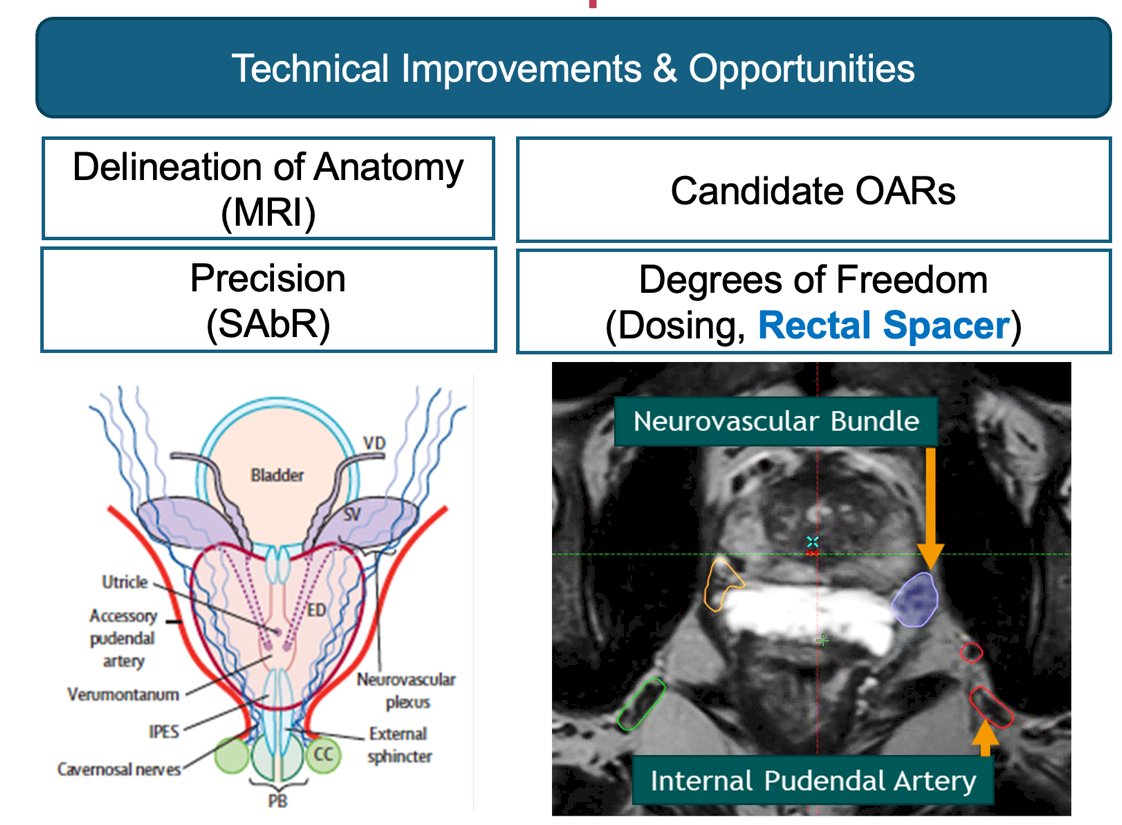
Dr. Desai began his presentation by highlighting the increasing focus on the implementation of rectal spacers in prostate radiation, emphasizing both technical opportunities and quality assurance. Improvements in anatomical delineation with MRI, enhanced precision through stereotactic approaches (SAbR), and individualized dosing strategies allow for better protection of organs at risk. Key anatomical landmarks, such as the neurovascular bundle and internal pudendal artery, should be kept in mind when placing rectal spacers (Figure below) and underscore the importance of accurate placement. On the quality front, he stressed the need for consistency and safety, citing recent data associating inadequate placement with increased rectal toxicity and severe injury.1
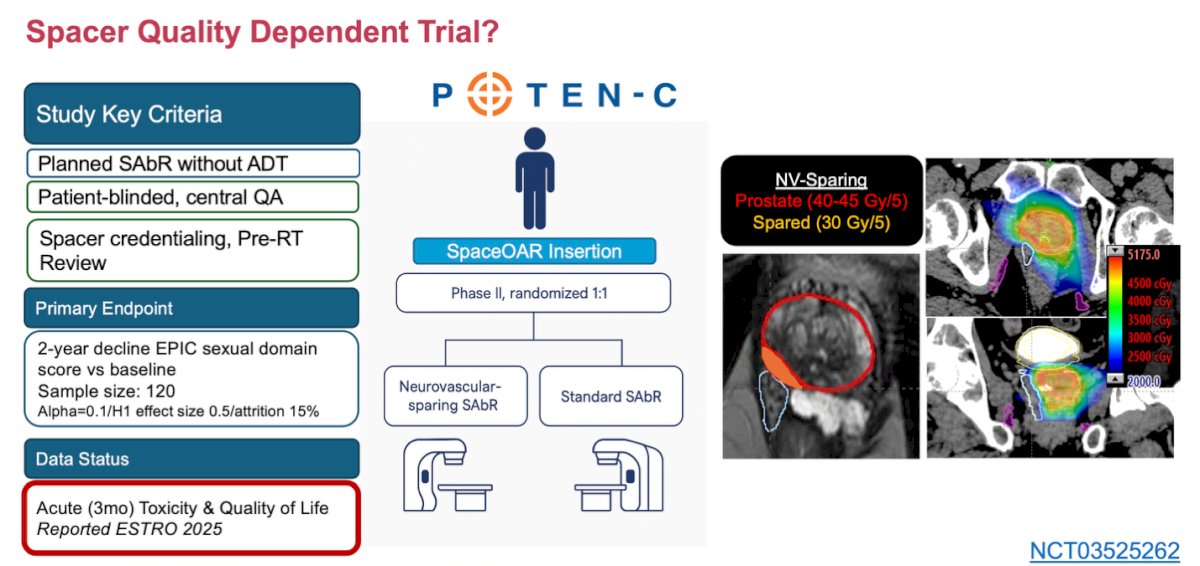
The POTEN-C trial (NCT03525262) is a randomized phase II study designed to evaluate whether neurovascular (NV)-sparing stereotactic ablative radiotherapy (SAbR) combined with high-quality hydrogel rectal spacer placement can preserve erectile function in men with localized low- or favorable-intermediate risk prostate cancer. Key eligibility criteria included a baseline EPIC sexual domain score ≥60 and preserved baseline erectile function without medication. Patients were randomized 1:1 to receive either NV-sparing or standard SAbR following MRI-guided spacer placement. The trial emphasized pre-RT credentialing, rapid review of initial NV-sparing cases, and central quality assurance of all contours and plans. With a planned sample size of 120 patients and an expected 50% improvement in EPIC sexual function decline (from –20 to –10), early data on acute (3-month) toxicity and quality of life were reported at ESTRO 2025.
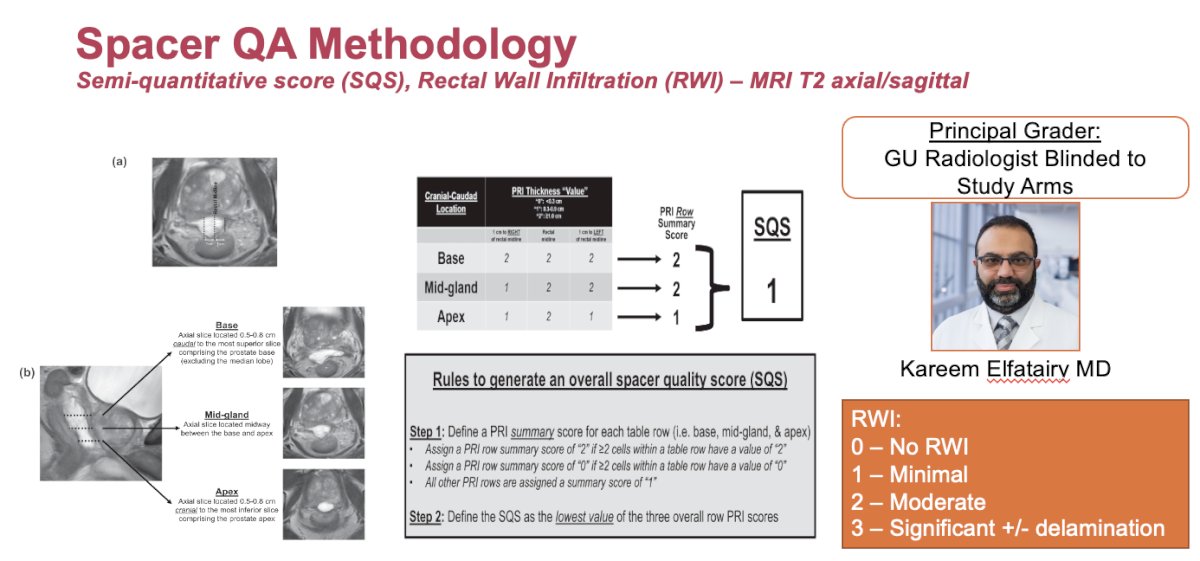
This study was supported by postgraduate researcher Dr. Pramukh Atluri, with independent confirmation by GU radiologist Dr. Kareem Elftairy, a semi-quantitative scoring system (SQS) was developed to assess rectal wall infiltration (RWI) following rectal spacer placement using MRI T2 axial/sagittal sequences. The scoring methodology evaluates the degree of spacer infiltration across three anatomical levels: base, mid-gland, and apex; assigning a PRI (perirectal interface) score at each level. The overall SQS is derived from the lowest of these values, with RWI graded from 0 (no infiltration) to 3 (significant infiltration with or without delamination). The study design is illustrated below.1
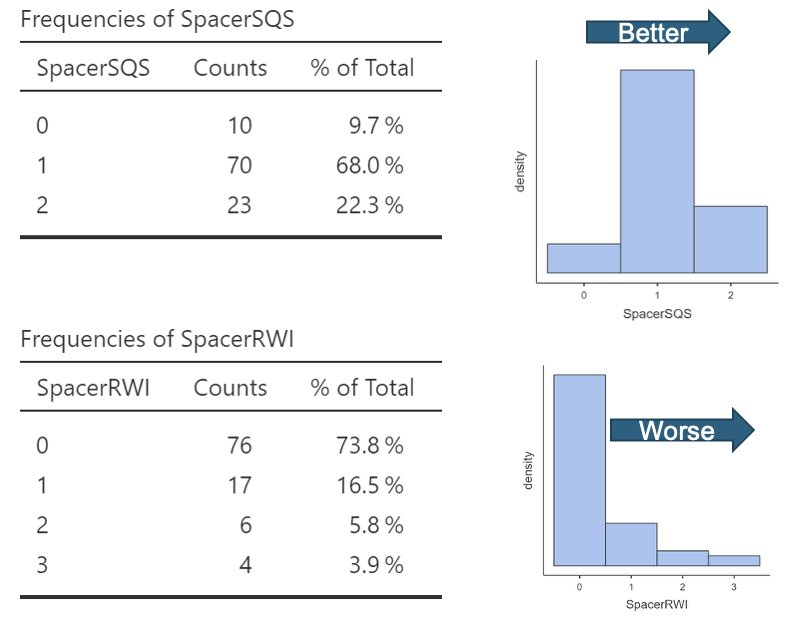
Using the above spacer QA methodology, in a cohort of 103 patients (86%) who underwent post-spacer MRI, dosimetry, and 3-month follow-up, the majority achieved acceptable spacer quality scores: 68% scored 1, 9.7% scored 0, and 22.3% scored 2. In terms of rectal wall infiltration (RWI), 73.8% had no evidence of infiltration (RWI=0), while 16.5%, 5.8%, and 3.9% showed minimal to significant RWI (scores 1–3). Notably, three patients were excluded from treatment based on rapid QA review. When compared to other studies such as MSKCC/UTSW and SPORT, this cohort demonstrated comparable, though slightly less favorable, spacer quality distributions.2
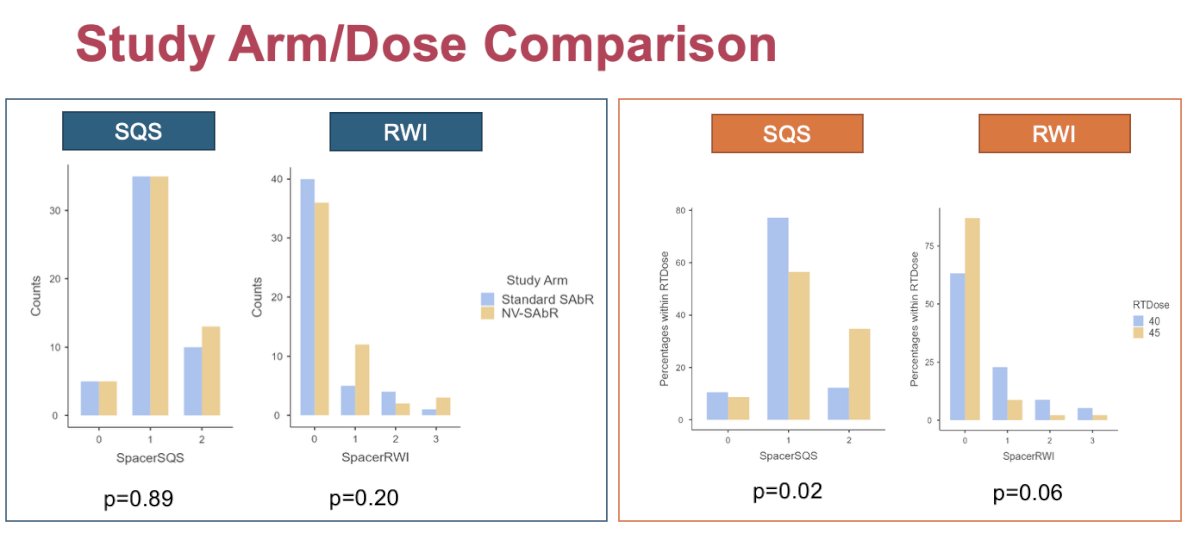
The study employed chi-square testing to assess the association between spacer quality and both treatment arms (Standard SaBR vs NV-SaBR) and radiation dose (40 Gy vs 45 Gy). No significant differences in spacer quality score (SQS) or rectal wall infiltration (RWI) were observed between study arms (p=0.89 and p=0.20, respectively). However, SQS distribution differed significantly by RT dose (p=0.02), with a trend toward higher RWI scores at 45 Gy (p=0.06), as shown below.
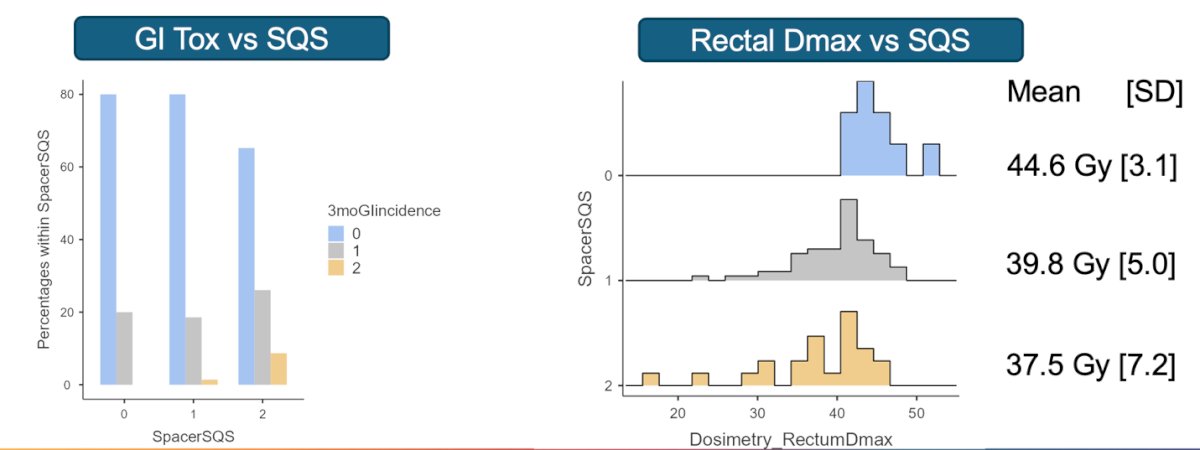
Notably, they reported SQS and RWI did not correlate with short-term GI toxicity or EPIC bowel domain scores; SQS showed significant correlation with rectal Dmax (p<0.01), suggesting dosimetric impact. Importantly, spacer quality did not differ significantly by study arm but was modestly associated with prescribed dose (p=0.02 for SQS). These findings underscore the relevance of quality assurance and spacer technique in optimizing rectal dosimetry for prostate SAbR.
Dr Desai concluded the presentation with the following key takeaways:
- SQS and RWI was modestly higher in this multi-center RCT than single center series with independent radiology review
- Higher SQS scores correlated to lower rectal max dose without apparent early impact on toxicity or QoL. Follow up is needed to assess for late toxicity assessment and impact on NV-sparing benefits
- Spacer-mediated anatomy sparing RT trials can practically include central quality assurance before treatment and post-hoc to ensure safety and inform implementation
Written by: Julian Chavarriaga, MD, Urologic Oncologist at Cancer Treatment and Research Center (CTIC) Luis Carlos Sarmiento Angulo Foundation via Society of Urologic Oncology (SUO) Fellow at The University of Toronto. @chavarriagaj on Twitter during the 2025 American Society for Radiation Oncology (ASTRO) Annual Meeting, San Francisco, CA, September 28th – 30th, 2025
Reference:
- Grossman CE, Folkert MR, Lobaugh S, Desai NB, Kollmeier MA, Gorovets D, McBride SM, Timmerman RD, Zhang Z, Zelefsky MJ. Quality Metric to Assess Adequacy of Hydrogel Rectal Spacer Placement for Prostate Radiation Therapy and Association of Metric Score With Rectal Toxicity Outcomes. Adv Radiat Oncol. 2023 Jan 24;8(4):101070. doi: 10.1016/j.adro.2022.101070. PMID: 37213478; PMCID: PMC10196227.
- Giacometti V, McLaughlin O, Comiskey P, Marshall H, Houlihan OA, Whitten G, Prise KM, Hounsell AR, Jain S, McGarry CK. Validation of a Quality Metric Score to Assess the Placement of Hydrogel Rectal Spacer in Patients Treated With Prostate Stereotactic Radiation Therapy. Adv Radiat Oncol. 2024 Jan 19;9(3):101396. doi: 10.1016/j.adro.2023.101396. PMID: 38304109; PMCID: PMC10831189.