

Cabozantinib is a guideline-recommended, multitargeted inhibitor of multiple kinases, including vascular endothelial growth factor (VEGF) receptor and MET. In the CABOSUN trial, it was shown to improve outcomes in the first-line setting compared to sunitinib and, in the METEOR trial, it was shown to improve outcomes in advanced lines compared to everolimus. Notably, cabozantinib has enhanced activity in bone. Radium-223 is an alpha-emitting radioisotope with natural bone-seeking proclivity which has proven overall survival benefits in men with castration-resistant prostate cancer. A prior pilot study of radium-223 and VEGF-inhibition demonstrated safety, as well as evidence of declines in markers of bone formation and resorption.
RADICAL/Alliance A031801 (NCT04071223) is a phase II randomized, open-label, multicenter study. The study is recruiting patients with metastatic RCC of any histology with ≥2 metastatic bone lesions who have not received prior radiation therapy and have received no more than 2 prior lines of systemic therapy. While patients with non-clear cell RCC are eligible, they will be capped at 20% of the total accrual goal. Additionally, inclusion criteria include a Karnofsky performance status of ≥60%, symptomatic bone pain defined as a prior SSE or need for analgesics, and use of an osteoclast-targeted therapy unless otherwise contraindicated.
In the RADICAL/Alliance A031801, patients are randomized in a 1:1 fashion to receive either cabozantinib with (Arm A) or without (Arm B) radium-223. The starting dose of cabozantinib for Arm A is 40 mg by mouth daily which is to be escalated to 60 mg daily after cycle 1 (1 cycle = 28 days) in the absence of persistent grade 2 or grade ≥3 toxicity. Radium-223 is administered at a fixed dose of 1.49 microcurie/kg IV every 28 days x 6 doses.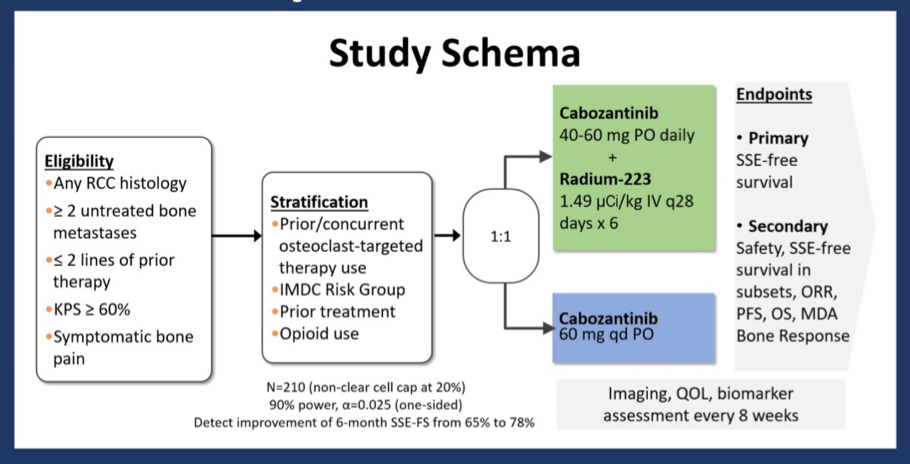
The primary endpoint is SSE-free survival with secondary endpoints including safety, progression-free survival, overall survival, quality of life measures, and correlative analyses including liquid biopsy studies and tumor tissue analysis.
Based on a target accrual of 210 patients to ensure 191 evaluable patients, the study has 90% power to detect an improvement in 6-month SSE-free survival rate from 65% to 78% with one-sided α = 0.025 significance. Further, the study includes a safety run-in and an interim futility analysis when 50% of the expected number of events (72 SSE events) have been observed.
The study was activated in December 2019 and accrual is currently ongoing throughout the NCTN (www.CTSU.org).
Presented by: Rana R. McKay, MD, Medical Oncologist, Associate Professor of Medicine, UC San Diego Health
Written by: Christopher J.D. Wallis, Urologic Oncology Fellow, Vanderbilt University Medical Center, Contact: @WallisCJD on Twitter at the 2021 American Society of Clinical Oncology (ASCO) Annual Meeting, Virtual Annual Meeting #ASCO21, June, 4-8, 2021