

(UroToday.com) The 2025 EAU annual meeting featured a prostate cancer session and a presentation by Dr. Alicia Morgans discussing the impact of baseline PSA on clinical outcomes in patients with metastatic hormone sensitive prostate cancer (mHSPC) treated with darolutamide triplet therapy in ARASENS. In ARASENS, ADT + docetaxel + darolutamide significantly reduced the risk of death by 32.5% (HR 0.68, 95% CI 0.57-0.80) versus ADT + docetaxel + placebo in patients with mHSPC.1 Additionally, the darolutamide triplet achieved deep and durable PSA responses, with 67% of patients reaching undetectable PSA (<0.20 ng/mL) at any time, compared to 29% in the control group, along with a significantly longer time to PSA progression. Moreover, achieving deep PSA decline was associated with improved clinical outcomes regardless of disease volume. This post-hoc analysis of ARASENS presented at EAU 2025 evaluated the association between baseline PSA and clinical outcomes.
Patients in the darolutamide arm and in the placebo + ADT + docetaxel arm were stratified into 3 subgroups by baseline PSA:
- Low: Q1, <4.80 ng/mL
- Middle: Q1–median, ≥4.80–<27.55 ng/mL)
- High: ≥median, ≥27.55 ng/mL

Undetectable PSA rate was defined as the proportion of patients achieving PSA <0.2 ng/mL. Time to castration-resistant prostate cancer (CRPC) and time to PSA progression were compared across baseline PSA subgroups for darolutamide and placebo separately, using Kaplan-Meier estimates and Cox regression models. The association between treatment and time to PSA progression was evaluated with stratified Cox regression models within baseline PSA subgroups. Treatment-emergent adverse events were summarized across subgroups.
A total of 651 darolutamide and 653 placebo patients with a baseline PSA assessment were included:

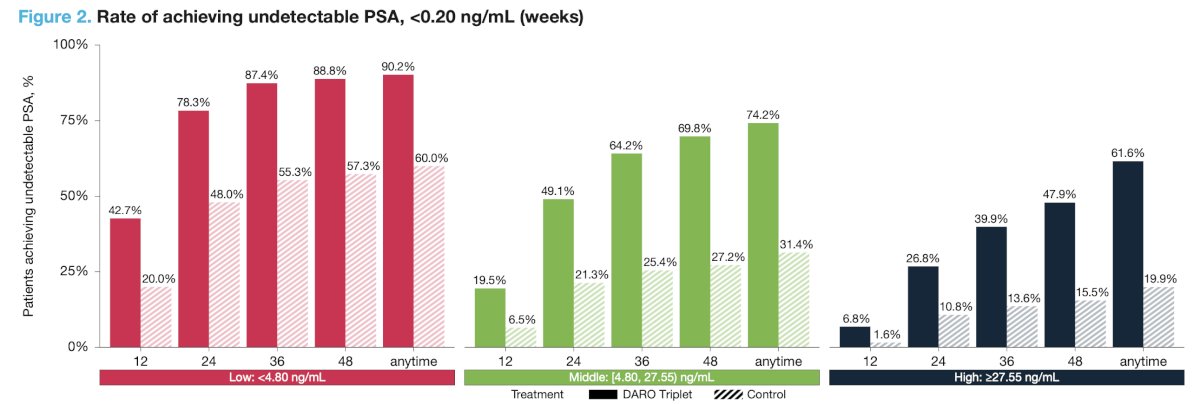
A trend of higher rates of achieving undetectable PSA at any time with lower baseline PSA was observed, with darolutamide consistently showing improvement over placebo across all baseline PSA patient subgroups (low: 90.2% versus 60.0%; middle: 74.2% versus 31.4%; high: 61.6% versus 19.9%):
Darolutamide patients with low baseline PSA had a 59% lower risk of PSA progression versus high baseline PSA (HR 0.41, 95% CI 0.25–0.68), and patients with middle baseline PSA had a 34% lower risk versus high baseline PSA (HR 0.66, 95% CI 0.43–1.01):
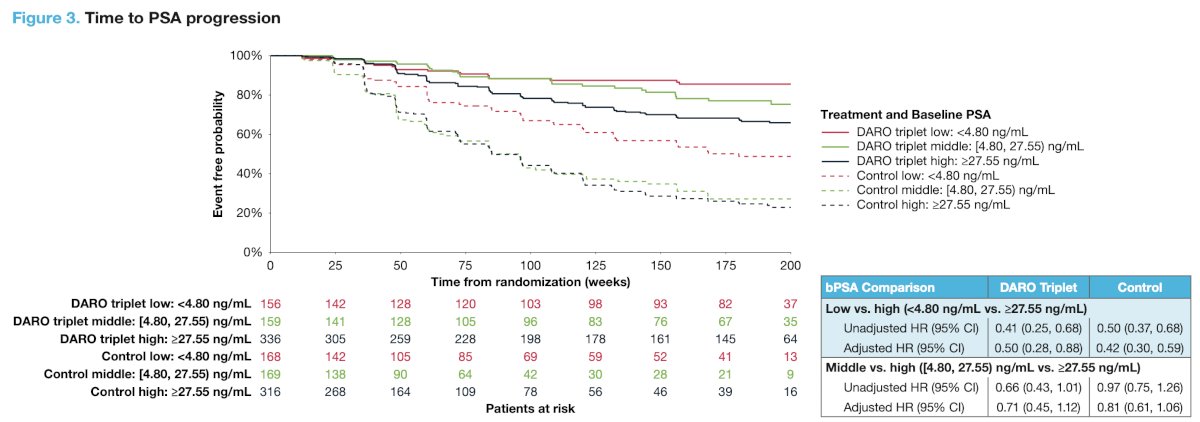
Darolutamide patients had longer time to PSA progression versus placebo patients, with consistent results observed across baseline PSA subgroups (low: HR 0.25, 95% CI 0.15‒0.41; middle: HR 0.20, 95% CI 0.13–0.30; high: HR 0.28, 95% CI 0.22–0.37). Among darolutamide patients, time to CRPC was significantly longer in the low versus high baseline PSA group (HR, 95% CI 0.67, 0.47–0.94):

The safety profile of darolutamide was consistent with previous data regardless of baseline PSA levels:

Dr. Morgans concluded her presentation by discussing the impact of baseline PSA on clinical outcomes in patients with mHSPC treated with darolutamide triplet therapy in ARASENS with the following take home points:
- Lower baseline PSA was associated with higher rates of achieving undetectable PSA at any time, longer time to PSA progression, and longer time to CRPC progression
- Treatment with darolutamide triplet therapy was consistently associated with higher rates of undetectable PSA at any time and longer time to both PSA and CRPC progression compared to control, benefiting patients across all baseline PSA levels
- These findings highlight the efficacy and clinical value of adding darolutamide to ADT and docetaxel in appropriate patients across a wide range of baseline PSA, including those with low baseline PSA
Written by: Zachary Klaassen, MD, MSc – Urologic Oncologist, Associate Professor of Urology, Georgia Cancer Center, Wellstar MCG Health, @zklaassen_md on Twitter during the 2025 European Association of Urology (EAU) Annual Meeting held in Madrid, Spain between March 21st and 24th 2025
References:
Related Content
ARASENS Trial Analysis Investigates Impact of Initial PSA Values on Treatment Response in mHSPC - Alicia Morgans