

Notably, the expression of Nectin-4 is a prerequisite for therapy response to EV, but no data are available concerning its expression in GCTT. In this study, we found that only a small minority of GCTT exhibit positive weak Nectin-4 membrane expression, but a subgroup of potentially aggressive GCTT (especially CHC and post-chemotherapy metastatic recurrences) more frequently exhibit Nectin-4 membrane expression, thus prompting future studies to assess whether these patients may be potentially eligible for EV therapy. Specifically, we found that 4/4 (100%) CHC were membrane positive (all with weak expression), with staining almost exclusively confined to syncytiotrophoblasts, thus mirroring what is found in normal placental tissue (adopted as positive control in our study), which exhibits diffuse and strong Nectin-4 membrane expression in the syncytiotrophoblast component.
Choriocarcinoma is the most aggressive GCTT, with high rates of early hematogenous spread (lungs, liver, gastrointestinal tract, brain, spleen, and adrenal glands), high stage at onset, hemorrhagic complications, and different clinical symptoms (hemoptysis, neurological dysfunction, anemia, hypotension, endocrine dysfunction, and “CHC syndrome” with multiorgan hemorrhage and sudden decompensation). Patients with CHC show a 3-year survival rate of 21% when treated with combination chemotherapy, but the outcome may be better with standard chemotherapy for metastases confined to the lungs, chemotherapy followed by complete resection of the residual mass, or high-dose chemotherapy and autologous peripheral blood stem cell transplant. In this clinical scenario, our study presents an extremely intriguing research topic with potential clinical and therapeutic implications for CHC. Since this aggressive tumor expresses Nectin-4, our findings strongly encourage future studies, research protocols, and clinical trials to evaluate EV's efficacy and feasibility in CHC therapy. Meanwhile, our study group (Bologna University), in collaboration with other leading institutions (Indiana University, University of Porto, IRCSS San Raffaele Scientific Institute, etc.) is collecting a large multicentric cohort of CHC patients to further evaluate Nectin-4 and correlate its expression with clinical, pathological, and follow-up data.
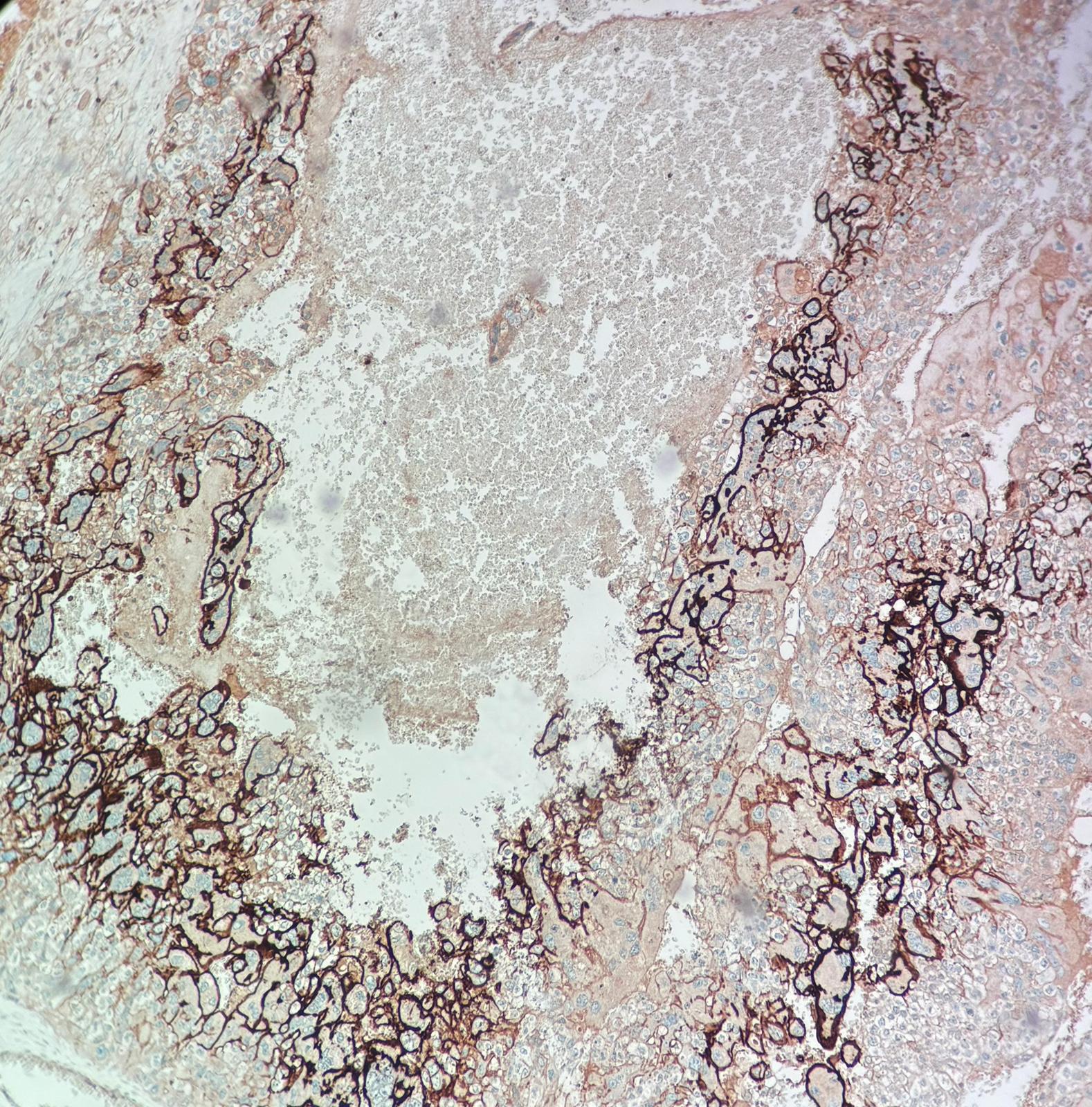
Figure: example of CHC with a diffuse and strong membrane Nectin-4 expression, mainly confined to syncytiotrophoblasts (Original Magnification x100).
Written by: Costantino Ricci, Pathology Unit, DIAP-Dipartimento Interaziendale Anatomia Patologica, Maggiore Hospital-AUSL Bologna, Bologna, Italy.
Read the Abstract