

To streamline diagnosis and reduce patient anxiety, the kidney cancer team in the Department of Urology at Addenbrooke’s Hospital, developed the Cambridge Kidney One-Stop Mass Investigation Clinic (CkOSMIC) - a feasibility study assessing the safety, diagnostic performance, and patient experience of a same-day biopsy and reporting pathway.
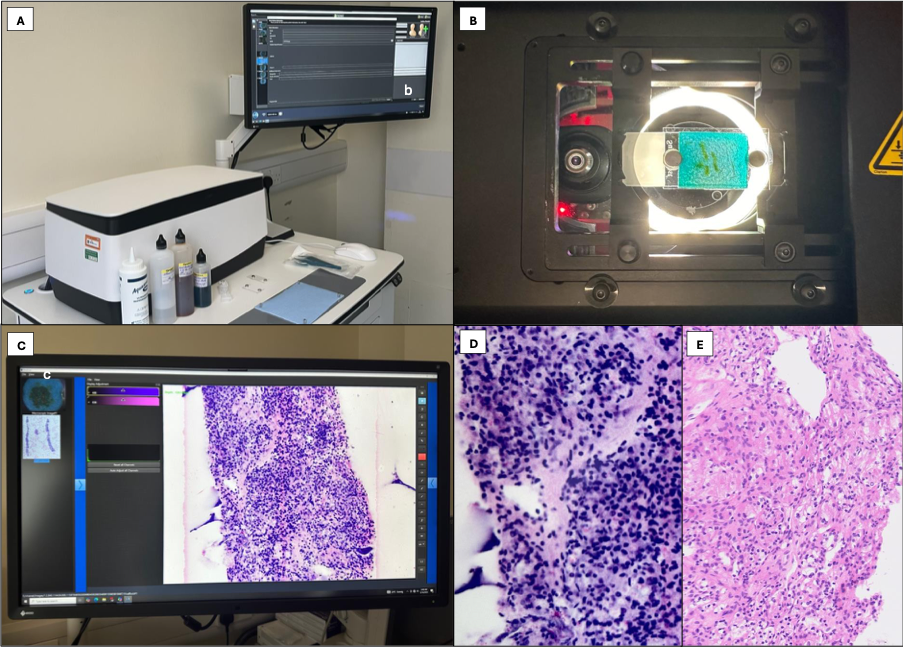
CkOSMIC integrates ultrasound-guided renal mass biopsy with real-time ex-vivo confocal laser scanning microscopy. Following tissue acquisition, the fresh biopsy specimen is immediately imaged to produce digital pseudo-histology slides resembling conventional H&E sections (Figure). These images are reviewed by experienced uropathologists, enabling a provisional diagnosis within minutes and same-day multidisciplinary discussion and treatment planning.
Over the 2024, 50 patients were enrolled in the CkOSMIC clinic. Forty-eight (96%) received a same-day provisional diagnosis. Diagnostic performance was high, with a sensitivity of 94% (95% CI: 79–98%), specificity of 100% (95% CI: 82–100%), and complete concordance with final histopathology in 91.7% of cases (partial concordance in 8.3% - cancer identified but equivocal histological subtype). The median time from biopsy to treatment decision was reduced from 55 days in the standard pathway to 25 days with CkOSMIC (p<0.001). Time from biopsy to diagnosis was reduced from 24 days to zero, meeting the NHS Faster Diagnosis Standard.
Patient feedback was uniformly positive: all participants reported being “satisfied” or “very satisfied,” and most preferred same-day communication of results over delayed follow-up. No adverse events related to the accelerated diagnostic process were observed.
These findings demonstrate that a one-stop renal mass biopsy pathway can deliver rapid, accurate, and safe diagnosis without compromising diagnostic quality. By integrating digital pathology into real-world clinical workflow, CkOSMIC establishes a scalable framework for same-day cancer diagnostics, potentially applicable across different countries and multiple tumour types.
Written by: Chiara Re, MD, IRCCS San Raffaele Hospital, Milan, Italy; University of Cambridge, CUH, Cambridge, UK
Reference:
Read the Abstract