

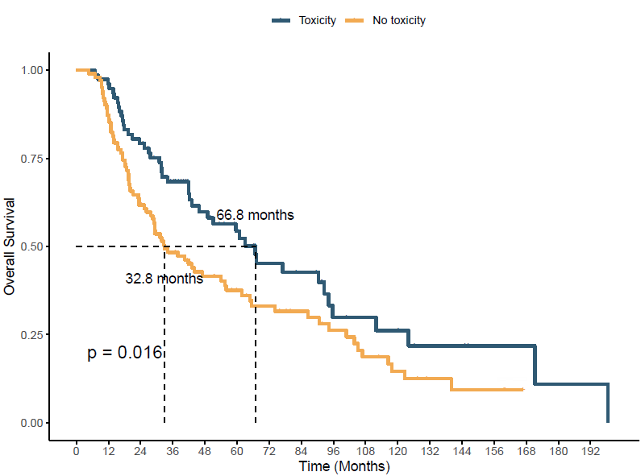
This study evaluated the real-world effectiveness of individually dosed cabozantinib as a later-line therapy for metastatic renal cell carcinoma. Among the 179 patients, median progression-free survival was 11.2 and 11.6 months, and median overall survival was 15.6 and 17.1 months for second- and third-line treatment, respectively. Results emphasize the effect of cabozantinib in later lines and the importance of individualized dosing for optimal outcomes. Patients with dose reductions due to toxicity have longer survival.
This study reinforces the existing data on the effectiveness of cabozantinib as a later-line treatment for mRCC in real-world settings. We report 40 mg as the preferred landing zone. Furthermore, we identify patients needing dose reductions due to toxicity as a subgroup carrying a significantly better prognosis. The results emphasize the importance of individual dosage for optimizing treatment outcomes and point out treatment-related toxicity as a surrogate marker for sufficient serum concentration of the active metabolite.
Written by: Malou Aarønæs Thybo,1 Johanne Ahrenfeldt,2 Iben Lyskjær,2 Niels Fristrup1
- Department of Clinical Oncology, Aarhus University Hospital, Aarhus, Denmark.
- Department of Molecular Medicine, Aarhus University Hospital, Aarhus, Denmark.
Read the Abstract