

In our multicenter study of 889 patients with metastatic RCC treated with nivolumab alone or with ipilimumab,2,3 we focused on 336 patients aged ≥70 years. We observed that treatment outcomes were comparable to those of younger patients: median overall survival (OS) was 25.1 months in ≥70 vs 23.5 months in <70 years (HR 1.02, p=0.82), while median progression-free survival (PFS) was 7.8 vs 6.3 months (HR 0.93, p=0.40).
We also assessed prognostic stratification tools. The IMDC score maintained its prognostic validity in older adults, but the Meet-URO score - which incorporates neutrophil-to-lymphocyte ratio and presence of bone metastases to the IMDC2 - showed superior accuracy (c-index 0.66 vs 0.63), identifying five distinct risk groups. In patients ≥70 years, survival curves stratified by the Meet-URO score showed clear separation across prognostic classes, ranging from 50 months in group 1 to 3.7 months in group 5 (p<0.001). Similarly, median PFS ranged from 16.5 months in group 1 to 2.5 months in group 5 (p<0.001) (Figure 1).
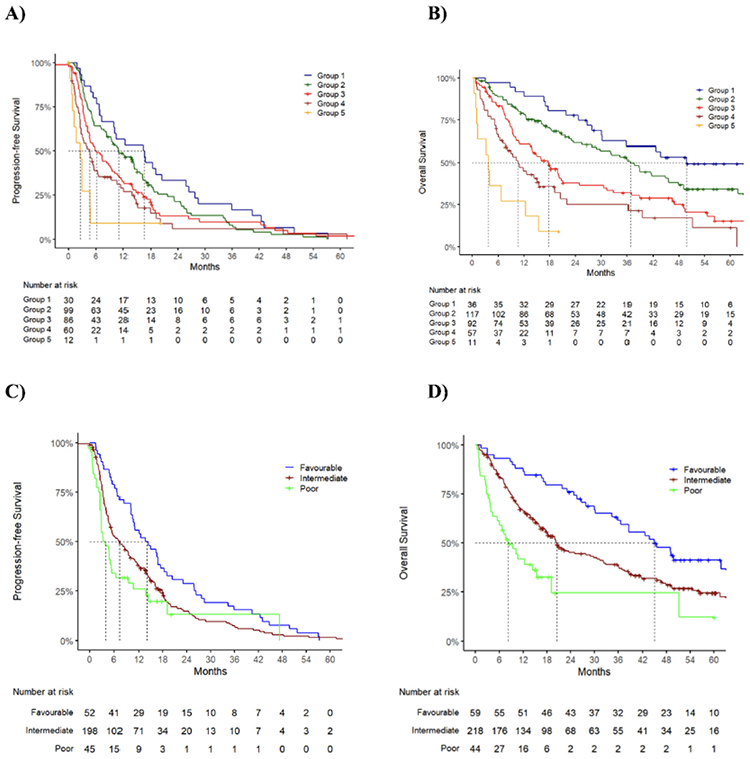
Fig.1: Progression-free survival and overall survival in patients aged ≥ 70 by the Meet-URO (A and B) and the IMDC (C and D) scores.
These results highlight two clinically relevant messages:
- Outcomes in older patients with mRCC receiving nivolumab-based immunotherapy are comparable to those in younger patients.
- The Meet-URO score provides refined prognostic stratification, helping to identify both patients likely to derive long-term benefit and those with limited expected outcomes.
Written by: Veronica Murianni, MD, Medical Oncology, Azienda Sanitaria Locale 1 Imperiese, Ospedale Sanremo, Italy
On behalf of the Meet-URO Group
References:
- Padala SA, Barsouk A, Thandra KC, et al. Epidemiology of renal cell carcinoma. World J Oncol 2020;11:79–87. https://doi.org/10.14740/wjon1279.
- Rebuzzi SE, Signori A, Banna GL, et al. Inflammatory indices and clinical factors in metastatic renal cell carcinoma patients treated with nivolumab: the development of a novel prognostic score (Meet-URO 15 study). Ther Adv Med Oncol 2021;13: 1–13. https://doi.org/10.1177/17588359211035225.
- 14. Basso U, Paolieri F, Rizzo M, et al. Compassionate use program of ipilimumab and nivolumab in intermediate or poor risk metastatic renal cell carcinoma: a large multicenter Italian study. Cancers (Basel) 2022;14:2293.