

Histotripsy introduces a fundamentally different approach. Instead of applying thermal energy, it uses focused ultrasound pulses to generate microbubbles that mechanically fractionate tissue through cavitation. This results in a uniform, acellular slurry while sparing surrounding healthy structures. Cavitation occurs only when a specific pressure threshold is exceeded, allowing for greater precision and sharper treatment margins.2
Preclinical studies have demonstrated that histotripsy produces sharply demarcated lesions while preserving structurally robust tissues, such as blood vessels and the collecting system.3 In vivo animal models have shown complete tissue fractionation with minimal perifocal injury.4 In kidney-specific models, histotripsy has proven effective in creating non-thermal damage with preservation of the surrounding architecture and collecting system.5
Early clinical translation began with the treatment of benign prostatic hyperplasia. While that indication did not show sufficient clinical improvement, it confirmed procedural feasibility and safety across multiple patients. The first human application for tumors was reported by Vidal-Jove et al. in 2022, in a phase I study evaluating histotripsy in liver tumors.6 All 11 lesions were technically treated with no device-related complications. Two cases of local tumor progression were attributed to incomplete ablation or confounding growth patterns. These early results demonstrated histotripsy’s feasibility, laying the groundwork for expanded oncologic use.
The HOPE4LIVER trial,7 which enrolled patients with hepatocellular carcinoma (HCC) or metastatic liver tumors who were refractory or intolerant to other treatments, further demonstrated technical success in 95% of cases and a 7% major complication rate. These data supported FDA clearance for the non-invasive treatment of liver tumors. A follow-up 30-day outcomes analysis in 230 treated patients reported just three major complications, all in patients with advanced disease undergoing palliative treatment.8 One-year follow-up data from the HOPE4LIVER trial indicated promising local control and survival rates, particularly in the HCC subgroup.9
Encouraged by these results, two clinical trials are now evaluating histotripsy in RCC. The CAIN study (NCT05432232)10and HOPE4KIDNEY trial (NCT05820087)11 are assessing feasibility, safety, and technical success in primary solid renal tumors using the Edison™ system. While the studies focus on “non-cancer” endpoints due to regulatory designations, they represent the first formal exploration of histotripsy’s use in RCC. Both trials include general anesthesia and real-time ultrasound guidance, with penetration depth sufficient for treating centrally located tumors. Longer-term follow-up is planned to assess treatment effectiveness and safety.
Compared to thermal ablation, histotripsy presents several potential advantages. It avoids the heat-sink effect, spares connective tissue structures, and offers sharply defined lesion boundaries. Importantly, because it is externally delivered, it eliminates the need for percutaneous access. These features may prove valuable for patients with tumors in surgically difficult locations or for whom traditional ablative therapies pose higher risk.
In conclusion, histotripsy represents an emerging non-invasive therapeutic option for RCC. Ongoing clinical trials will determine its role in the treatment landscape, but existing preclinical and early clinical evidence supports its feasibility, safety, and potential as a precise and tissue-selective treatment. We welcome the readers to read our full manuscript. We invite readers to review our full manuscript for a comprehensive understanding.12
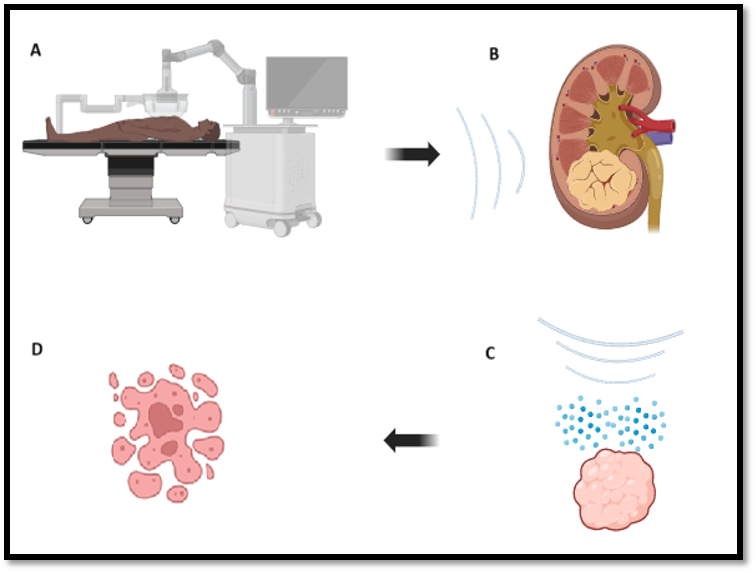
Figure 1: Schematic representation of histotripsy treatment for RCC
FIGURE 1. Schematic representation of histotripsy treatment.
- Ultrasound energy is externally delivered toward the tumor.
- A cavitation cloud forms at the targeted lesion.
- The cavitation process disrupts cellular structures.
- The affected tissue undergoes liquefaction and cell lysis, resulting in nonthermal mechanical ablation.
Written by: Etan Eigner,1, Kamil Malshy,2 Jathin Bandari,2 Nicola Fazaa,1 Ameer Nsair,1 Laena Hines,2 Melissa Atallah,1 Jean Joseph,2 Phillip M Rappold,2
- The Department of Urology, Rambam Health Care Campus, Haifa, Israel
- Department of Urology, University of Rochester Medical Center, Rochester, NY, USA
References:
- Malshy K, Fazaa N, Eigner E, Steidle M, Nsair A, Atallah M, et al. Shifting paradigms in the treatment of small renal masses. Transl Androl Urol. 2025 May;14(5):1174–81.
- Maxwell A, Sapozhnikov O, Bailey M, Crum L, Xu Z, Fowlkes B, et al. Disintegration of Tissue Using High Intensity Focused Ultrasound: Two Approaches That Utilize Shock Waves. Acoust Today. 2012;8(4):24.
- Vlaisavljevich E, Kim Y, Allen S, Owens G, Pelletier S, Cain C, et al. Image-Guided Non-Invasive Ultrasound Liver Ablation Using Histotripsy: Feasibility Study in an In Vivo Porcine Model. Ultrasound Med Biol. 2013 Aug;39(8):1398–409.
- Longo KC, Knott EA, Watson RF, Swietlik JF, Vlaisavljevich E, Smolock AR, et al. Robotically Assisted Sonic Therapy (RAST) for Noninvasive Hepatic Ablation in a Porcine Model: Mitigation of Body Wall Damage with a Modified Pulse Sequence. Cardiovasc Intervent Radiol. 2019 Jul 30;42(7):1016–23.
- Hall TL, Kieran K, Ives K, Fowlkes JB, Cain CA, Roberts WW. Histotripsy of Rabbit Renal Tissue in Vivo : Temporal Histologic Trends. J Endourol. 2007 Oct;21(10):1159–66.
- Vidal-Jove J, Serres X, Vlaisavljevich E, Cannata J, Duryea A, Miller R, et al. First-in-man histotripsy of hepatic tumors: the THERESA trial, a feasibility study. International Journal of Hyperthermia. 2022 Dec 31;39(1):1115–23.
- Mendiratta-Lala M, Wiggermann P, Pech M, Serres-Créixams X, White SB, Davis C, et al. The #HOPE4LIVER Single-Arm Pivotal Trial for Histotripsy of Primary and Metastatic Liver Tumors. Radiology. 2024 Sep 1;312(3).
- Wehrle CJ, Burns K, Ong E, Couillard A, Parikh ND, Caoili E, et al. The first international experience with histotripsy: a safety analysis of 230 cases. Journal of Gastrointestinal Surgery. 2025 Apr;29(4):102000.
- Ziemlewicz TJ, Critchfield JJ, Mendiratta-Lala M, Wiggermann P, Pech M, Serres-Créixams X, et al. The #HOPE4LIVER single-arm Pivotal Trial for Histotripsy of Primary and Metastatic Liver Tumors. Ann Surg. 2025 Apr 9;
- HistoSonics Inc. The HistoSonics Investigational System for Treatment of Primary Solid Renal Tumors Using Histotripsy (CAIN). 2025.
- HistoSonics Inc. https://clinicaltrials.gov/study/NCT05820087?intr=Histotripsy&page=1&rank=2. 2025. The HistoSonics EdisonTM System for Treatment of Primary Solid Renal Tumors Using Histotripsy (#HOPE4KIDNEY) (#HOPE4KIDNEY).
- Eigner E, Malshy K, Bandari J, Fazaa N, Nsair A, Hines L, Atallah M, Joseph JV, Rappold PM. Histotripsy in the Management of RCC: A New Frontier in Focused Therapies. Clin Genitourin Cancer. 2025 Apr 16;23(4):102360. doi: 10.1016/j.clgc.2025.102360. Epub ahead of print. PMID: 40367635.