

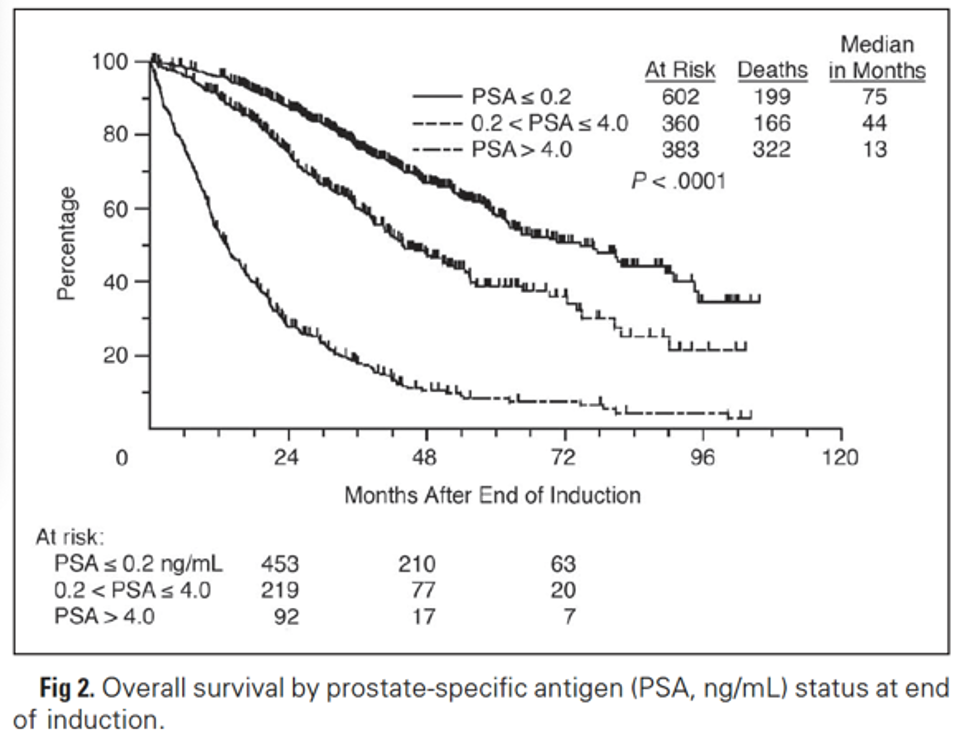
Hussain et al. SWOG 9346.
Since then, the therapeutic landscape has evolved, and so have the thresholds. The once-standard <0.2 ng/mL has been challenged by newer targets: <0.1 ng/mL in abiraterone-treated cohorts, and the almost-undetectable <0.02 ng/mL “ultralow PSA” derived from TITAN post-hoc analyses with apalutamide. This multiplicity of benchmarks has generated confusion, leaving a key clinical question unanswered:
What is the expected PSA evolution in mHSPC patients treated with ADT + ARPI, and which threshold best predicts outcomes in the modern era?
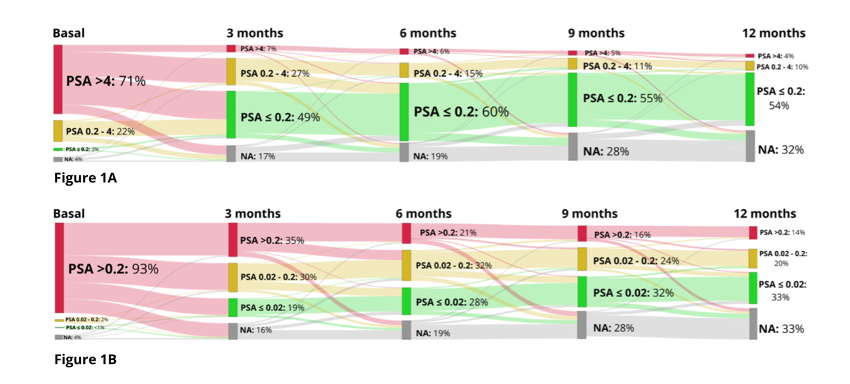
To our knowledge, no previous study has systematically characterized first-year PSA kinetics in real-world patients receiving ARPI-based intensification. This multicenter study enrolled 586 men with mHSPC treated with ADT + ARPI (apalutamide, abiraterone, or enzalutamide) from 2017 to 2024. PSA was recorded at 3, 6, 9, and 12 months. We applied two historical stratification models:
- The classical SWOG model (<0.2 / 0.2–4 / >4 ng/mL)
- The TITAN model (<0.02 / 0.02–0.2 / >0.2 ng/mL)
- 74% of our cohort achieved PSA <0.2 ng/mL (SWOG)
- But only 36% reached an ultralow PSA <0.02 ng/mL (TITAN)
Patients achieving <0.02 ng/mL had a non-reached median rPFS
- Compared to 38, 24, and 11 months in progressively higher PSA categories (p<0.001). Notably, 20% of initially poor responders (<optimal PSA at 3 months) eventually reached deep responses by 9–12 months, significantly altering their prognosis.
Conclusion
SWOG and TITAN thresholds offer contrasting perspectives on PSA response: while SWOG classifies the majority as good responders, TITAN applies a more demanding and balanced approach. Our study shows that not all PSA declines are created equal, and that features such as low baseline PSA and metachronous disease make a significant difference. In the ARPI era, reaching the right threshold at the right time can redefine a patient’s prognosis.
Written by: Rocío Martínez-Corral,1 Pedro De Pablos-Rodríguez,2 Celia Bardella-Altarriba,3 Francisco Javier Vera-Ballesteros,4 Arnau Abella-Serra,5 Victor Rodríguez-Part,2 María Elena Martínez-Corral,1 Natalia Picola-Brau,3 Alicia López-Abad,4 Álvaro Gómez-Ferrer,2 Manuel Beamud-Cortés,2 José Francisco Suárez-Novo,3 Pedro Ángel López-González,4 Mireia García-Puche,5 Ana María Álvarez-Gracia,6 Daniel Pérez-Fentes1
- Department of Urology, Complejo Hospitalario Universitario de Santiago de Compostela, University of Santiago de Compostela, Spain.
- Department of Urology, Instituto Valenciano de Oncología, Valencia, Spain.
- Department of Urology, Hospital de Bellvitge, Barcelona, Spain.
- Department of Urology, Hospital Virgen de la Arrixaca, Murcia, Spain.
- Department of Urology, Hospital Universitari Germans Trias i Pujol, Barcelona, Spain.
- Department of Radiation Oncology, Institut Català de Oncologia, Barcelona, Spain.
Read the Abstract