

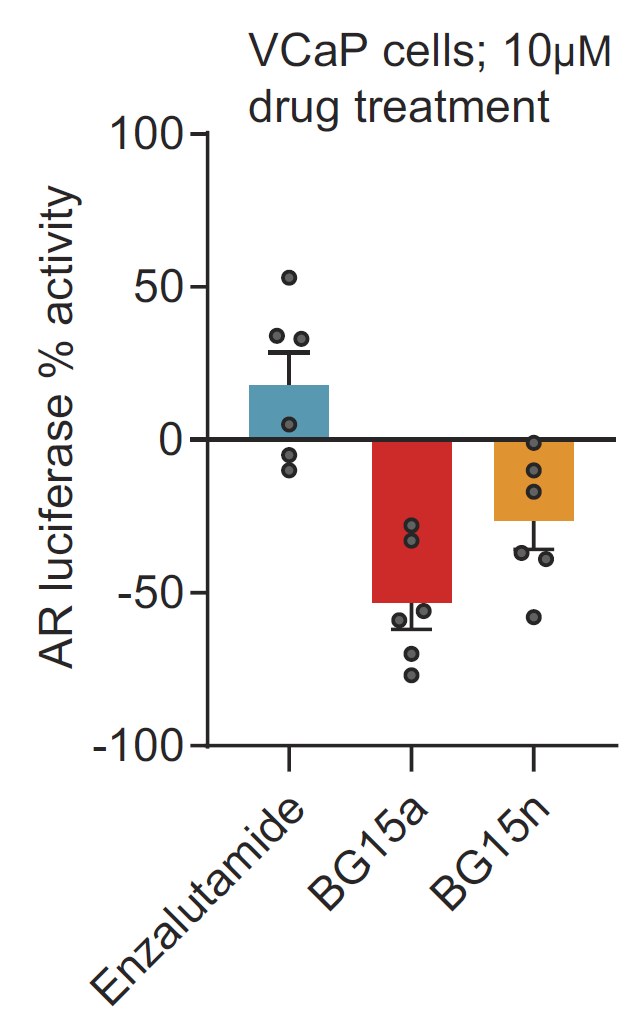
We then began to routinely use an AR-driven luciferase assay to test our compounds - and for about 6 months, everything we made had some ability to either increase AR-driven transcription or to reduce it down to control levels (ie, the background luciferase signal in the absence of testosterone stimulation). Then, the shock came when some of our latest molecules began reducing transcription below the background levels. An example is shown here:
This set us on a nearly 10-year-long journey to figure out why this was happening. For a long time, we thought these were acting as "Inverse Agonists", based on examples for other hormone receptors. Inverse Agonists can work to actively suppress the steroid receptor's target genes, by inducing a protein confirmation that changes the co-recruited proteins from co-activators (eg, NCoA1) to co-repressors (eg, NCoRs). After years of trying to prove that our molecules were acting in that way, eventually, we had to abandon that hypothesis. While we still don't fully understand them, the key features of these BG15 series molecules are the following:
- They strongly repress AR-driven transcription
- They are more potent than enzalutamide and other AR antagonists in PCa models, including models that resist enzalutamide by amplifying the AR.
- Unlike enzalutamide, the BG15 molecules strongly induce nuclear translocation, AR self-association, and chromatin binding.
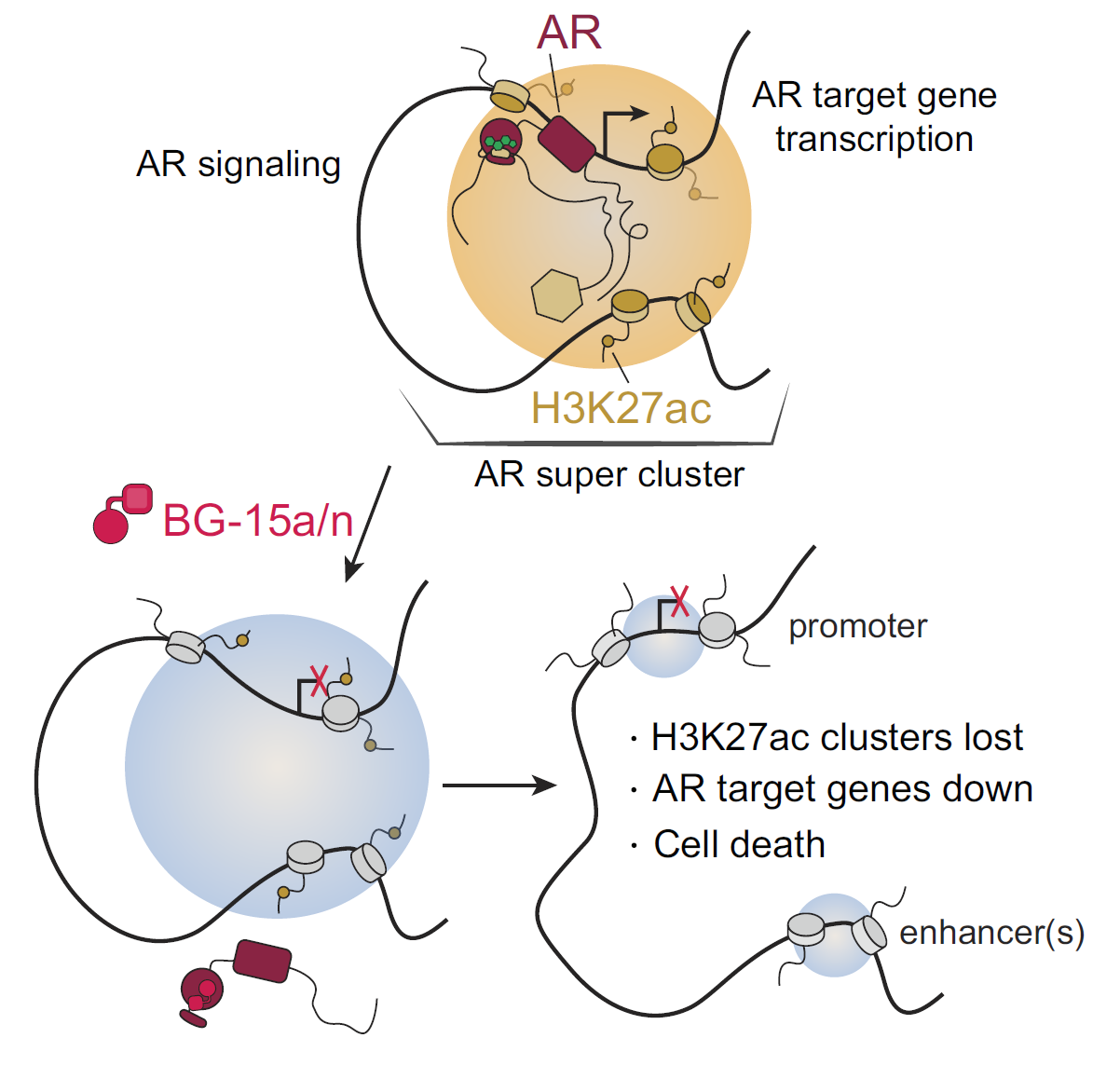
- The BG15 molecules shut down AR targets by collapsing the "super-clusters" of enhancers surrounding AR target genes.
I suspect that BG15 molecules are causing an unnatural AR aggregation that ultimately prevents its ability to recruit chromatin partners such as the BAF complex. Breakthroughs in super-resolution imaging and cryo-EM of chromatin are needed to evaluate this idea fully.
Written by: Berkley Gryder, PhD, Assistant Professor, Case Western Reserve University, Department of Genetics & Genome Sciences, Case Comprehensive Cancer Center, Cleveland, OH
Read the Abstract