

We investigated whether baseline bladder microbiome composition is associated with oncologic outcomes following intravesical BCG therapy. We retrospectively analyzed 31 patients with high-risk NMIBC, stratified into BCG responders and BCG non-responders according to contemporary guidelines and FDA definitions.6,7 Microbiome profiling was performed on pre-treatment formalin-fixed paraffin-embedded bladder tumor tissue using high-throughput 16S rRNA gene sequencing, an approach aimed at minimizing sampling heterogeneity and contamination compared with urine-based analyses.8,9
Clinically relevant differences in microbial composition emerged between responders and BCG-resistant patients. BCG responders demonstrated significantly higher relative abundances of Firmicutes A and Verrucomicrobiota, as well as a greater prevalence of Fusobacteriota, while Cyanobacteria were significantly more common among BCG-resistant patients. These microbial patterns were associated with key clinical endpoints, including the number of BCG instillations and recurrence rates, suggesting a potential interaction between microbial composition, treatment tolerance, and oncologic efficacy.
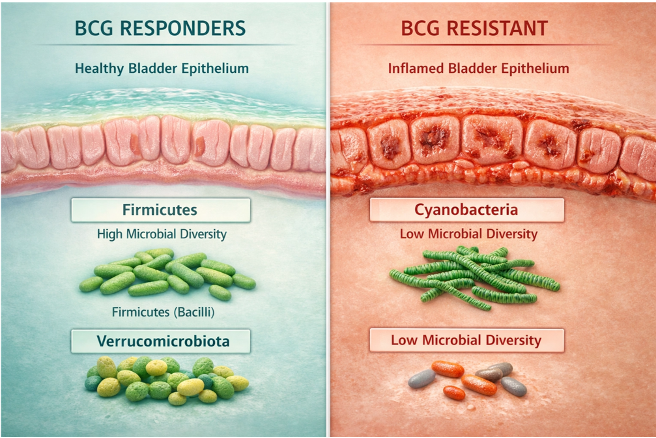
Figure 1: Differential Urobiome Composition in BCG Responders and Non-Responders: This infographic illustrates the distinct microbial profiles observed in patients with non-muscle-invasive bladder cancer (NMIBC) undergoing Bacillus Calmette–Guérin (BCG) immunotherapy.
These findings support the hypothesis that the bladder microbiome may modulate the host immune response to BCG. The antitumor activity of BCG relies on a complex interplay between innate and adaptive immunity, involving cytokine release and immune cell recruitment.3,10 Increasing evidence indicates that microbial communities and their metabolites can influence immune activation, immune checkpoint signaling, and response to immunotherapy.11–13 In this context, specific bladder microbial profiles may enhance immune synergy with BCG, whereas others may contribute to immune evasion or an intrinsically more aggressive tumor phenotype.15
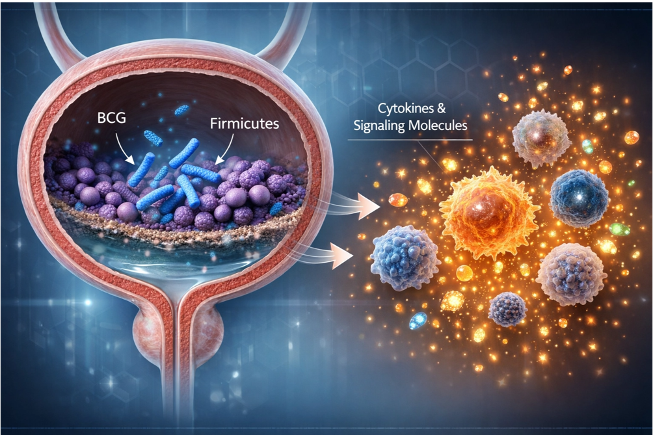
Figure 2: Conceptual Model of Urobiome-Mediated Synergy in BCG Immunotherapy. Proposed mechanism by which the bladder microbiome enhances the efficacy of intravesical Bacillus Calmette–Guérin (BCG) therapy.
Our results are consistent with previous reports suggesting an association between urinary microbiome composition and BCG outcomes. Sweis et al. reported a higher abundance of Firmicutes in patients with favorable responses to BCG,14 while other exploratory studies have linked specific microbial signatures to recurrence risk in NMIBC.12,13 The higher prevalence of Cyanobacteria observed in BCG-resistant patients in our cohort may therefore reflect both reduced immunologic synergy with BCG and baseline tumor aggressiveness.
Our study suggests that distinct bladder microbiome signatures are associated with differential responses to intravesical BCG in high-risk NMIBC. Prospective, multicenter studies with longitudinal microbiome profiling are warranted to validate these findings and to determine whether microbiome-based biomarkers may support patient stratification and personalized treatment strategies, including early consideration of alternative intravesical agents or systemic immunotherapy.6
Written by: Gabriele Tulone, Nicola Pavan, and Alchiede Simonato
Department of Precision Medicine in the Medical, Surgical and Critical Care Area (Me.Pre.C.C.), University of Palermo, Palermo, Italy.
References:
- Schmidt S, Kunath F, Coles B, Draeger DL, Krabbe LM, Dersch R, Kilian S, Jensen K, Dahm P, Meerpohl JJ. Intravesical Bacillus Calmette-Guérin versus mitomycin C for Ta and T1 bladder cancer. Cochrane Database Syst Rev. 2020 Jan 8;1(1):CD011935. doi: 10.1002/14651858.CD011935.pub2. PMID: 31912907; PMCID: PMC6956215.
- Li R, Sundi D, Zhang J, Kim Y, Sylvester RJ, Spiess PE, Poch MA, Sexton WJ, Black PC, McKiernan JM, Steinberg GD, Kamat AM, Gilbert SM. Systematic review of the therapeutic efficacy of bladder-preserving treatments for non-muscle-invasive bladder cancer following intravesical Bacillus Calmette-Guérin. Eur Urol. 2020 Sep;78(3):387-399. doi: 10.1016/j.eururo.2020.02.012. PMID: 32143924; PMCID: PMC7771323.
- Kates M, Matoso A, Choi W, Baras AS, Daniels MJ, Lombardo K, Brant A, Mikkilineni N, McConkey DJ, Kamat AM, Svatek RS, Porten SP, Meeks JJ, Lerner SP, Dinney CP, Black PC, McKiernan JM, Anderson C, Drake CG, Bivalacqua TJ. Adaptive immune resistance to intravesical BCG in non-muscle-invasive bladder cancer. Clin Cancer Res. 2020 Feb 15;26(4):882-891. doi: 10.1158/1078-0432.CCR-19-1920. PMID: 31712383.
- van der Meijden AP, Sylvester RJ, Oosterlinck W, Hoeltl W, Bono AV. Maintenance Bacillus Calmette-Guérin for Ta T1 bladder tumors is not associated with increased toxicity: results from a European Organisation for Research and Treatment of Cancer Genito-Urinary Group Phase III trial. Eur Urol. 2003 Oct;44(4):429-434. doi: 10.1016/s0302-2838(03)00357-9. PMID: 14499676.
- Kates M, et al. Bacillus Calmette-Guérin (BCG) treatment failure in bladder cancer: defining the high-risk patient and improving therapy. Nat Rev Urol. 2018 Apr;15(4):211-224. doi: 10.1038/nrurol.2018.13.
- U.S. Department of Health and Human Services Food and Drug Administration. BCG-Unresponsive Non-Muscle-Invasive Bladder Cancer: Developing Drugs and Biologics for Treatment. Guidance for Industry. 2018.
- Li R, et al. Systematic review of therapeutic strategies after BCG failure. Eur Urol. 2020;78(3):387-399.
- Whiteside SA, Razvi H, Dave S, Reid G, Burton JP. The microbiome of the urinary tract—A role beyond infection. Nat Rev Urol. 2015 Feb;12(2):81-90. doi: 10.1038/nrurol.2014.361. PMID: 25600098.
- Chorbińska J, Krajewski W, Nowak Ł, Małkiewicz B, Del Giudice F, Szydełko T. Urinary microbiome in bladder diseases—Review. Biomedicines. 2023 Oct 17;11(10):2816. doi: 10.3390/biomedicines11102816. PMID: 37893189; PMCID: PMC10604329.
- [Zhang W, Yu L, Chang Z, Xiong H. BCG immunotherapy promotes tumor-derived T-cell activation through the FLT3/FLT3LG pathway in bladder cancer. J Cancer. 2024 Jan 1;15(3):623-631. doi: 10.7150/jca.90085. PMID: 38213738.
- [Gopalakrishnan V, Spencer CN, Nezi L, et al. Gut microbiome modulates response to anti-PD-1 immunotherapy in melanoma patients. Science. 2018 Jan 5;359(6371):97-103. doi: 10.1126/science.aan4236.
- [Roy S, Trinchieri G. Microbiota: a key orchestrator of cancer therapy. Nat Rev Cancer. 2017 May;17(5):271-285. doi: 10.1038/nrc.2017.13.
- [Zitvogel L, Ayyoub M, Routy B, Kroemer G. Microbiome and anticancer immunosurveillance. Cell. 2016 Apr 7;165(2):276-287. doi: 10.1016/j.cell.2016.03.001.
- [Sweis RF, Golan S, Barashi N, et al. Association of the commensal urinary microbiome with response to Bacillus Calmette-Guérin immunotherapy in non-muscle-invasive bladder cancer. J Clin Oncol. 2019;37:423.
- [Zhang W, Yang F, Mao S, et al. Bladder cancer-associated microbiota: recent advances and future perspectives. Heliyon. 2023 Jan 16;9(1):e13012. doi: 10.1016/j.heliyon.2023.e13012. PMID: 36704283; PMCID: PMC9871226.
The visual assets presented in this publication were generated using advanced artificial intelligence (AI) generative models. Specifically, a large language model (LLM) with integrated image generation capabilities was employed to create detailed and scientifically accurate illustrations based on textual prompts. The process involved iterative refinement of prompts to ensure the visual representation accurately reflected complex biological concepts, such as microbial interactions within the bladder microenvironment, the impact of specific bacterial phyla on immune responses, and the mechanisms of action of immunotherapies.
Read the Abstract