

This systematic review and meta-analysis, published in Critical Reviews in Oncology/Hematology, highlights how methodological assumptions underlying commonly used survival analyses—specifically, the Kaplan-Meier (KM) method—may be violated, thereby challenging conclusions drawn from retrospective comparative effectiveness research.
Kaplan-Meier Assumptions and Informative Censoring
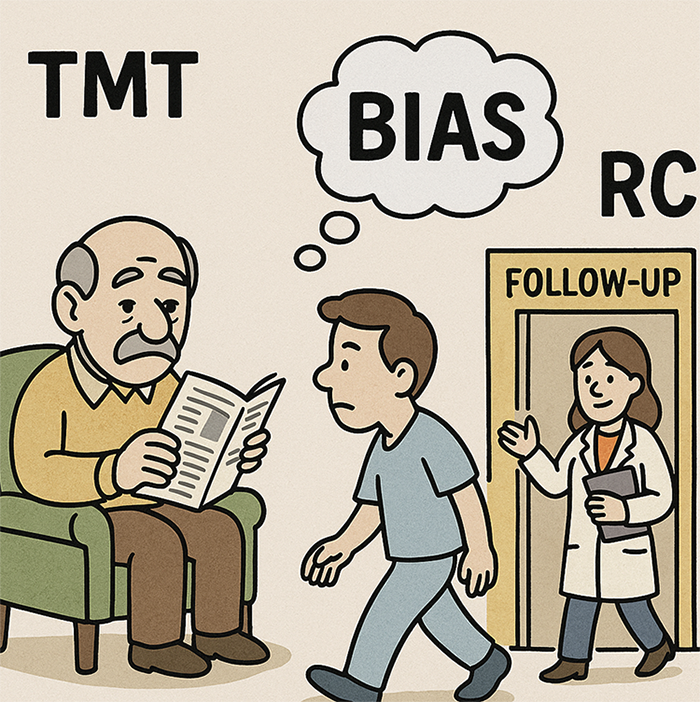
At the heart of the issue lies an - often-ignored - assumption: non-informative censoring. The KM estimator assumes that patients censored from survival analyses (e.g., due to loss to follow-up) are at equal risk of experiencing the event of interest (e.g., death, progression) as those who remain under observation. If this assumption does not hold—if censoring is informative, meaning that the reason for censoring is related to prognosis—the resulting survival curves may be biased. This is particularly relevant in observational studies comparing TMT and RC, where patient populations differ significantly in baseline health status, frailty, and ability to adhere to structured follow-up. For example, patients selected for TMT are often older or have more comorbidities, while those undergoing RC may be lost to follow-up due to surgical complications or transition of care away from high-volume centers. These real-world phenomena introduce asymmetry in censoring patterns, which can subtly but meaningfully influence survival estimates.
We exploited reverse Kaplan-Meier analyses, LOWESS smoothing, and simulation models to reconstruct survival data from six retrospective studies comprising 8,594 patients. In 10 out of 12 analyzed endpoints—including overall survival (OS), cancer-specific survival (CSS), and disease-free survival (DFS)—there were significant differences in the censoring patterns between TMT and RC cohorts. This imbalance was not random but suggested a consistent risk of informative censoring.
Correcting for Informative Censoring: What Changes?
To quantify the potential impact of informative censoring, we performed a simulation analyses estimating the minimum proportion of censored patients who would need to experience an event in order to offset the bias introduced by unequal censoring patterns. Across the included studies, this threshold ranged from 16% to 33% for overall survival (OS), demonstrating that relatively small changes in censored outcomes could meaningfully alter observed survival differences between trimodal therapy (TMT) and radical cystectomy (RC).
However, a critical methodological limitation must be acknowledged: only 6 out of 19 eligible studies could be included in these analyses. The other 13 studies were excluded because their Kaplan-Meier (KM) curves did not report the number at risk over time, a necessary component for accurate digital reconstruction of survival data. Without this, we were not able to assess the censoring pattern or simulate the potential impact of informative censoring. This omission, common in retrospective oncologic literature, underscores a widespread problem in reporting transparency and impairs the field’s ability to detect and correct for bias.
As a result, while the findings from the 6 analyzable studies consistently showed that RC remained superior to TMT even after adjusting for informative censoring (adjusted HR for OS: 1.11, 95% CI 1.05–1.19), these results cannot be generalized to the broader body of literature. The exclusion of the majority of eligible studies means we cannot conclude that RC is definitively superior overall—only that in the subset of studies where censoring could be robustly evaluated, IC was present and likely biased survival estimates.
Thus, the key contribution of this analysis is not to affirm the superiority of one treatment over another, but rather to highlight the unrecognized and potentially distorting effect of informative censoring in retrospective comparisons between TMT and RC. The findings call for greater caution in interpreting non-randomized survival data and emphasize the need for higher-quality studies that ensure complete and transparent reporting.
Conclusion: Proceed with Caution
This study underscores a critical and often overlooked source of bias in comparative oncology research. Informative censoring—if unrecognized and unaddressed—can falsely elevate one treatment over another or mask true differences. While TMT remains a vital option for selected patients unfit for surgery or prioritizing quality of life, clinicians should be cautious in interpreting claims of oncological equivalence with RC based solely on retrospective data.
Our work calls for high-quality, non-inferiority RCTs with stringent follow-up protocols to provide definitive answers. Until then, informed shared decision-making should emphasize that bladder preservation with TMT, although promising, has not yet achieved oncological parity with radical cystectomy in MIBC.
Written by: Daniele Robesti,1 Filippo Micheli,2 Shesh N. Rai,3 Giuseppe Fallara,4 Andrea Gallina,2 Francesco Montorsi,5 Alberto Briganti,1 Nicola Fossati,2 Antoine G. van der Heijden,5 Guillaume Ploussard,6 Bernard Malavaud,7 Alberto Martini7
- URI - Urological Research Institute, Department of Urology, Division of Experimental Oncology, IRCCS Ospedale San Raffaele, Milan, Italy; Università Vita-Salute San Raffaele, Milan, Italy.
- Ente Ospedaliero Cantonale, Università della Svizzera Italiana, Department of Surgery, Service of Urology, Lugano, Switzerland.
- Biostatistics and Informatics Shared Resource, University of Cincinnati Cancer Center, University of Cincinnati, Cincinnati, OH, USA.
- Division of Urology, Unit of Urology, ASST Santi Paolo e Carlo, Milan, Italy.
- Department of Urology, Radboud University Medical Center, Nijmegen, the Netherlands.
- Department of Urology, Institut Universitaire du Cancer Toulouse-Oncopôle, Toulouse, France; Department of Urology, La Croix du Sud Hospital, Toulouse, France.
- Department of Urology, La Croix du Sud Hospital, Toulouse, France.
- Department of Urology, University of Cincinnati College of Medicine, Cincinnati, OH, USA.