

Background
Urinary incontinence (UI) and continence health are crucial for overall well-being, often wrongly associated solely with old age.1 Among the general population, the prevalence of being incontinent at least once in the past 12 months with any type of UI ranges from 25% to 45%2,3 indicating its widespread impact. This condition not only hampers independence and productivity in daily life,1 but also poses a significant economic burden, yet remains largely unquantified at the EU level. Health inequities across EU Member States remain a significant driver for coordinated action at the EU level. Access to continence care varies widely—particularly in terms of reimbursement for physiotherapy, medications, protective materials, and surgical interventions, as well as access to specialist services.
These disparities, which disproportionately affect women with gynaecological-related continence issues, highlight gaps in the realisation of women’s right to health—an emerging EU priority. Although non-communicable diseases are on the EU agenda, continence health remains overlooked, presenting a clear opportunity to advance gender equity and reduce variation in care across the Union.
Context for the economic burden analysisIn response, the European Association of Urology launched the Urge to Act campaign in 2023, aiming to reform continence health policies in the EU. As part of this initiative, an economic analysis was conducted.4 The aims of this economic analysis were to; 1) review and summarise existing scientific literature on the economic burden of UI in the EU, 2) to estimate the economic burden of incontinence on society and 3) to describe and estimate the environmental impact of UI waste disposal, 4) to serve as a basis for a Continence Health Manifesto addressing the action points for an EU campaign.5
During the analysis design, authors noted a dearth of recent literature on the economic impact of UI in the EU, with studies dating back 15-17 years and primarily focused on select EU countries.6,7 Surprisingly, only three studies in the last decade quantified the economic burden of UI, with the majority based in the US and only one in Europe.8–10 This gap is striking considering UI's preventable and treatable nature,11 offering opportunities to mitigate symptoms early and reduce healthcare costs. Additionally, there was a scarcity of standardised prevalence data from reputable sources like the Global Burden of Disease or World Health Organization, necessitating reliance on individual peer-reviewed studies.
Economic analysis approach
The economic burden analysis included all 27 European Union countries, adopting a societal perspective that considered both direct and indirect costs. These included expenses for incontinence pads, medical consultations, diagnostics, treatments, and productivity losses due to absenteeism for both patients and informal caregivers. Additionally, the analysis estimated the costs and environmental impact of UI waste disposal,12 recognising its significance amidst the global climate crisis. Data for this analysis were sourced from literature, interviews with clinical experts, and surveys from 13 national urological societies. An uncertainty analysis was conducted to evaluate the potential impact of variability in key parameters.
Firstly, the analysis revealed significant disparities in how UI prevalence data were documented across EU studies, driven by methodological variations, cultural factors, and inadequate data collection. Few studies reported age-standardised rates.13 The most commonly reported category of UI in the literature was 'any' UI, which was used to facilitate the economic calculations. While prevalence varied widely among countries, consistent trends emerged: women generally experienced higher rates than men, and prevalence increased with age for both genders. Women typically reported UI at younger ages, around 25 years and older, whereas men's estimates were more common from age 40 onwards.
The economic analysis revealed that UI imposed a substantial burden across all EU countries, totalling EUR€69.1 billion in 2023 (lower estimate EUR€26.1 billion, upper estimate EUR€133.4 billion). This amounts to approximately half the economic burden of diabetes, which cost the EU around EUR€149 billion in 2019, and two-thirds of the economic burden of cancer, which totalled about EUR€100 billion in 2020. Notably, caregiver costs were excluded from the published literature, and thus were also initially omitted from the analysis results comparison purposes (see Figure 1).
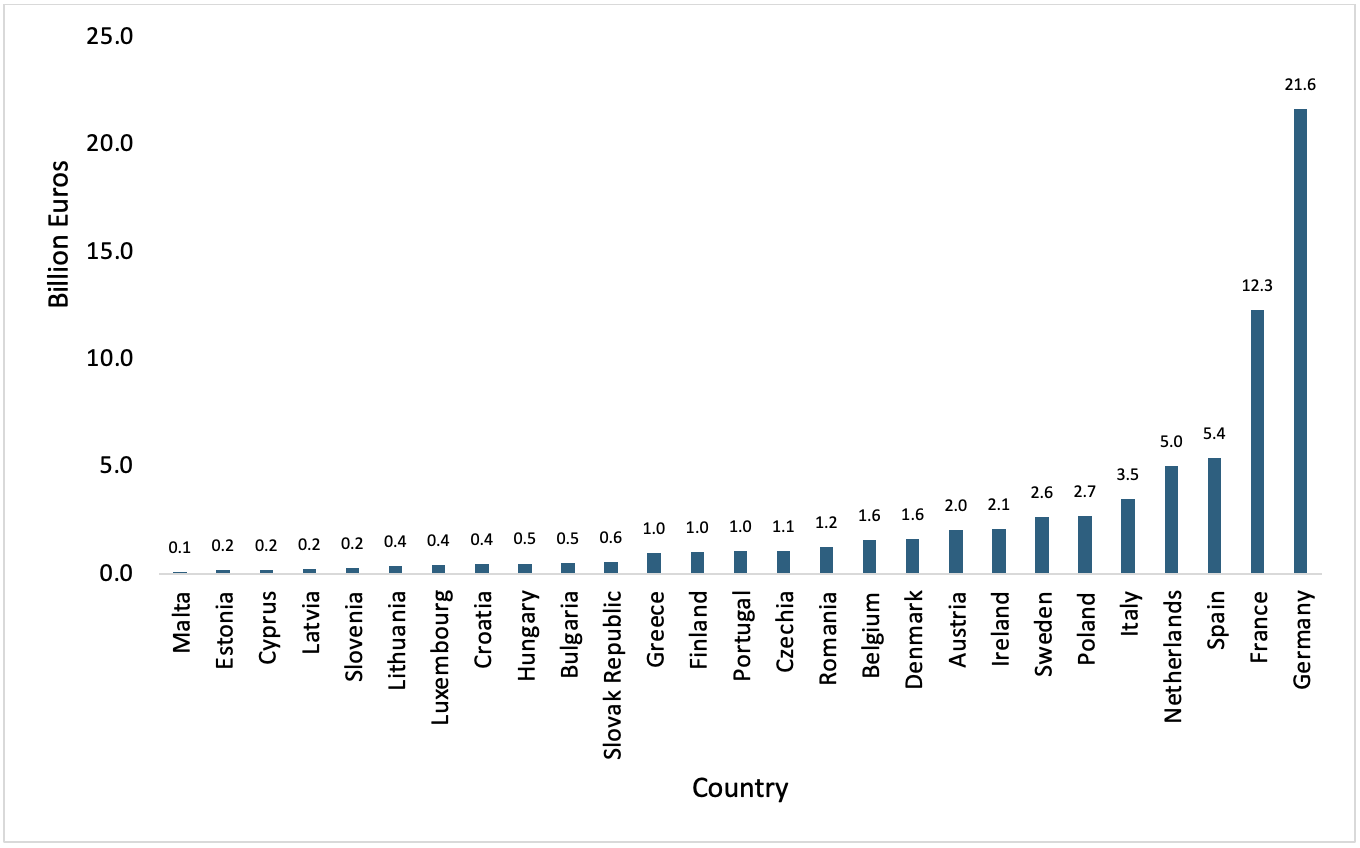
Figure 1. Economic burden of UI males and females combined in 27 EU-member states in 2023, billion Euros.
Note: Data supporting figure excludes caregiver costs.
The economic burden for females was four times higher than for males and increased by approximately 16% when considering informal caregiver support, often provided by family members. With caregiver costs included, the total economic burden reached about EUR€80 billion in 2023. In terms of direct costs, incontinence pads, medications, and physiotherapy accounted for the largest share. Productivity losses, including caregiver costs, made up about 42% of the total burden. If no action is taken, the analysis projects a 25% increase in the annual economic burden of UI by 2030, reaching EUR€86.7 billion (EUR€32.8 billion–EUR€167.2 billion) without caregiver costs and EUR€100.2 billion (EUR€40.8 billion–EUR€188.6 billion) with caregiver costs. Per-patient costs, including caregiver costs, were estimated to rise from EUR€1,700 in 2023 to EUR€2,129 in 2030 (see Table 1).
Table 1. Total per patient, per year costs in EU countries with and without caregiver costs, in 2023 and 2030.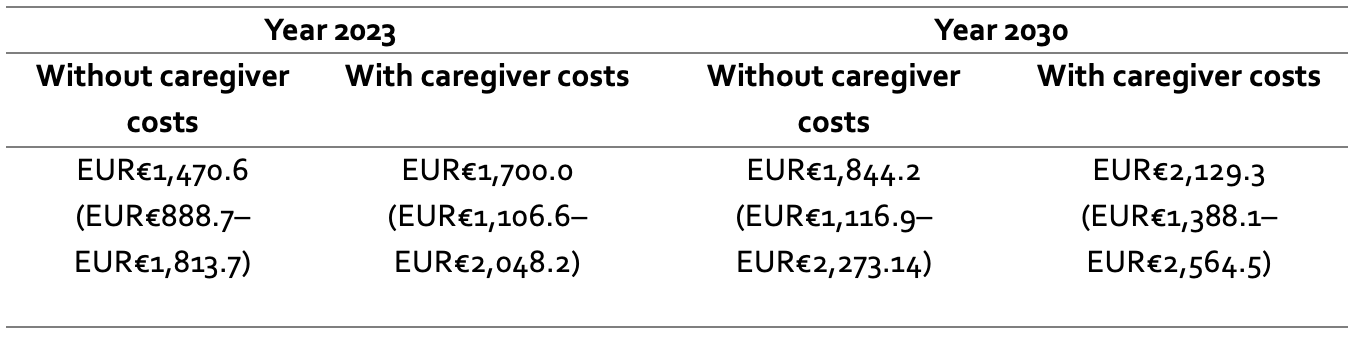
The waste disposal results were also noteworthy. Recycling or incinerating incontinence pad waste incurred similar costs across all countries, amounting to EUR€83.4 billion and EUR€83.3 billion respectively in 2023. However, the study suggests that transitioning to 100% recycling of incontinence waste could slash the carbon footprint of continence health in Europe by 157.2 million kg CO2e in 2023 and accrue a cumulative reduction of 1.1 billion kg CO2e from 2024 to 2030. This underscores the environmental benefits of preventing UI.
The authors acknowledge that the primary study limitation was inconsistent prevalence data reporting and, as such, advocated for enhanced surveillance to bolster future UI research. These results and their noted limitations served as the basis for the guidance for continence health policy reform in the EU.
Continued actionIn parallel to the economic analysis, the EAU also worked with a multistakeholder alliance of non-commercial stakeholders such as patient organisations and medical societies to develop a manifesto of 10 main action points. The alliance encourages the EU and EU member states to:
- Develop a comprehensive EU continence health strategy
- Give individuals full and equitable access to continence health solutions
- Guarantee access to toileting facilities in public and private spaces
- Improve the number and accessibility of trained healthcare providers
- Find and fund sustainable continence care solutions for health systems
- Support informal caregivers
- Understand the interconnections of continence and related health domains
- Improve funding for continence health research
- Run public awareness campaigns
- Encourage public-private partnerships to improve continence health
To follow on from this manifesto, an Interest Group on Continence Health has been inaugurated in the European Parliament in June 2025 and a guide for policymakers has been produced.14,15
Take home message
For a condition that is not life threatening, UI imposes a staggering EUR€80 billion burden on the EU, with females bearing four times the cost. Despite its scale, UI remains largely absent from EU health policy frameworks, including non-communicable disease strategies. This gap presents a critical opportunity to advance women’s health rights, reduce health inequities, and align continence care with sustainability goals. The findings of this analysis support urgent EU-level action, as outlined in the 10-point Continence Health Manifesto and reinforced by the recent launch of the Interest Group on Continence Health in the European Parliament.Written by: Chrissy Bishop,1 Federico Rodriguez-Cairoli,1 Arnold Hagens,1 Maria Angela Bermudez,2 Philip Van Kerrebroeck,2 Sarah Collen,2
- Triangulate Health Ltd, Doncaster, South Yorkshire, UK.
- European Association of Urology, Arnhem, The Netherlands.
- NHS England. Excellence in Continence Care [Internet]. 2018. Available from: www.england.nhs.uk
- Kilonzo M, Vale L. Economics of urinary and faecal incontinence, and pelvic organ prolapse. 2023.
- Milsom I, Gyhagen M. The prevalence of urinary incontinence. Climacteric. 2019 May 4;22(3):217–22.
- Bishop C, Rodriguez-Cairoli F, Hagens A, Bermudez MA, Kerrebroeck P Van, Collen S. Prevalence, Socioeconomic, and Environmental Costs of Urinary Incontinence in the European Union. Eur Urol. 2025 Jun;
- European Association of Urology. European Association of Urology. [cited 2024 Apr 24]. p. 1–1 An Urge to Act. Available from: https://uroweb.org/an-urge-to-act
- Irwin DE, Mungapen L, Milsom I, Kopp Z, Reeves P, Kelleher C. The economic impact of overactive bladder syndrome in six Western countries. BJU Int. 2008 Dec 23;103(2):202–9.
- Reeves P, Irwin D, Kelleher C, Milsom I, Kopp Z, Calvert N, et al. The Current and Future Burden and Cost of Overactive Bladder in Five European Countries. Eur Urol. 2006 Nov;50(5):1050
- Kleinman NL, Chen CI, Atkinson A, Odell K, Zou KH. Economic burden of urge urinary incontinence in the workplace. J Occup Environ Med. 2014;56(3):266–9.
- Ruff L, Bagshaw E, Aracil J, Velard ME, Pardhanani G, Hepp Z. Economic impact of onabotulinumtoxinA for overactive bladder with urinary incontinence in Europe. J Med Econ. 2016 Dec 1;19(12):1107–15.
- Continence Foundation of Australia. The economic impact of incontinence in Australia. 2011.
- Chen JV, Gahn JC, Nesheim J, Mudd PN. Budget Impact Analysis of Vibegron for the Treatment of Overactive Bladder in the USA. Pharmacoeconomics. 2022 Oct 1;40(10):979–88.
- Velasco Perez M, Sotelo Navarro PX, Hermoso Lopez Araiza JP, Morillas AV, Espinosa Valdemar RM. Waste management and environmental impact of absorbent hygiene products: A review. Waste Management & Research: The Journal for a Sustainable Circular Economy. 2021 Sep 10;39(6):767–83.
- Irwin DE, Kopp ZS, Agatep B, Milsom I, Abrams P. Worldwide prevalence estimates of lower urinary tract symptoms, overactive bladder, urinary incontinence and bladder outlet obstruction. BJU Int. 2011 Oct;108(7):1132–8.
- European Association of Urology. MEP Interest Group on Continence Health.
- European Association of Urology. Making the change for 55 million Europeans: Improving EU policy to support continence health. Brussels; 2023.