

LAS VEGAS, NV USA (UroToday.com) - Purpose: To report on the 36-month final results of the Sustained Therapeutic Effects of Percutaneous Tibial Nerve Stimulation (STEP) Study, which examined the safety and effectiveness of percutaneous tibial nerve stimulation (PTNS) with the Urgent® PC Neuromodulation System for overactive bladder syndrome (OAB).
 Methods: 60/110 subjects in the multi-center, randomized, double-blind SUmiT Study met the primary endpoint of “moderately or “markedly improved” for overall bladder symptoms on the Global Response Assessment (GRA) after 12 weekly PTNS treatments. Of these subjects, 50 were consented and enrolled in the STEP Study. Subjects were prescribed a 14-week continued tapering treatment regimen followed by a personalized treatment plan aimed at sustaining OAB symptom improvement. OAB and quality of life questionnaires were completed every 3 months and 3-day voiding diaries were completed every 6 months after study entry. Adverse events were recorded throughout the study.
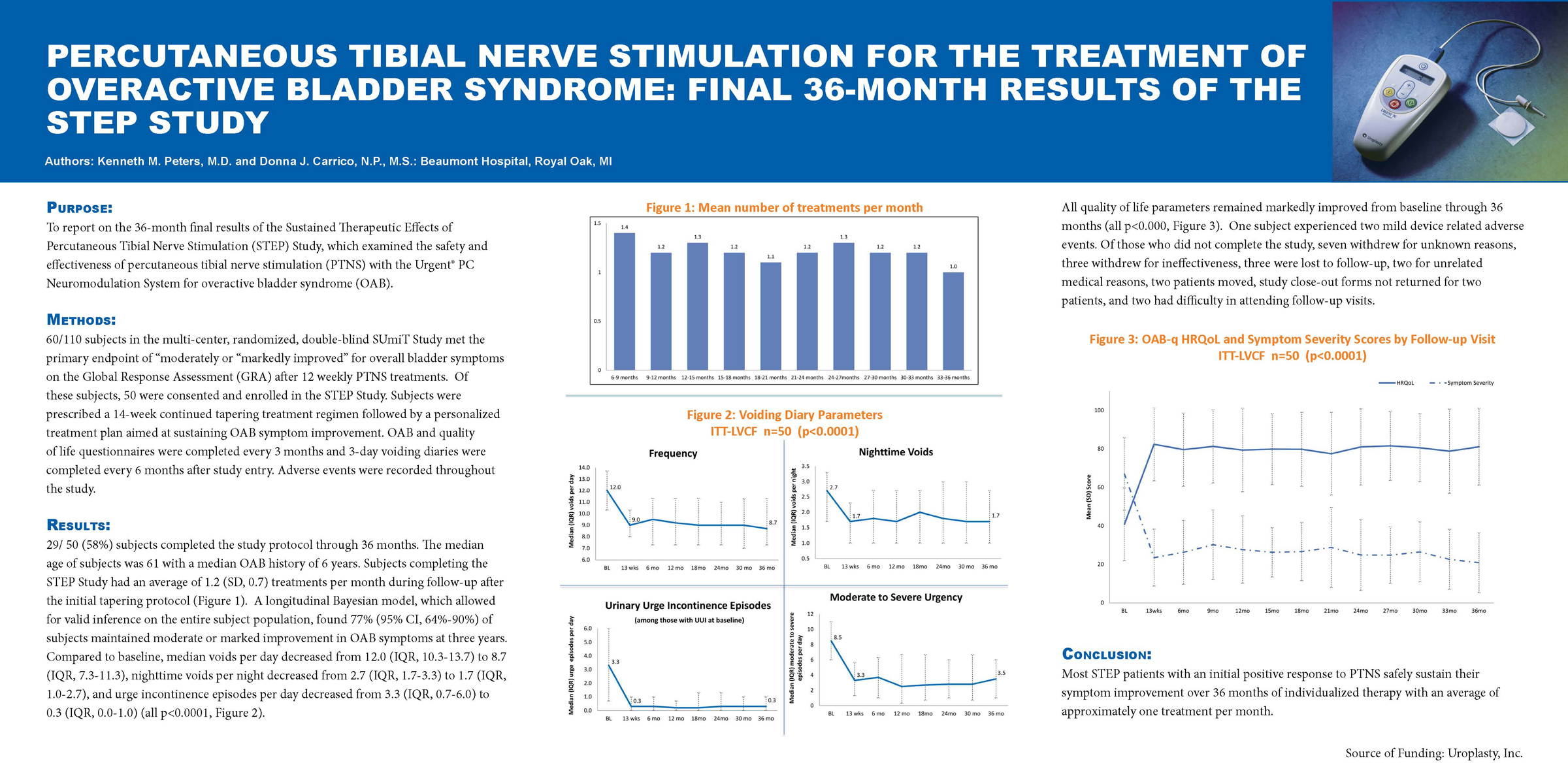
Results: 29/ 50 (58%) subjects completed the study protocol through 36 months. The median age of subjects was 61 with a median OAB history of 6 years. Subjects completing the STEP Study had an average of 1.2 (SD, 0.7) treatments per month during follow-up after the initial tapering protocol (Figure 1). A longitudinal Bayesian model, which allowed for valid inference on the entire subject population, found 77% (95% CI, 64%-90%) of subjects maintained moderate or marked improvement in OAB symptoms at three years. Compared to baseline, median voids per day decreased from 12.0 (IQR, 10.3-13.7) to 8.7 (IQR, 7.3-11.3), nighttime voids per night decreased from 2.7 (IQR, 1.7-3.3) to 1.7 (IQR, 1.0-2.7), and urge incontinence episodes per day decreased from 3.3 (IQR, 0.7-6.0) to 0.3 (IQR, 0.0-1.0) (all p < 0.0001, Figure 2). All quality of life parameters remained markedly improved from baseline through 36 months (all p < 0.000, Figure 3). One subject experienced two mild device related adverse events. Of those who did not complete the study, seven withdrew for unknown reasons, three withdrew for ineffectiveness, three were lost to follow-up, two for unrelated medical reasons, two patients moved, study close-out forms not returned for two patients, and two had difficulty in attending follow-up visits.
Conclusions: Most STEP patients with an initial positive response to PTNS safely sustain their symptom improvement over 36 months of individualized therapy with an average of approximately one treatment per month.
Source of Funding: Uroplasty, Inc.
Presented by Kenneth M. Peters, MD and Donna J. Carrico, NP, MS at the Society for Urodynamics, Female Pelvic Medicine and Urogenital Reconstruction (SUFU) 2013 Winter Meeting - February 26 - March 2, 2013 - Caesars Palace - Las Vegas, NV USA
Beaumont Hospital, Royal Oak, MI USA
View Full SUFU 2013 Winter Meeting Coverage