

For decades, semen analysis has been viewed primarily as a fertility test. But that perspective is changing.
A growing body of evidence suggests that male-factor infertility is not just about reproduction—it may be an early signal of broader health risks, including cardiometabolic disease and even mortality. In this sense, semen quality may serve as a window into a man’s overall health trajectory.
At the same time, another critical determinant of health has often been underrecognized in urology: place. Where patients live—their neighborhood conditions, resources, and access to care—can shape outcomes in profound ways.
Bringing biology and social context into the same frame
Building on our recent work, we examined how semen quality (Total motile sperm count/TMSC), neighborhood deprivation (Area Deprivation Index, ADI), and life expectancy intersect.
Across more than 2,000 men evaluated for infertility, those in more disadvantaged neighborhoods had lower TMSC and shorter life expectancy. Both ADI and TMSC independently predicted life expectancy—even after adjusting for age and race.
Notably, risk was not evenly distributed. The decline in life expectancy became steeper at higher levels of deprivation, highlighting disproportionate impact in the most vulnerable populations.
Why this matters for everyday urology practice
Semen analysis should be treated as a broader health signal. Low TMSC may reflect systemic vulnerability beyond reproduction.
ADI offers a practical way to integrate social context into care. Patients in the highest deprivation categories may require more proactive follow-up, not just more testing.
Together, semen quality and social context provide complementary, independent insights for clinical decision-making.
From insight to action
The infertility visit is a critical moment for prevention. Abnormal semen parameters should trigger expanded evaluation including cardiometabolic risk, lifestyle factors, and mental health.
At the same time, integrating ADI into workflow can help identify patients who may benefit from navigation support, improved access, and targeted follow-up.
In this way, infertility care becomes both a clinical intervention and an equity intervention.
A broader shift in perspective
Semen quality reflects biology, while ADI reflects lived environment. Together, they shape long-term health and longevity.
Male infertility should therefore be reframed as a life-course health indicator—not just a reproductive diagnosis.
Bottom line
- Semen analysis is more than a fertility test—it is a clinical signal.
- Neighborhood deprivation is more than context—it is measurable risk.
- Integrating both advances a preventive, personalized, and equity-informed model of urologic care.
- Marion A., et al. Our Fertility and Sterility data linking ADI, sperm counts and life expectancy. Fertil Steril. 2025;124:E211. DOI: 10.1016/j.fertnstert.2025.07.660
- Jensen et al., American Journal of Epidemiology (2009): Higher semen quality is associated with longer life expectancy.
- Glazer et al., Human Reproduction (2019): Male infertility is linked to increased mortality risk.
- Del Giudice et al., Urology (2021): Systematic review confirming the association between infertility and mortality.
- Latif et al., American Journal of Epidemiology (2017): Semen parameters predict future morbidity.
- Priskorn et al., Human Reproduction (2025): Large cohort data linking semen quality with lifespan.
- Kimmins et al., Nature Reviews Urology (2024): Highlights the importance of equity and social determinants in male fertility research.
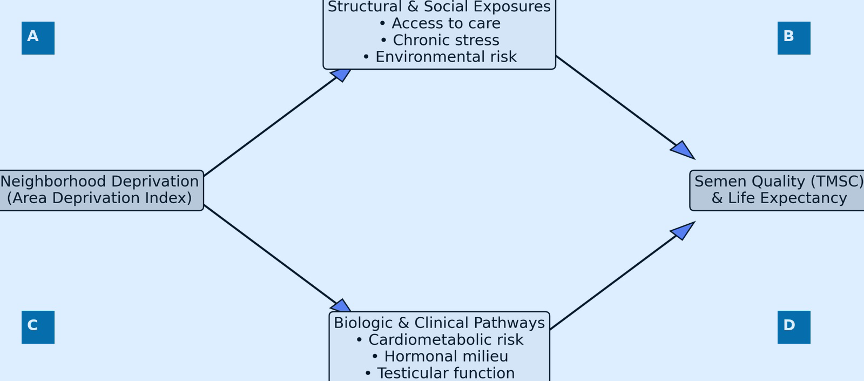
Figure 1. Conceptual framework linking neighborhood deprivation, semen quality, and life expectancy. (A) Neighborhood deprivation (ADI). (B) Structural and social exposures. (C) Biologic and clinical pathways. (D) Semen quality (TMSC) and life expectancy. Social context and biologic factors contribute additively to men’s health risk.
Written by: Abdelmoneim Younis, DVM, PhD and Kristina C. Hawkins, MD
- Professors of OB/GYN, Atrium Health-Navicent/Mercer University School of Medicine
- Researchers, Department of OB/GYN, Wake Forest University School of Medicine