

Often, they have already tried one of these options before the consultation. For the clinician, this creates a practical problem: simply saying that “the evidence is insufficient” is scientifically accurate, but clinically incomplete.
The real question is not whether a benefit has ever been reported. In this field, positive findings are common. The more useful question is whether the signal is reproducible, standardized, clinically interpretable, and safe enough to guide counseling. This was the motivation behind our focused secondary synthesis of the AFU/SFMS evidence base on phytotherapies and complementary therapies for erectile dysfunction.
Our manuscript should be understood in that context. It is a focused secondary synthesis and critical clinical interpretation of the AFU/SFMS evidence base, not a new de novo systematic review. The parent AFU/SFMS evidence review used a predefined search and selection process in PubMed/Medline for French- and English-language publications from January 1999 to January 2023, updated through October 2023. No additional de novo search or new risk-of-bias reassessment was performed for this manuscript. This methodological transparency is important because our purpose was not to produce another meta-analysis, but to help clinicians interpret a difficult evidence base.
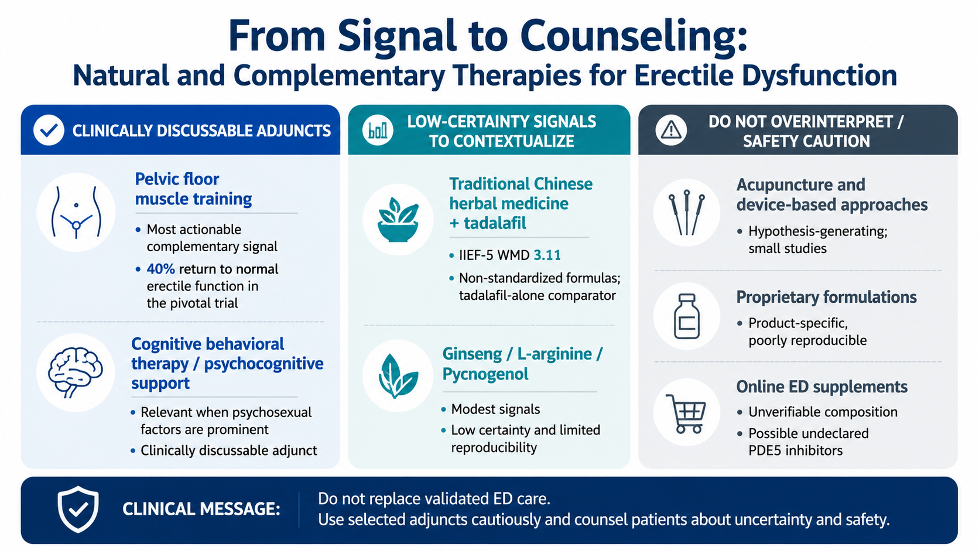
Among phytotherapies, the most coherent signal concerned traditional Chinese herbal medicine combined with tadalafil. In the meta-analysis included in the evidence base, this combination was associated with a pooled IIEF-5 weighted mean difference of 3.11 points compared with tadalafil alone. This signal is clinically interesting, but it should not be overinterpreted. The herbal formulas were non-standardized, the regimens were heterogeneous, and the comparator was tadalafil alone rather than tadalafil plus placebo. Therefore, part of the observed benefit may reflect contextual or expectancy effects related to adding an intervention, rather than a reproducible pharmacological effect of the herbal component itself. In practical terms, this is a coherent signal, but not a validated, reproducible herbal adjunct ready for routine recommendation.
Other phytotherapies were even more difficult to translate. Ginseng, L-arginine, and Pycnogenol showed modest low-certainty signals. Ginseng is particularly illustrative: earlier syntheses were more favorable, whereas the Cochrane interpretation was more cautious. This discrepancy likely reflects differences in included studies, outcome definitions, risk-of-bias assessment, and certainty-of-evidence methodology. For the clinician, the message is not that ginseng has no signal at all, but that the signal remains too uncertain and insufficiently reproducible for strong endorsement. Tribulus, Maca, Saffron, and several proprietary polyherbal formulations remain more preliminary, inconsistent, or product-specific. A positive trial of one formulation does not establish a reproducible therapeutic category.
Among complementary therapies, pelvic floor muscle training provided the clearest clinically actionable signal. In the pivotal randomized trial, 40% of men regained normal erectile function at 6 months. This does not mean that pelvic floor muscle training should be presented as a universal treatment for erectile dysfunction. The evidence base remains limited, therapist and protocol effects are important, and much of the broader rehabilitation literature concerns post-prostatectomy or post-pelvic-surgery erectile dysfunction, which was outside the core scope of this manuscript. Nevertheless, pelvic floor muscle training is plausible, conservative, and compatible with broader erectile dysfunction care. It can be discussed as an adjunct in selected patients.
Cognitive behavioral therapy and psychocognitive support also deserve a more serious place in clinical discussion than many “alternative” interventions. Their rationale is clinically recognizable, particularly when psychosexual factors are prominent, and randomized evidence supports benefits on symptoms and psychosexual outcomes. This does not make cognitive behavioral therapy a replacement for validated erectile dysfunction treatments, but it does make it a clinically discussable adjunct, especially in patients whose erectile dysfunction is strongly influenced by anxiety, avoidance, relationship dynamics, or performance-related mechanisms.
By contrast, acupuncture, electrical stimulation, functional electrical stimulation, and low-frequency magnetic pulse therapy remain hypothesis-generating or proof-of-concept approaches. Some reported effects are intriguing, but the studies are small, follow-up is short, protocols are heterogeneous, and replication is limited. Low-intensity extracorporeal shockwave therapy is clinically important in erectile dysfunction, but it was outside the core Q2 phytotherapy/complementary-therapy corpus and was addressed separately in the AFU/SFMS guideline program. Aerobic exercise was retained only as a contextual comparator/reference in this manuscript, with lifestyle interventions addressed elsewhere.
One of the most important messages is a safety message. Commercial online erectile dysfunction supplements are not only affected by uncertain efficacy; they are also affected by uncertain composition. Some products may contain undeclared PDE5 inhibitors, creating risks of overdose, drug interactions, or use despite contraindications. This is a practical public health issue. When a patient says he is taking a “natural” sexual supplement, the clinician should not assume that the product is pharmacologically inactive.
In our view, the most useful clinical posture is neither uncritical endorsement nor reflexive dismissal. Clinicians should ask what the patient is already using or considering, explain the difference between a weak but coherent signal and an unstable claim, prioritize validated erectile dysfunction care, consider pelvic floor muscle training or psychocognitive support in selected patients, and warn clearly against online supplements or proprietary formulations with unverifiable composition.
The value of this work lies in moving beyond the binary question: “Does it work?” A safer and more clinically useful question is: “Is the signal reproducible, interpretable, standardized, and safe enough to guide counseling?” For most phytotherapies and complementary therapies in erectile dysfunction, the answer remains no. For a few selected interventions, the answer may be: possibly, as an adjunct, with caution.
Written by: Cédric Lebâcle, Urology Department, University Hospital of Bicêtre-Paris Saclay University, Le Kremlin-Bicêtre, Paris, France
Read the Abstract