

As the use of enucleation techniques continues to expand, whether bladder outlet obstruction (BOO) procedures yield inferior outcomes in men with DUA compared with those with NC remains unclear. Therefore, we aimed to conduct an updated systematic review and meta-analysis of the available evidence comparing surgical outcomes in these populations.
Functional outcomes included changes in International Prostate Symptom Score (IPSS), maximum urinary flow rate (Qmax), quality of life (QoL), and postvoid residual volume (PVR). Perioperative outcomes included urinary retention rates, minor and major complications (according to the Clavien-Dindo grading system), operative time, length of stay (LOS), and rates of urge urinary incontinence (UUI) and stress urinary incontinence (SUI).
Studies were grouped, and subgroup analyses were conducted based on the type of BPH surgery performed. Six procedural subgroups were analyzed: holmium laser enucleation of the prostate (HoLEP), transurethral resection of the prostate (TURP), laser photovaporization (LVP), photoselective vaporization (PVP), holmium laser transurethral incision of the prostate (Ho-TUIP), and simple prostatectomy (SP).
Our initial database search identified 1758 studies. After screening, 14 studies met the inclusion criteria, totaling 4345 patients. HoLEP was the most frequently performed procedure (n=5 studies), followed by TURP (n=3 studies), PVP (n=2 studies), and green laser PVP (GL-PVP), Ho-TUIP, and SP (1 study each).
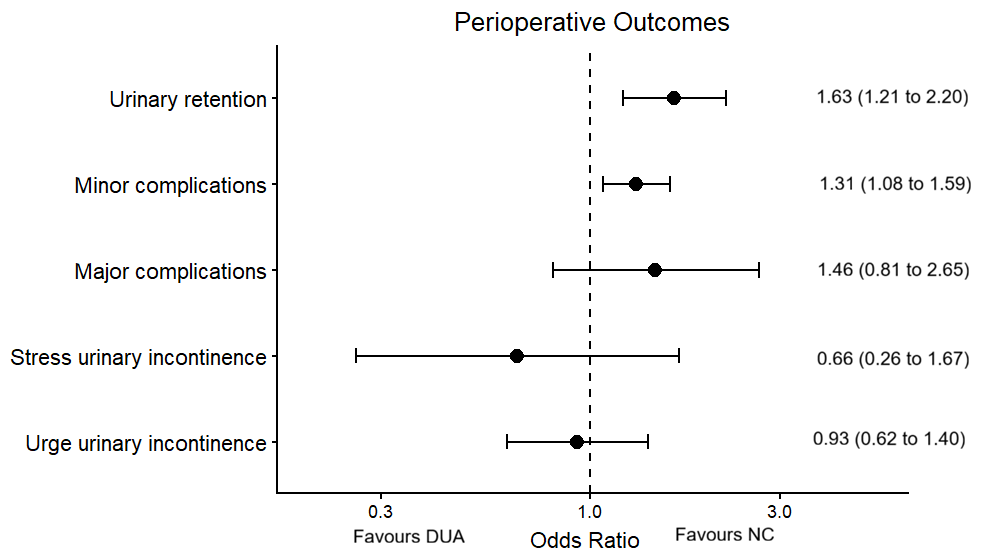
Based on pooled analyses, higher rates of postoperative urinary retention and minor complications were observed in the DUA group, whereas major complications and early postoperative stress urinary incontinence and urge urinary incontinence (up to 3 months postoperatively) were comparable. At 3 months, improvements in IPSS and Qmax favored NC patients, while QoL and PVR were similar. At 6 months, most functional data were derived from HoLEP studies; at this time point, changes in Qmax and PVR were comparable, whereas IPSS reduction favored NC patients. While there was no HoLEP data, IPSS difference between groups was not maintained at 1 year.
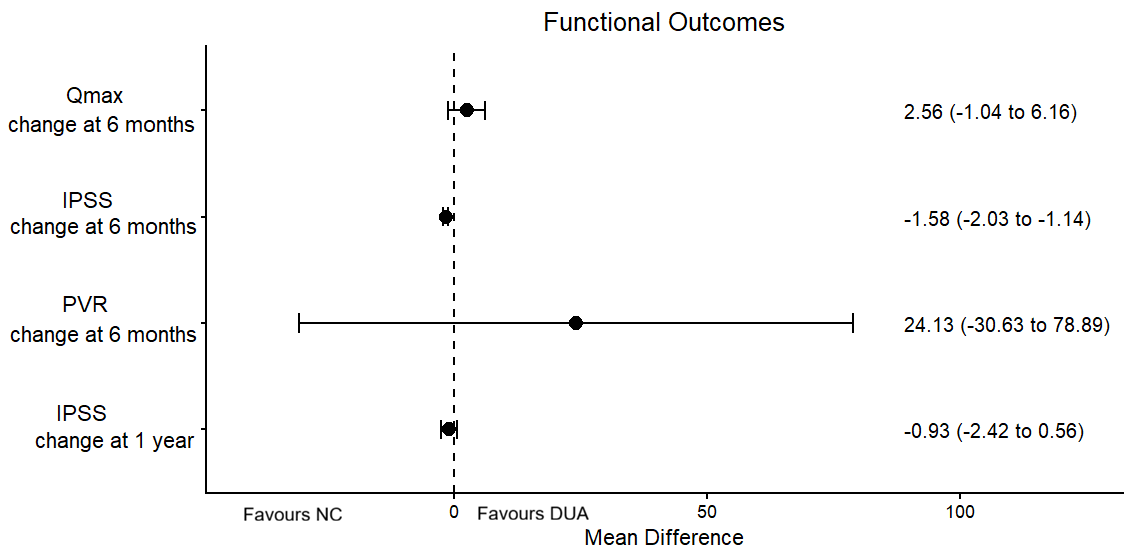
Our findings demonstrate that BPH surgery appears to be safe and effective in men with concomitant DUA. While minor complications, including postoperative urinary retention, were more common in the DUA group, major complications and changes in functional outcomes were comparable to those in patients with NC. Early differences in symptom and flow improvements diminished over time, suggesting a delayed but clinically relevant recovery in men with DUA. However, evidence quality remains limited, and outcomes remain less certain than in men with NC. Further randomized studies with longer follow-up, reporting catheter-free status, and using standardized DUA definitions are needed to better define the role of surgical intervention in this population.
Written by: Alejandro Calvillo-Ramirez,1 Luis A. Esparza-Miranda,2 Ana Paulina Casas-Huesca,3 Hector R. Gutierrez,3 David E. Hinojosa-Gonzalez,4 Mahmoud Khalil,1 Abhinav Sidana1
- Section of Urology, Department of Surgery, University of Chicago, Chicago, IL, USA
- Department of Urology, The Ohio State University Wexner Medical Center, Columbus. OH, USA
- Facultad de Medicina, Universidad Autónoma de Guadalajara, Guadalajara, Jalisco, México
- Scott Department of Urology, Baylor College of Medicine, Houston, TX, USA