

Seventeen studies reporting data on 702 patients treated with TPLA were included in this systematic review and analyzed. The EchoLaser™ system (SoracteLite™) (Elesta s.r.l., Calenzano (FI), Italy), consisting of a multisource diode laser (4 independent lasers operating at 1064 nm wavelength), a biplanar TRUS probe and a dedicated software to place the fibers and plan the treatment, was used to perform all procedures.
TPLA showed promising results in relieving obstructive symptoms, while preserving and even improving erectile and ejaculatory function, suggesting that it could be a valid option for young patients strongly interested in maintaining ejaculation.
This procedure also proved to be safe, with an acceptable rate of low-grade complications and no reported major adverse event (Clavien-Dindo grade > III). The possibility of being carried out in an outpatient setting with local anesthesia, at the cost of relatively few and low-grade side effects, makes this technique very attractive for elderly, multimorbid patients suffering from lower urinary tract symptoms (LUTS) due to BPH, who may benefit from a minimally invasive treatment, avoiding the risks associated with general anesthesia and hospitalization.
Careful patient selection is needed to offer this technique to the most suitable candidates and to achieve the best post-operative outcomes according to patients’ characteristics and expectations.
Since the evidence available is still limited, prospective comparative studies with longer follow-up are warranted to confirm the great efficacy and safety of TPLA, so that it can finally become a common practice for the treatment of obstructive LUTS.
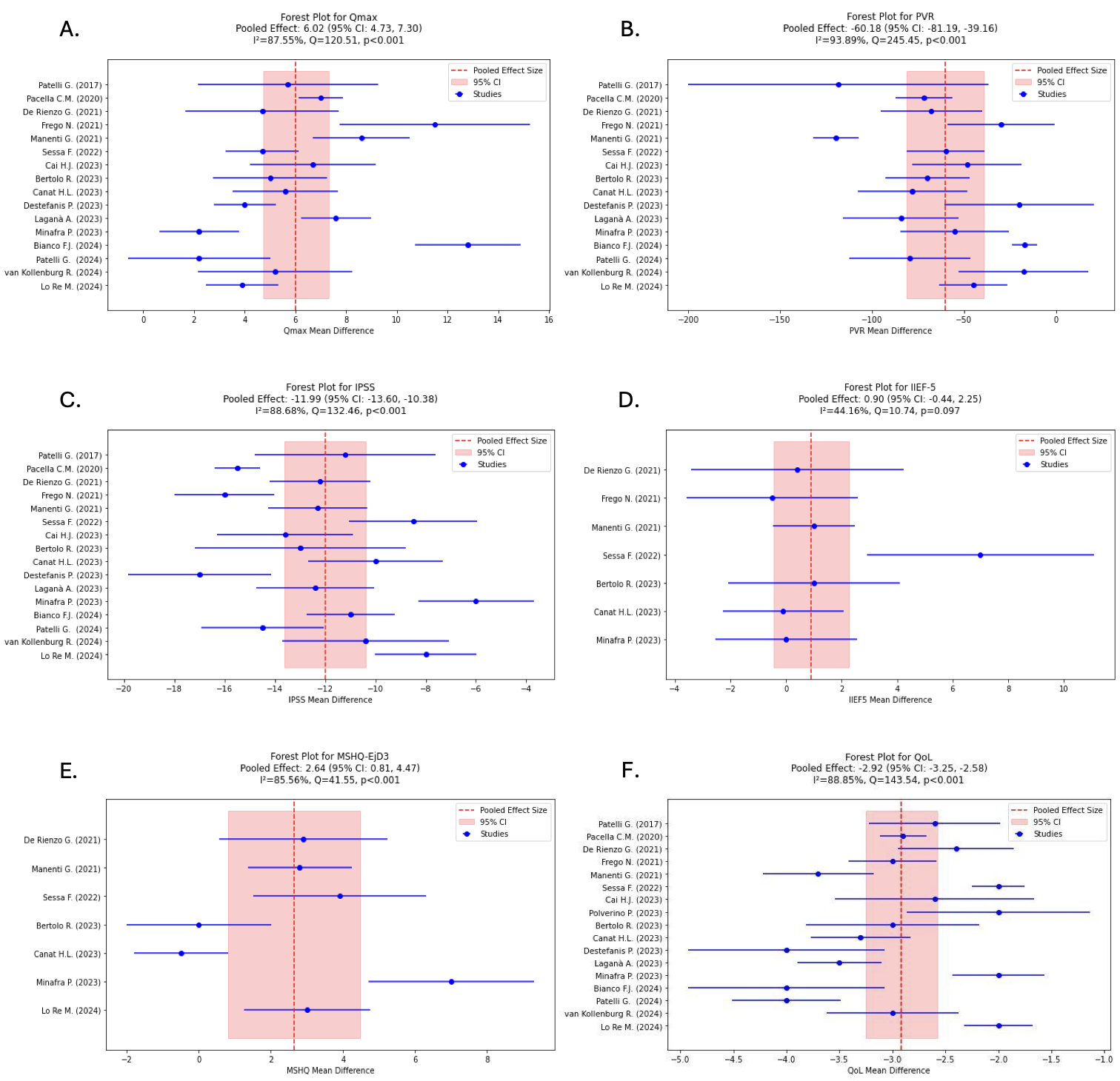
Figure. Forest plot displaying the pooled effect on functional outcomes after TPLA (difference from baseline). A. Qmax. B. Post-Void Residual (PVR) C. IPSS scores. D. IIEF-5 scores. E. MSHQ-EjD3 scores. F. Quality of Life (QoL) scores.
Written by: Andrea Alberti,1,2,# Mattia Lo Re,1,2,# Rossella Nicoletti,1,2,3 Paolo Polverino,1,2 Anna Cadenar,1,2 Elena Ciaralli,1,2 Francesca Solazzi,1,2 Beatrice Giustozzi,1,2 Francesco Sessa,1,2 Anna Rivetti,1,2 Riccardo Campi,1,2 Arcangelo Sebastianelli,1,2 Sergio Serni,1,2 Mauro Gacci1,2
- Unit of Urological Robotic Surgery and Renal Transplantation, University of Florence, Careggi Hospital, Florence, Italy
- Department of Experimental and Clinical Biomedical Science, University of Florence, Florence, Italy.
- S.H.Ho Urology Centre, Department of Surgery, The Chinese University of Hong Kong, Hong Kong, China.
Read the Abstract