

Uric acid stones are distinguishable from other types of stones by certain physical characteristics, in particular their lower radiodensity on computed tomography (CT), typically measuring less than 500 HU (Hounsfield units).
Another characteristic of uric acid stones is their potential to be dissolved in vivo through oral therapy. This makes accurate diagnosis essential, as it allows clinicians to avoid invasive treatments that are instead mandatory for other types of urinary stones. A combination of the patient's clinical history and the evaluation of CT radiodensity values should be sufficient to identify uric acid stones in most cases.
Uric acid stones can be dissolved by alkalinizing the urine because the solubility of uric acid increases dramatically when urinary pH exceeds the threshold of 5.4.2 However, it is important to point out that sodium and potassium urate crystals are not dissolved by alkalinization. In fact, their solubility decreased as urinary pH increases, making them resistant to dissolution through alkalinization.3 This event, although uncommon, must always be considered in the treatment planning because excessive alkalinization could favor the precipitation of these urate crystals. Furthermore, it must be considered that when urine is alkalinized above 6.2, the pH values can cause the precipitation of poorly soluble calcium phosphate salts that can overlap with the initial uric acid nucleus, hindering its dissolution and complicating management.
Alkalinizing treatment is generally obtained with the administration of potassium and magnesium citrate salts, which are preferred to bicarbonate salts due to their more favorable impact on urinary saturation. The use of citrates must, however, be aimed at maintaining urinary pH values in the appropriate therapeutic “window”, high enough to increase the solubility of uric acid, but not so high as to promote the precipitation of sodium and potassium urates or calcium phosphate salts.
In this series of clinical cases, a mixture of potassium and magnesium citrate with theobromine (Lit-Control® pH Up) was used.
Theobromine is a natural alkaloid present in the cocoa plant and its derivatives, such as chocolate, and approximately 20% of the ingested compound is excreted unchanged in the urine. It represents an innovative product due to its uric acid solubilizing effect, which is independent of urinary alkalinization.4,5 This unique mechanism allows for the solubilization of uric acid crystals without the associated risk of excessive alkalinization and its potential complications.6
Another therapeutic strategy employed in this series was the careful monitoring of urinary pH values throughout the day by using an innovative device (Lit-Control® pH Meter), which enables simple and reliable self-measurement of urinary pH values. The use of this device allowed for the personalization of drug dosage, avoiding fluctuations of urinary pH outside of the therapeutic “window” and minimizing fluctuations that could compromise treatment efficacy.
The results presented in this series are extremely satisfactory, with a high rate of stone dissolution achieved in a relatively short period of time. The cases include both renal and ureteral stones of different sizes and locations, whether single or multiple, including large staghorn stones that were completely dissolved (Figure 1).
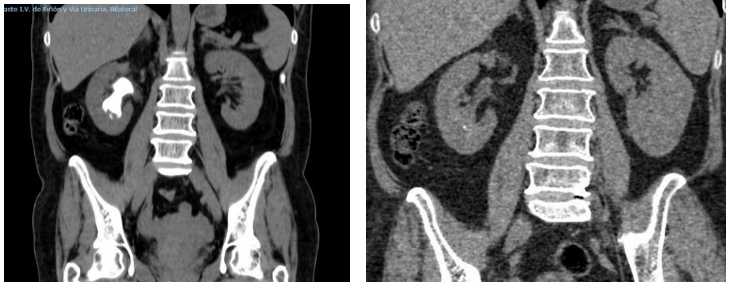
Figure 1 - Complete chemolysis of a 6 cm right renal staghorn stone
In conclusion, an established treatment can be significantly enhanced through pharmacological and technological innovations that optimize its clinical efficacy. For this reason, the presence of a uric acid stone should always be ruled out before starting invasive treatment, especially in patients who develop stone disease after the age of 60.
Appropriate therapy, coupled with careful monitoring, can ensure excellent results, preventing patients from undergoing unnecessary invasive treatments.
Written by: Bernat Isern1 & Alberto Trinchieri2
- Laboratori d’Investigació en Litiasi Renal, Universitat de les Illes Balears, Spain
- CDC Ambrosiana, Milano, Italy
References:
- Trinchieri A, Montanari E. Prevalence of renal uric acid stones in the adult. Urolithiasis. 2017 Dec;45(6):553-562. doi: 10.1007/s00240-017-0962-5.
- Grases F, Costa-Bauzá A, Gomila I, Ramis M, García-Raja A, Prieto RM. Urinary pH and renal lithiasis. Urol Res. 2012 Feb;40(1):41-6. doi: 10.1007/s00240-011-0389-3.
- Kippen I, Klinenberg JR, Weinberger A, Wilcox WR. Factors affecting urate solubility in vitro. Ann Rheum Dis. 1974 Jul;33(4):313-7. doi: 10.1136/ard.33.4.313.
- Grases F, Rodriguez A, Costa-Bauza A. Theobromine inhibits uric acid crystallization. A potential application in the treatment of uric acid nephrolithiasis. PLoS One. 2014 Oct 21;9(10):e111184. doi: 10.1371/journal.pone.0111184.
- Trinchieri A. Theobromine for treatment of uric acid stones and other diseases. Arch Ital Urol Androl. 2024 Nov 21;96(4):13277. doi: 10.4081/aiua.2024.13277.
- Hernandez Y, Costa-Bauza A, Calvó P, Benejam J, Sanchis P, Grases F. Comparison of Two Dietary Supplements for Treatment of Uric Acid Renal Lithiasis: Citrate vs. Citrate + Theobromine. Nutrients. 2020 Jul 7;12(7):2012. doi: 10.3390/nu12072012.