

The concept of miniaturization in PCNL originated from the “minimally invasive PCNL” (MIP) for larger renal stones. Despite the initial skepticism because MIP showed higher operative time and fewer SFR,2 refinements in surgical techniques and a better understanding of the underlying physics have allowed for the miniaturization of the procedure.3 Since Scoffone et al,4 introduced the Endoscopic Combined Intrarenal Surgery (ECIRS) in 2008, this procedure has been growing exponentially and currently, is accepted worldwide as the first surgical option in the treatment of multiple and complex kidney stones. The logical next step was to reduce the possible perioperative complications of ECIRS, and it is for this reason that miniaturized ECIRS (mini-ECIRS) was introduced in 2020.5 However, few studies that have evaluated the advantages of the miniaturization technique. Therefore, we aimed to report the outcomes and the safety of mini-ECIRS in our series.
In this study, we showed the results of our series in miniECIRS for complex urolithiasis treatment. We included 60 patients divided according to the Guy’s Stone Score (GSS). We excluded patients who underwent other percutaneous procedures: PCNL, MIP, ECIRS, or patients with multiple urinary tract surgeries. We took advantage of the vacuum cleaner effect of MIP which allows the carefully directed extraction of stone fragments without any supplementary tool and we used a basket only for stone relocation and the ‘’pass the ball’’ technique in the retrograde flexible ureteroscopy.

Figure 1: Surgeon’s position and room setup
Stone Free Rate (SFR) Grade A was achieved in 48 (80%) and Grade C in 12 (20%) patients. Thirteen (21.7%) patients presented Clavien-Dindo Grade I-II complications. When we divided the patients according GSS, we found that patients GSS 1,2 and 3 presented statistically significant lower operative time (52 min vs. 69 min), higher tubeless (95.8% vs. 25%), lower length of hospital stays (24 h vs. 48 h), less postoperative complications (85.4% vs. 50%), higher SFR Grade A (93.8% vs. 25%), and lower second-look procedures (6.3% vs. 66.7%).
Table: BMI = Body Max Index. GSS = Guy’s Stone Score. HU = Hounsfield Units. SFR = Stone Free Rate
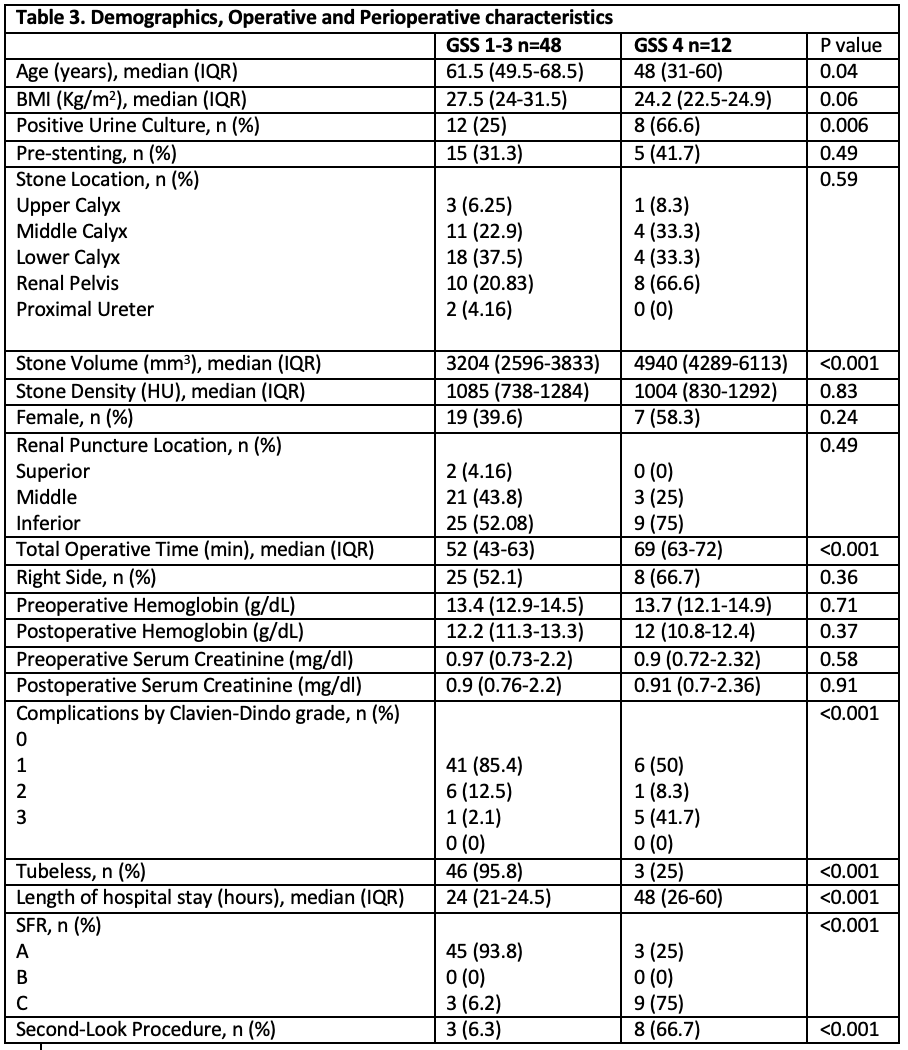
We found that patients in the group of GSS 4 presented significantly higher postoperative complications. Nevertheless, the overall complication rate was 21.7% and all of them were minor complications (Clavien-Dindo ≤2). No patient required blood transfusions and embolization for renal arteriovenous fistula indicating the safety profile of the combined procedure.
Therefore, is it worth miniaturizing the ECIRS? We should indeed personalize the surgical approach in each patient according to the demographics, the anatomy, and the stone characteristics. However, if miniaturizing the procedure allows us to significantly reduce major complications, is it worth performing a second-look procedure for complex kidney stones (GSS 4) treatment? Larger and randomized studies are required to confirm these favorable outcomes.
In conclusion, mini-ECIRS is a safe and effective procedure for the treatment of complex kidney stones. Patients with GSS 4 are more likely to need a second look procedure and present a higher probability of postoperative complications.
Written by: Luis Rico, Leandro Blas, Javier Pizzarello, Lorena Banda, and Pablo Contreras
Hospital Aleman de Buenos Aires, Buenos Aires, Argentina.
References:
- Lim EJ, Osther PJ, Valdivia Uría JG, Ibarluzea JG, Cracco CM, Scoffone CM, Gauhar V. Personalized stone approach: can endoscopic combined intrarenal surgery pave the way to tailored management of urolithiasis? Minerva Urol Nephrol. 2021
- Giusti G, Piccinelli A, Taverna G, Benetti A, Pasini L, Corinti M, Teppa A, Zandegiacomo de Zorzi S, Graziotti P. Miniperc? No, thank you! Eur Urol. 2007 Mar;51(3):810-4; discussion 815. doi: 10.1016/j.eururo.2006.07.047
- Ruhayel Y, Tepeler A, Dabestani S, MacLennan S, Petřík A, Sarica K, Seitz C, Skolarikos A, Straub M, Türk C, Yuan Y, Knoll T (2017) Tract sizes in miniaturized percutaneous nephrolithotomy: A systematic review from the European Association of Urology Urolithiasis Guidelines Panel. Eur Urol 72:220–235. doi.org/10.1016/j.eurur o.2017.01.046
- Scoffone CM, Cracco CM, Cossu M, et al. Endoscopic combined intrarenal surgery in Galdakao-modified supine Valdivia position: a new standard for percutaneous nephrolithotomy? Eur Urol 2008; 54:1393–1403.
- Usui K, Komeya M, Taguri M, et al. Minimally invasive versus standard endoscopic combined intrarenal surgery for renal stones: a retrospective pilot study analysis. Int Urol Nephrol 2020; 52:1219–1225.