

In a retrospective analysis published in the World Journal of Urology (2025), Rein et al. examined 84 patients who underwent MiLEP with slim or ultra-slim HoLEP instruments. This study represents the first comparative clinical evaluation in which the ultra-slim technique was used in a standardised setting.
Despite smaller prostate volumes in the ultra-slim group (median 45 ml versus 65 ml in the slim group), enucleation weights and total operating times were comparable. This can be explained by the fact that most prostates in the Slim HoLEP group were in the 50–70 ml range, which contributed to the similarity in enucleation weights and operating times. Both groups showed high efficiency, with no cases of urethral strictures at the three-month follow-up.
Importantly, functional outcomes such as maximum urinary flow rate (Qmax) and residual urine volume (PVR) improved significantly in both cohorts after surgery. The ultra-slim group showed a trend towards higher Qmax (33.4 ml/s vs. 19.2 ml/s) and slightly higher residual PVR (15 ml vs. 0 ml), although these differences were not consistently statistically significant.
The use of miniaturised endoscopes appears to reduce trauma to the urethra and offers a noticeable advantage in terms of postoperative continence and stricture rates – complications that are commonly associated with larger resectoscopes (≥ 26 Fr). It is noteworthy that meatus dilation was required in only 12.9% of cases (9 patients), further supporting the growing recognition that smaller diameter instruments can maintain enucleation performance while minimising side effects.
A major limitation of the study is the short follow-up period (three months) and the lack of validated symptom scores such as IPSS, which limits conclusions about long-term durability. Nevertheless, these initial experiences lay an important foundation for future prospective evaluations.
New instrument development: high-flow sheath for improved visualisation. Building on the success of the miniaturised MiLEP platform, the authors also highlight the recent introduction of a special high-flow shaft system for the 22 Fr platform, which has been available for two months. The new high-flow sheath, which is compatible with the Slim Enucleoscope, improves irrigation performance during enucleation. However, it should be noted that the conventional irrigation system was used in this study.
Conclusion
MiLEP with Slim and Ultra-Slim instruments demonstrates safety and efficacy in the surgical treatment of BPH. With the added benefit of new high-flow system, the technique now addresses previous concerns regarding visualisation while maintaining the advantages of reduced urethral trauma. MiLEP can therefore not only complement conventional HoLEP procedures, but may even be an alternative for certain patient groups, offering urologists a versatile and patient-oriented treatment method in the constantly evolving field of endoscopic prostate surgery.
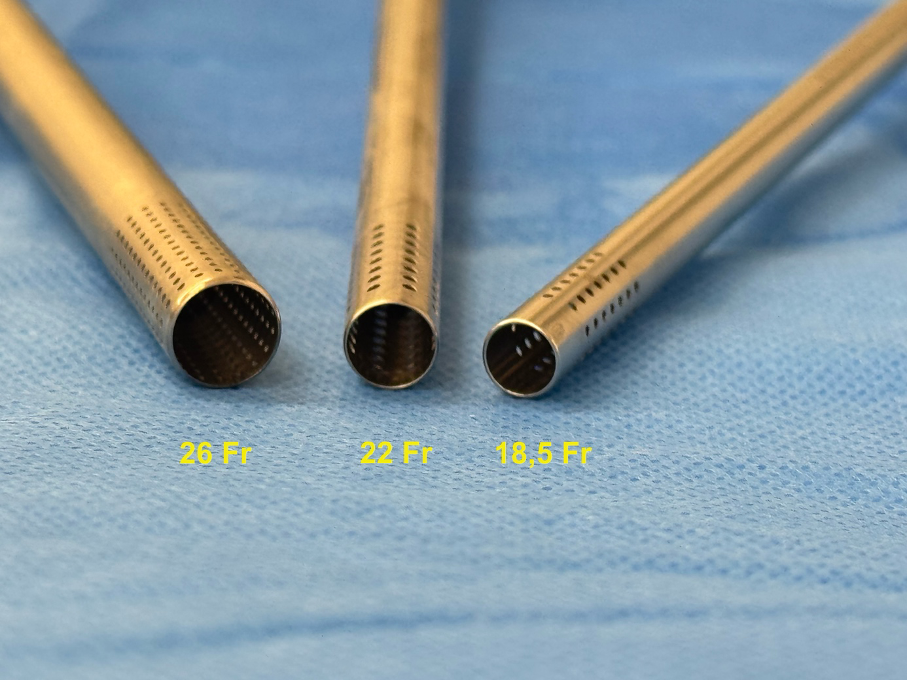
Comparison of system sizes
Picture © by Patrick Rein

Slim HoLEP Enucleoscope
RZ Slim HoLEP Enucleoscope (with permission from RZ Medizintechnik Tuttlingen)

Slim HolEP high flow system
RZ Slim HoLEP Enucleoscope high flow system (with permission from RZ Medizintechnik Tuttlingen)
Written by: Patrick Rein,1-3 Christina Meisl,4,5 Orlando Burkardt,6 Dominik Abt,7
- Praxis für Urologie, Aechelistrasse 4, Heerbrugg, 9435, Switzerland.
- Department of Surgery, HOCH Health Ostschweiz, Cantonal Hospital Grabs, Grabs, Switzerland.
- Department of Urology, HOCH Health Ostschweiz, Cantonal Hospital St. Gallen, St. Gallen, Switzerland.
- Department of Surgery, HOCH Health Ostschweiz, Cantonal Hospital Grabs, Grabs, Switzerland.
- Department of Urology, Charité- Universitätsmedizin Berlin, Berlin, Germany.
- Department of Urology, HOCH Health Ostschweiz, Cantonal Hospital St. Gallen, St. Gallen, Switzerland.
- Department of Urology, Hospital center Biel / Bienne, Biel / Bienne, Switzerland.
- Huang SW, Tsai CY, Tseng CS et al. Comparative efficacy and safety of new surgical treatments for benign prostatic hyperplasia: systematic review and network meta-analysis. BMJ. 2019;367:l5919.
- Alves BB, Gabrich P, Favorito LA. Prospective results of the minimally invasive laser enucleation of the prostate (MiLEP). Prostate. 2024
- de Figueiredo FCA, Teloken PE. Minimally invasive laser enucleation of the prostate (MiLEP): slim (22Ch) and ultra slim (18.5 Ch) HoLEP. Urology Video Journal. 2022;14:100146.
- Chavali JSS, Rivera ME, Lingeman JE. HoLEP Learning Curve-Resident Perspective: Survey of Senior Residents from High-Volume Tertiary Center. J Endourol. 2024;38:977-981.
- Saitta G, Becerra JEA, Del Álamo JF et al. ‘En Bloc’ HoLEP with early apical release in men with benign prostatic hyperplasia. World J Urol. 2019;37:2451-2458.
- Clavien PA, Barkun J, de Oliveira ML et al. The Clavien-Dindo Classification of Surgical Complications. Ann Surg. 2009;250:187-196.
- Elsaqa M, Risinger J, El Tayeb MM. Urethral Complications Post-Holmium Laser Enucleation of the Prostate: A Seven-Year Experience. J Endourol. 2022;36:1575-1579.
- Licari LC, Bologna E, Manfredi C et al. Incidence and management of BPH surgery-related urethral stricture: results from a large U.S. database. Prostate Cancer Prostatic Dis. 2024;27:537-543.
- Ibis MA, Tokatlı Z. Does the use of a small-size resectoscope during enucleation prevent transient urinary leakage and urethral stricture following holmium laser enucleation of the prostate? Low Urin Tract Symptoms. 2021