

To address this gap, we developed and internally validated a machine learning-based predictive model aimed at estimating renal function decline, expressed as the change in estimated glomerular filtration rate (eGFR), at three months following minimally-invasive PN. The algorithm was constructed using a dataset of 556 patients treated between 2015 and 2023. The database incorporated 25 clinical and surgical variables, including comorbidities, nephrometry scores, and key intraoperative strategies: clamping modality (clampless, global, or selective), resection technique (enucleoresection vs. pure enucleation), and renorrhaphy configuration (single- vs. double-layer closure).
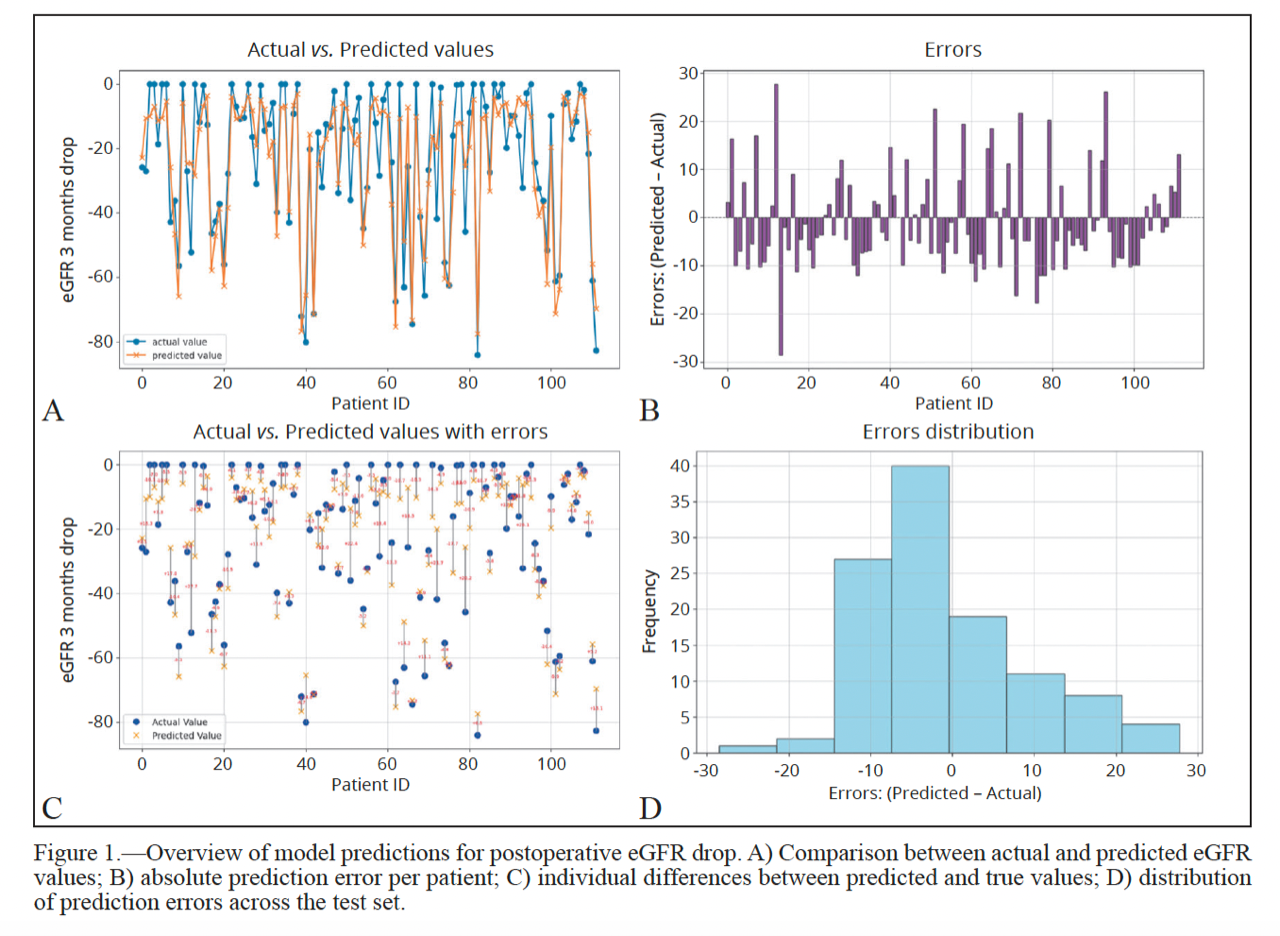
Following data preprocessing and exclusion of low-frequency combinations, the dataset was divided into a training set (n = 444) and a separate test set (n = 112). Among the machine learning algorithms evaluated, a random forest regressor demonstrated the most favorable performance. On the training set, the model achieved a mean absolute error (MAE) of 4.12 mL/min/1.73 m², with 96.9% of predictions falling within ±15 mL/min/1.73 m² of the actual eGFR drop. On the independent test set, the MAE was 8.09, and prediction accuracy remained high at 89.3%. The Pearson correlation coefficient between predicted and observed outcomes in the test set was 0.904 (p < 10⁻⁴²), indicating strong concordance.
A distinctive strength of the model lies in its integration of intraoperative variables, which are often overlooked in traditional predictive tools. By including surgical strategy combinations, each represented by a sufficient number of cases, we were able to quantify their relative impact on postoperative renal function with statistical reliability. This allowed for a nuanced assessment of how specific technical choices, such as clamping strategy or renorrhaphy technique, contribute to functional preservation.
While these results are promising, it is important to acknowledge the current limitations. The model was developed using a single-institution dataset and has not yet undergone external validation. Therefore, it cannot be applied clinically at this stage. Future work must include prospective, multicentric studies to confirm its generalizability and reliability across diverse patient populations and surgical settings.
Nonetheless, the study highlights the potential of artificial intelligence to support clinical decision-making in urologic surgery. Once adequately validated, such models may contribute to personalized surgical planning, enable more precise preoperative counseling, and support the transition from qualitative to quantitative.
Written by: Daniele Amparore,1 Alberto Piana,1 Andrea Simeri,2 Vincenzo Pezzi,3 Michele DI Dio,4 Cristian Fiori,1 Gianluigi Greco,2 Francesco Porpiglia1
- Department of Urology, San Luigi Gonzaga Hospital, University of Turin, Orbassano, Turin, Italy
- Department of Mathematics and Computer Science, University of Calabria, Rende, Cosenza, Italy.
- Department of Pharmacy, Health and Nutritional Sciences, University of Calabria, Rende, Cosenza, Italy.
- Department of Surgery, Division of Urology, SS Annunziata Hospital, Cosenza, Italy.