

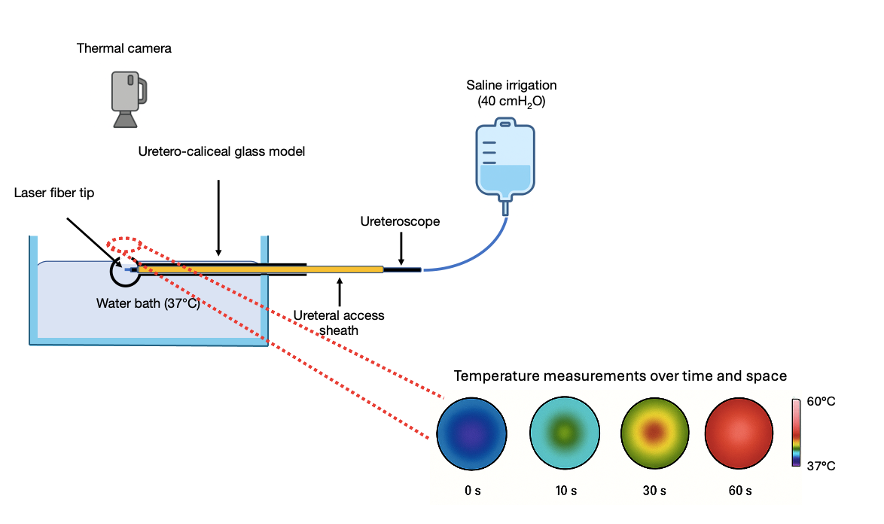
However, tissue injury is not determined solely by a specific temperature threshold. Instead, it depends on both the temperature reached and the duration of exposure - a concept known as thermal dose. This principle, introduced by Sapareto and Dewey to investigate organ damage upon thermal insults, shows that even brief exposure to high temperatures can result in irreversible cell injury. Their model describes this relationship as nonlinear, which emphasizes that an approach based on a fixed temperature value (e.g., avoid exceeding 43°C) may be oversimplistic.
The application of these principles to endourology led us to introduce the thermal safety distance concept. It was defined as the shortest distance from the fiber laser tip to exceed the safety threshold. As a general rule, the closer the laser fiber is to healthy tissue, the higher the local temperature, making available working space a critical factor when planning safe laser settings. Clinically, this translates into different safe power limits for ureteral versus renal procedures, as anatomical constraints and heat dissipation capacity vary by location.
To further complicate matters, several strategies exist to help mitigate excessive intrarenal temperatures. Each offers specific benefits but also presents potential drawbacks:
- Increased irrigation flow – While it can help cool the intrarenal environment, insufficient outflow may lead to elevated intrarenal pressure and associated risks.
- Intermittent laser activation – Reducing the duty cycle, ideally below 50%, limits cumulative heat generation.
- Use of low-power settings – Arguably the most consistent and effective strategy, supported by current evidence and technology, offering a balance between safety and efficacy.
Written by: Felipe Pauchard,1,2,3 Daniele Robesti,4 Eugenio Ventimiglia,1,2,5
- Progressive Endourological Association for Research and Leading Solutions, Paris, France
- European Association of Urology Endourology Section, Arnhem, The Netherlands
- Urology Department, Hospital Naval Almirante Nef, Viña del Mar, Chile
- Vita-Salute San Raffaele University, Milan, Italy
- Department of Surgical Sciences, Uppsala University, Uppsala, Sweden