

- A high rate of positive screening tests and biopsy (32 positive screens and 28 biopsies per 100 men randomized to screening in ERSPC [1])
- In PLCO [2] and ERSPC [1], between 21-50% of screen-detected cancers were over detected and would not have come to clinical attention in the absence of screening
- ProtecT [3] reported that to prevent one case of metastatic disease, the number needed to treat was 27 and 33 with radical prostatectomy and radiotherapy, respectively
- One in 6 men who undergo radical prostatectomy will experience urinary incontinence
- One in 3 men who undergo radiation will experience erectile dysfunction
- Target the population of 50-70 years of age
- Stop screening at low PSAs and later ages
- Increase screening intervals
- More stringent indications for biopsy: re-test, healthy well-informed patients, increase specificity
- High use of active surveillance in low risk patients
- Use of higher volume centers/expertise for care
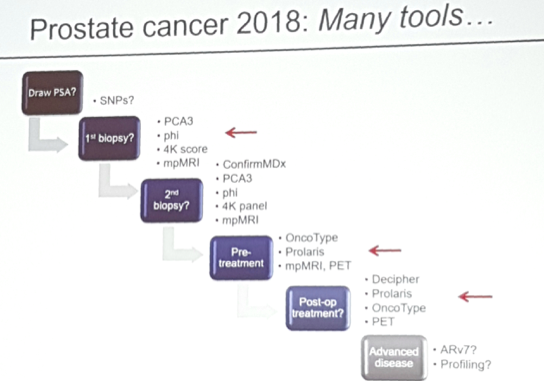
Dr. Carroll notes that detection paradigms are changing, from “detect all, treat all” (no deferred treatment) to “detect all, treat some” (offer surveillance to those with lower risk disease) to “detect some, treat some” (avoid detection of low-risk disease and offer surveillance to those with lower risk disease). The evolution of radical prostatectomy is such that in the past: (i) we treated low risk patients (T1/2, low grade), (ii) over-treatment was common, and (iii) survival benefit was limited. Presently, we have (i) delineated that high-risk patients have the most to benefit, (ii) more technology, biomarkers and imaging, and (iii) a multimodal approach.
Radical prostatectomy is one option for the management of clinically localized prostate cancer, and may be the preferred option for some men with locally extensive disease, according to Dr. Carroll. Radical prostatectomy is still a cost-effective option compared to other treatments, complications and outcomes are reasonably well studied, and surgery has very good/excellent cancer control rates. Dr. Carroll feels that regardless of open or robotic approach, we should have a clear understanding of the anatomy, meticulous technique with clear visualization, magnification, and proper instruments. In his open radical prostatectomy experience, Dr. Carroll’s rectal injury rate is 0.018% (no colostomies), ureteral injury rate is 0.018%, hospital length of stay is 1.8 days, transfusion rate is 1%, blood loss is 400cc and 5-year survival rate is 97%. For high-risk disease, Dr. Carroll feels that radical prostatectomy can be performed even if there is high volume disease, lymph node yield is important, and previous abdominal surgery is not a problem to date. When asked the question where robotic assisted prostatectomy is better than open radical prostatectomy, 10 years ago he would have stated “I don’t know”, but currently he feels that he thinks it probably is better and certainly is no worse.
In a study assessing real-world outcomes of open vs robotic radical prostatectomy [4], of which Dr. Carroll was a co-author, there were 1,892 men (n = 1137 open; n = 755 robotic) included in the analysis. Patients undergoing open prostatectomy had lower CAPRA score, Gleason grade at biopsy and radical prostatectomy, and pT-stage (all p < 0.01). Men undergoing robotic prostatectomy had comparable surgical margin rates, lymph node yields, and biochemical recurrence rates. In a subset analysis of 1451 men reporting baseline and follow-up quality of life data, patients undergoing open prostatectomy reported superior scores in urinary incontinence (open mean ± standard deviation 69 ± 26 vs robotic 62 ± 27) and bother (open 75±29 vs robotic 68±28, both p < 0.01) only in the 1st year after treatment. Differences in sexual outcomes did not differ between groups, neither did any quality of life scores beyond 1 year. Based on this data, Dr. Carroll concluded that patients should not expect different oncologic or quality of life outcomes based on surgical approach.
Dr. Carroll then discussed several different tips and tricks for robotic prostatectomy. In his opinion, nerve preservation for high-risk disease is difficult, but we should attempt what is feasible with the caveat of performing an appropriate oncologic procedure first and foremost. Second, it is crucial to maximize urethral length to assist with continence recovery. Third, there are several devices/adjunct agents available to help us with functional outcome recovery, including nerve monitoring systems and dehydrated amniotic stem cells. However, he cautions that we should test new technology and approaches like clinician scientists.
In conclusion, Dr. Carroll made several important take-home points:
- The ideal candidate for radical therapy today is much different than it was two decades ago
- We should match treatment to the patient and his cancer
- All treatment options require greater scrutiny in terms of their costs and appropriateness
- We must begin collecting and disclosing patient-reported, risk-adjusted outcomes prospectively, across multiple treatment modalities, facilities, and individual providers
- We should test novel therapy appropriately
Presented By: Peter Carroll, UC-San Francisco, San Francisco, CA
Written By: Zachary Klaassen, MD, Urologic Oncology Fellow, University of Toronto, Princess Margaret Cancer Centre, @zklaassen_md ,at the 2018 North American Robotic Urology Symposium, February 16-17, 2018 - Las Vegas, NV
References:
1. Schroder FH, Hugosson J, Roobol MJ, et al. Screening and prostate-cancer mortality in a randomized European study. N Engl J Med 2009;360(13):1320-1328.
2. Andriole GL, Crawford ED, Grubb RL 3rd, et al. Mortality results from a randomized prostate-cancer screening trial. N Engl J Med 2009;360:1310-1319.
3. Hamdy FC, Donovan JL, Lane JA, et al. 10-Year Outcomes after Monitoring, Surgery, or Radiotherapy for Localized Prostate Cancer. N Engl J Med 2016;375(15):1415-1424.
4. Herlemann A, Cowan JE, Carroll PR, et al. Community-based outcomes of open vs robot-assisted radical prostatectomy. Eur Urol 2018;73(2):215-223.