

Methods
The National Cancer Database (NCDB) was queried for patients undergoing radical cystectomy for non-metastatic bladder cancer between 2004 and 2013. A total of 42,850 patients were included in the study. PSM as well as demographic information, clinical stage, neoadjuvant chemotherapy status, surgical approach and treatment facility factors were evaluated. PSM was defined as positive soft tissue or urothelial margins. Logistic regression analysis was used to assess the association between various co-variates and PSM. Multivariate Cox regression analysis was performed to estimate the impact of a PSM on OS.
Results
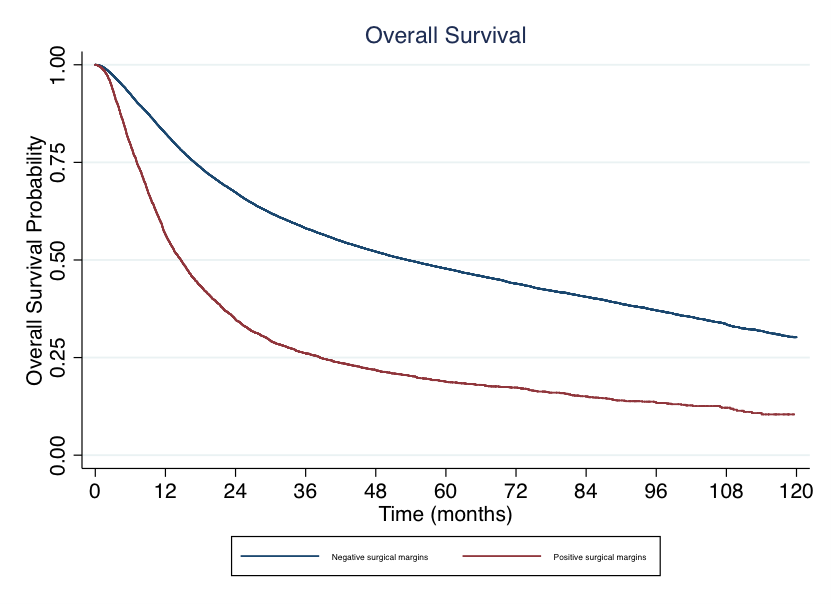
Overall, PSM rate was 11.6%, and more likely to occur with older, female, black race, Latino race patients, and with a Charlson comorbidity score of 2 or above. Additionally, PSM was more likely to occur when lymphovascular invasion, high clinical T stage, clinical node-positive disease, and non-pure urothelial carcinoma were present. Conversely, PSM were less likely to occur in patients who received neoadjuvant chemotherapy, underwent treatment at a high-volume academic center, and underwent RRC (compared to ORC). A PSM was associated with significantly reduced 5-year OS (18.8% vs. 48.8%, p<0.001) (Figure 1).
On multivariable Cox regression analysis, PSM was a significant predictor of OS (HR 2.02, p < 0.001). On the other hand, RRC and treatment at a high volume center were associated with a significantly reduced risk of mortality (HR 0.89, p =0.03 and HR 0.86, p=0.02, respectively). Additional predictors of mortality were Charlson comorbidity score of 2 or above (HR 1.55, p<0.001), and non-pure urothelial carcinoma (HR 1.32, p<0.001).
Conclusions
The authors concluded that their study demonstrates that patients were less likely to have a PSM at radical cystectomy if they were treated at a high-volume or academic center, received eoadjuvant chemotherapy, or had RRC. Patents with a PSM have substantially reduced 5-year OS.
Figure 1 – Overall survival in patients with positive surgical margins vs. negative surgical margins
Presented By: Akbar N. Ashrafi, USC Institute of Urology/Norris Comprehensive Cancer Center, Keck School of Medicine of USC, University of Southern California, USA
Written By: Hanan Goldberg, MD, Urologic Oncology Fellow (SUO), University of Toronto, Princess Margaret Cancer Centre @GoldbergHanan at the 2018 North American Robotic Urology Symposium, February 16-17, 2018 - Las Vegas, NV