

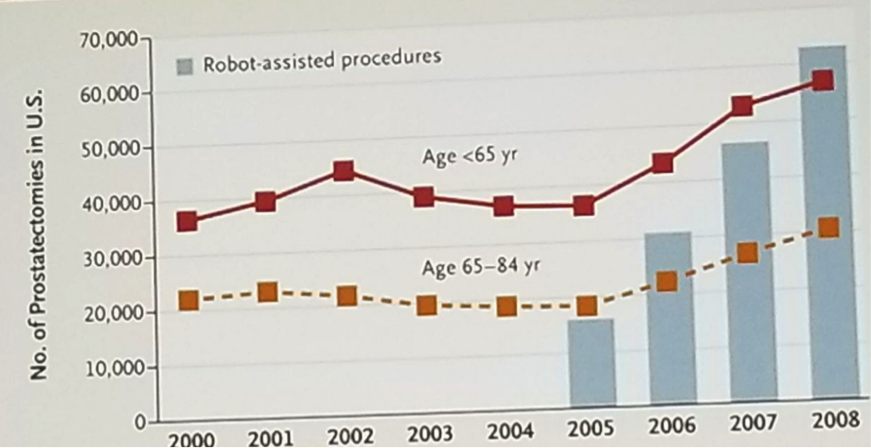
The number of robotic prostatectomies has increased significantly during the last 18 years, as can be seen in figure 1. The number of robotic programs today in the USA is quite astounding (figure 2). Furthermore, the number of Robotic assisted laparoscopic radical prostatectomies (RALRP) done on older men is growing (Figure 3). The acceptance of RALRP is due to a combination of marketing strategy, manufacturers, hospitals, urologists, and outcome analysis. It is important to remember that surgeons feel challenged, and sometime threatened, by the introduction of new technology.
Figure 1: Growing usage of robotic surgery through the years:
Figure 2: Robotic programs in the USA in 2010:
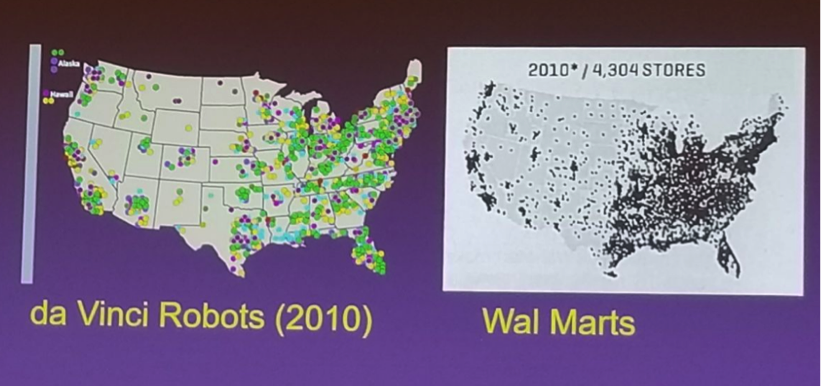
Figure 3: Utilization of robotic surgery on older men through the years:
When looking at large series and comparing open vs. laparoscopic vs. robotic prostatectomies, a clear difference can be seen in blood loss, catheterization times and complication rates. In an outcome analysis of open radical prostatectomy (ORP) it has been shown that the average blood loss is around 965 cc, with a fifth of the patients receiving blood transfusions, and 10.7% having some complication. When looking at large series of laparoscopic radical prostatectomies (LRP), the average blood loss is 291 cc, with 3.5% receiving blood transfusions and a complication rate of 11%. However, examining large robotic series, the average blood loss is 164 cc, with only 1.4% receiving blood transfusions and with a complication rate of 10.3%. Figure 4 summarizes the differences between the different surgical modalities of radical prostatectomies.
Figure 4: Comparison of different surgical modalities of radical prostatectomies:
There is a also a clear advantage in RALRP in regards to positive margins, with a rate of 13.6% compared to a rate of 24.4% and 21.3% in ORP and LRP, respectively. Even when examining the continence and erectile dysfunction rates, there seems to be an advantage to the RALRP. However, a systematic review published in the European Urology journal failed to find sufficient evidence proving the superiority of any of the surgical approaches for functional and oncological outcomes.1
Dr. Thomas concluded his talk by stating that the phenomenon of robotic surgery is here to stay, encompassing more than just the prostate, including surgery in kidney, involving women, children, reconstructive urology, benign conditions, multiple organ impacts, and worldwide acceptance.
Presented By: Raju Thomas, Tulane University School of Medicine, New Orleans, USA
Written By: Hanan Goldberg, MD, Urologic Oncology Fellow (SUO), University of Toronto, Princess Margaret Cancer Centre, @GoldbergHanan, at the 2018 North American Robotic Urology Symposium, February 16-17, 2018 - Las Vegas, NV
Reference:
1.Ficarra V, Novara G, Artibani W, et al. Retropubic, laparoscopic, and robot-assisted radical prostatectomy: a systematic review and cumulative analysis of comparative studies. European urology 2009; 55(5): 1037-63.