

(UroToday.com) The 2025 Western Section AUA annual meeting featured a prostate cancer session and a presentation by Dr. Eric Robinson discussing adoption and outcomes of tissue-based genomic testing for prostate cancer in an integrated health system. Accurately identifying which patients with localized, low-risk prostate cancer can remain on active surveillance is challenging because PSA, Gleason grade, and imaging have limited ability to distinguish tumor biology.
The Decipher genomic classifier (22-gene assay) refines risk stratification by estimating metastatic potential. Understanding the adoption and impact of Decipher for patients undergoing active surveillance has the potential to optimize treatment decisions, personalize patient care, and improve long-term outcomes.
This study was a retrospective review of men aged ≥45 years within Kaiser Permanente Southern California who underwent a Decipher test. Patients with Decipher referrals obtained between January 1, 2023, and May 1, 2024, were identified through electronic health records. Exclusions included prior definitive prostate cancer therapy and incomplete clinical data. Records were examined for transitions from active surveillance to definitive treatment (ie. prostatectomy, radiation) or continued active surveillance over 12 months. This study used descriptive statistics to assess management patterns, with outcomes documented by treatment dates and clinical follow-up.
Of 195 patients who underwent Decipher testing, 135 remained on active surveillance and 60 proceeded to treatment within 12 months. The following figure shows the Decipher risk categories stratified by treatment:

Patients who remained on active surveillance had a lower average Decipher score (0.35 versus 0.56, p < 0.001), higher median PSA (7.1 versus 6.1 ng/mL, p = 0.016), and no significant difference in positive biopsy core count (2.5 versus 2.8). Overall, 27% (21/77) of Grade Group 1 patients were deemed intermediate-high genomic risk, while 50% (46/92) of Grade Group 2 patients were low risk:
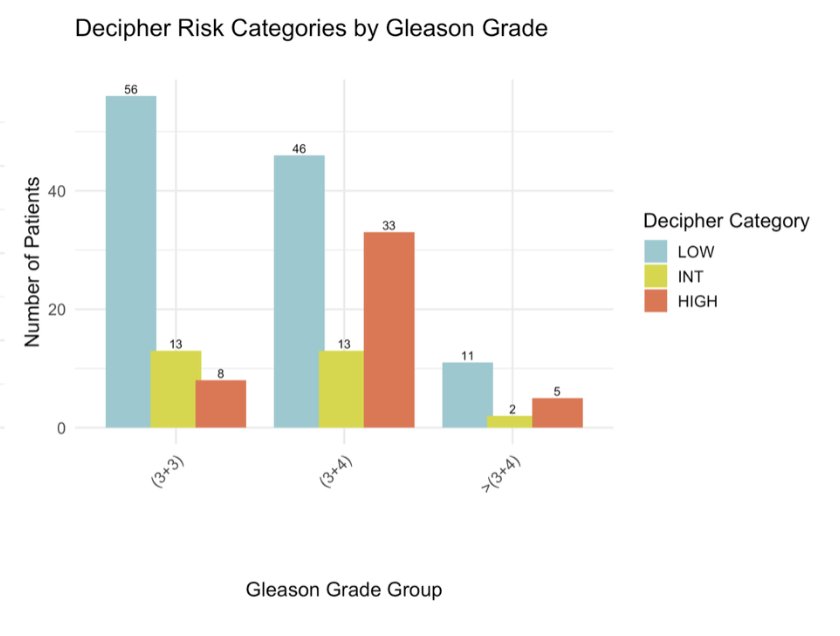
For Grade Group 1 patients, 89% (49/55) underwent active surveillance if low risk, and 66% (14/21) underwent active surveillance if intermediate-high risk. For Grade Group 2 patients, 74% (35/47) underwent active surveillance if low risk, and 43% (21/48) underwent active surveillance if intermediate-high risk.
Dr. Robinson concluded his presentation discussing adoption and outcomes of tissue-based genomic testing for prostate cancer in an integrated health system with the following take-home points:
- Decipher scores influenced patient decisions regarding active surveillance versus treatment, with many intermediate-high risk patients opting for active surveillance
- These findings underscore the multifactorial nature of prostate cancer management and the influence of genomic testing on shared decision making
Presented by: Eric J. Robinson, MD, PGY-4, Kaiser Permanente, Los Angeles, CA
Written by: Zachary Klaassen, MD, MSc – Urologic Oncologist, Associate Professor of Urology, Georgia Cancer Center, Wellstar MCG Health, @zklaassen_md on Twitter during the 2025 Western Section American Urological Association (AUA) Annual Meeting, Napa Valley, CA, Sun, Nov 2 – Thurs, Nov 6, 2025.