

(UroToday.com) Laparoscopic donor nephrectomy has been the gold standard for harvesting kidneys from living donors; however, there is a growing shift towards robotic donor nephrectomy. Even then, robotic donor nephrectomy is seemingly still underutilized which brings to question how robotic donor nephrectomy compares to the laparoscopic gold standard of which medical student, Sonam Saxena, addresses.
A literature review of studies from 2015 and later was conducted using the key terms “robotic donor nephrectomy” and “robotic versus laparoscopic donor nephrectomy” on the PubMed and Scopus databases.
From the literature review, Sonam found that, according to Creta et al., robotic donor nephrectomy was not inferior to the laparoscopic gold standard due to similar operative times and blood loss volumes. From a review by Kiani et al., Sonam established that the robotic approach was superior to a laparoscopic approach in terms of shorter postoperative length of stay (LOS) and less postoperative opioid use. The only drawbacks that Sonam uncovered were longer warm ischemia times and higher 90-day hospital costs according to Hinojosa-Gonzalez et al. and Jeong et al., respectively (Table 1).
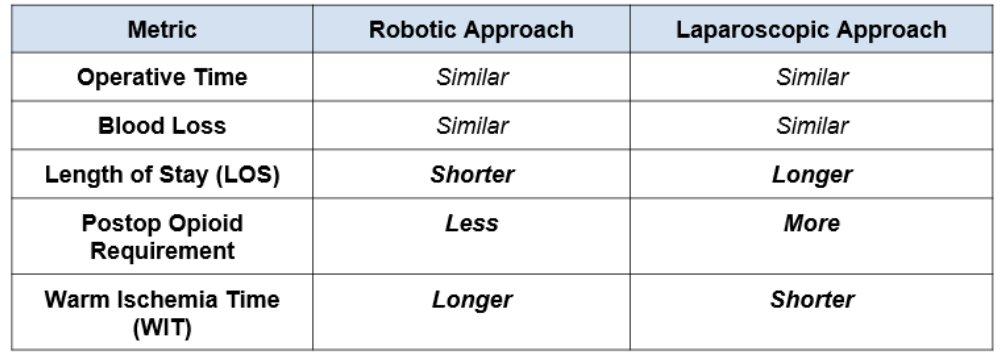
Table 1. Metric comparison between robotic and laparoscopic donor nephrectomy approaches.
Sonam then concludes that while robotic donor nephrectomy confers the benefits of shorter LOS and reduced opioid usage, this approach does have longer warm ischemia time from lack of an extraction port for kidney extraction as well as higher 90-day hospital costs that can be alleviated with increased procedural adoption. Lastly, Sonam adds that at her institution, they have completely converted to robotic donor nephrectomy as a standard approach since January 2025 after performing pure laparoscopic, hand-assisted laparoscopic, and laparoscopic single-site nephrectomies since 2003. Based on their team’s experience, operating time was significantly shorter with the robotic approach, and warm ischemia time was lower with increased robotic experience to overcome the learning curve.
Before wrapping up the presentation, one of the session moderators, Dr. Jennifer Linehan, asked Sonam if she had looked at the vein length as a factor, to which Sonam answered that they had not, as an overwhelming majority of the literature looked at the left side only, with little data to compare laterality. Dr. Linehan further asked Sonam if the warm ischemia time was statistically significant, to which Sonam replied that there was a difference of 1.5 minutes.
Presented by: Sonam Saxena, MS4 Research Fellow, Hackensack University Medical Center, Department of Urology, New Jersey
Written by: Victor Pham, B.S., University of California Irvine, @victorpham01 on X during the 2025 World Congress of Endourology and Uro-Technology (WCET) Annual Meeting: September 8 – September 12, 2025, Phoenix, Arizona