

(UroToday.com) During the Stones Medical Management poster session at the World Congress of Endourology and Uro-Technology, Qiuchen Li, a second-year medical student at Case Western Reserve University School of Medicine, presented a study investigating the impact of GLP-1 receptor agonists (GLP-1As) on nephrolithiasis in patients with obesity. He stated that given the recent increase in use of GLP-1As for weight management, understanding their potential impact on nephrolithiasis is of growing clinical relevance.
Li’s study employed the TriNetX U.S. Collaborative Research Network, which includes data from over 122 million patients. They queried for patients over the age of 18 years diagnosed with obesity, but without diabetes in the recent 20 years (n=255,916). They categorized these patients into those who have and have not had a history of nephrolithiasis, then divided them again into those who have and have not been initiated on GLP-1A treatment (Figure 1).

Figure 1
Their primary outcome was the rate of recurrent stone events in obese patients with a known history of nephrolithiasis who were maintained on GLP-1As compared to those who were not maintained on GLP-1As. They also performed a secondary analysis evaluating the incidence of stone-related events in patients without prior nephrolithiasis. A 1:1 propensity matching was also employed to account for confounders, including demographics, comorbidities, insulin use, and use of other second-line diabetic agents.
Among obese patients with a history of nephrolithiasis, those maintained on GLP-1As had significantly lower stone event rates compared to non-users (28% vs 43.5%, p<0.001), which also remained significant after propensity matching (28.7% vs 32.8%, p<0.001). Similarly, in patients without a prior history of nephrolithiasis, those receiving GLP-1A therapy also had fewer new stone events both before (0.54% vs 1.18%, p<0.001) and after matching (0.50% vs 0.63%, p<0.001) (Table 1).
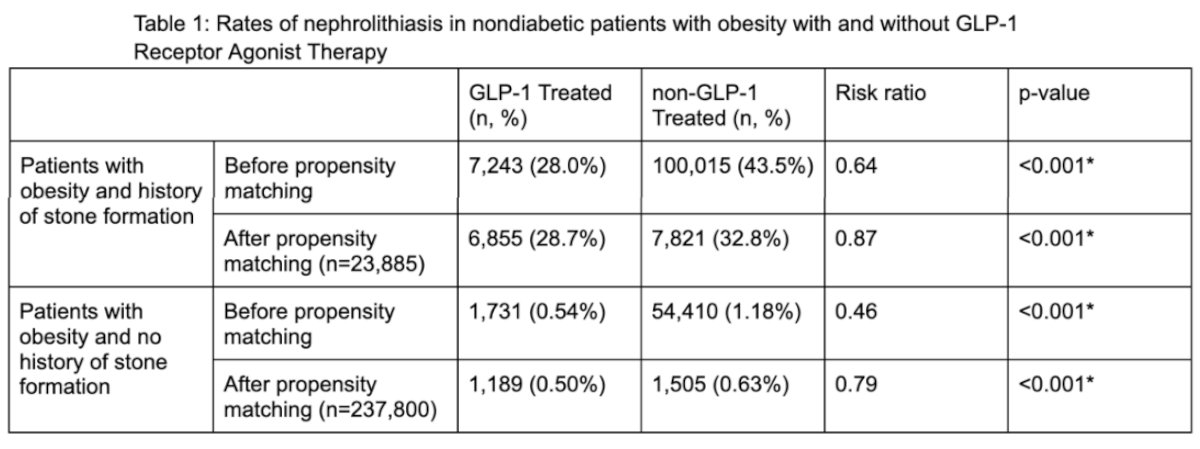
Li states that their findings suggest a consistent, independent association between GLP-1A use and reduced kidney stone risk, regardless of prior stone history. Additionally, Li reiterates that these results appear independent of glycemic control, as their study population excluded type II diabetics entirely.
Li concluded, stating that their results indicate a potential lithoprotective benefit from GLP-1A use in obese, at-risk populations. During the Question and Answers session, a member of the audience asked Li if their findings could be perhaps secondary to GLP-1A’s effects on caloric intake, blood sugar, and weight loss, or if there might be an underlying mechanism through which GLP-1A directly affects stone disease. Li welcomed this question, stating that his group was interested in investigating this same topic and that the next steps of their work will be to better characterize these mechanisms that may be resulting in alterations in urinary biochemistry.
Another member of the audience asked Li how stone events were defined and captured by TriNetX. Li responded, stating they used specific queries when using the TriNetX database, being sure to select patients with a history of stone disease prior to being started on GLP-1A use, then searching for subsequent new stone related events.
One of the moderators of the session, Dr. Sohrab Ali, asked Li if he was aware of how thirst mechanisms, which are also impacted by GLP-1A treatment, could also affect stone risk, especially for patients who may not be obese or diabetic, yet are still maintained on them. Li stated that while these questions are certainly interesting, he is not yet able to provide an answer based solely on the data collected from TriNetX; however, he mentions that perhaps a deeper exploration through chart review-based analysis could provide a clearer answer to this question. A second moderator, Dr. Kristina Penniston, commented that these patients could potentially serve as a control group when analyzing how obesity affects stone risk. Li was quick to agree with and thank her for her suggestion, concluding his presentation.
Presented by: Qiuchen Li, BA, Case Western Reserve University School of Medicine, Cleveland, OH
Written by: Tom No, BA, Department of Urology, University of California Irvine, during the World Congress of Endourology and Uro-Technology (WCET) Annual Meeting, September 8 – September 12, 2025, Phoenix, Arizona.
References:- Taylor EN, Stampfer MJ, Curhan GC. Obesity, Weight Gain, and the Risk of Kidney Stones. JAMA. 2005;293(4):455-462. doi:10.1001/jama.293.4.455
- Zhao K, Shkolnik, B, Lu J, Miller J, Schulsinger D. MP10-05 LITHOPROTECTIVE EFFECT OF GLP-1 AGONISTS IN DIABETIC STONE FORMERS. doi:101097/JU000000000000322505