

The 2025 World Congress of Endourology and Uro-Technology included an Imaging focused session featuring innovative work from Aryan Shah and colleagues at the University of Miami, who presented their study “Empowering Patients Through Augmented Reality: Enhancing Understanding and Confidence in Renal Mass Imaging”. For many patients, interpreting CT scans of renal masses can be confusing and stressful. This study explored whether augmented reality (AR) technology could help patients better understand their anatomy and treatment options by transforming conventional imaging into interactive 3D models.
Figure 1: 3D Visualization of Renal Mass
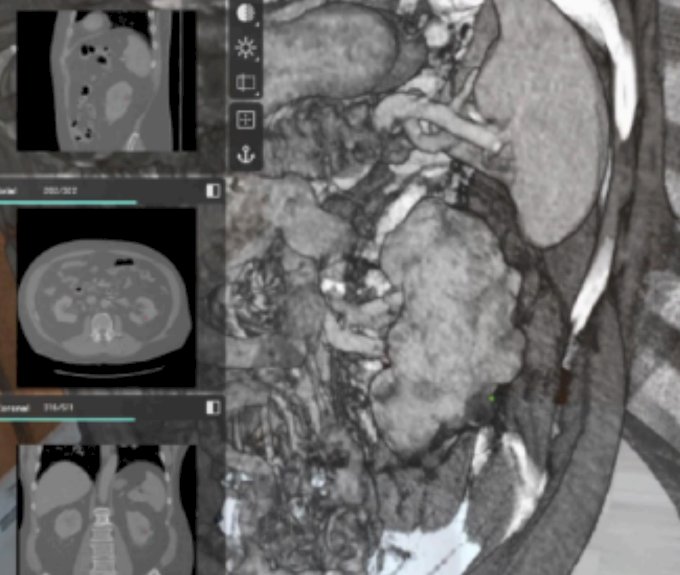
A total of 20 patients with CT-diagnosed renal masses were enrolled during routine care. Using a Microsoft HoloLens–based AR device, patients reviewed their imaging with guidance from trained staff. They completed structured assessments before and after the AR session, which measured comprehension of lesion size, location, and treatment choices, as well as anxiety levels. Pre- and post-intervention responses were compared statistically using the Wilcoxon test.
Figure 2: Patient Reported Scores After Visualization in AR
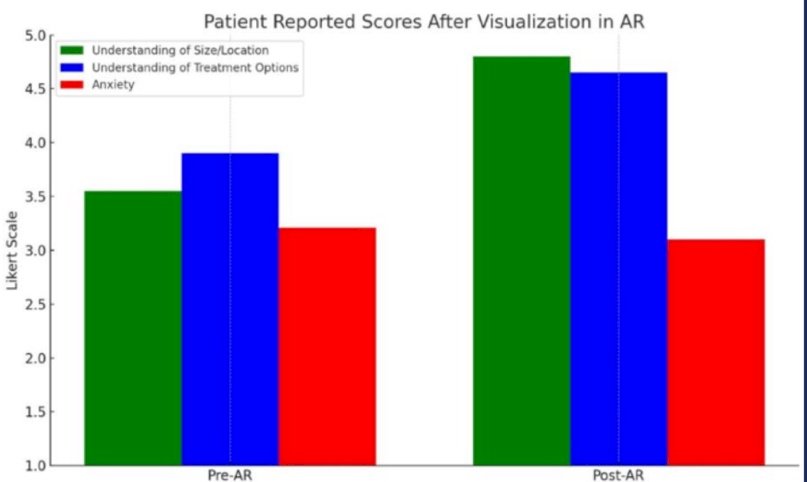
The results demonstrated clear benefits from AR integration. Patients reported feeling significantly more informed after the AR experience, with understanding of lesion size and location improving from an average score of 3.55 to 4.8 (p = 0.0039). Comprehension of treatment options also improved (3.90 to 4.65, p = 0.0430). Importantly, AR did not increase patient anxiety (3.21 pre-AR vs. 3.1 post-AR, p = 0.6289). After the intervention, 84% of patients felt more confident in discussing their diagnosis, and nearly 95% rated the AR experience as satisfying and said they would recommend it to others.
Mr. Shah concluded that AR has significant potential to enhance patient-centered care by making renal imaging more accessible and understandable, while maintaining stable anxiety levels. Future directions include expanding AR applications to prostate mpMRI findings and extending the study to patients with renal stones.
During the discussion, one moderator commented that the 3D visualization, while informative, might appear complicated to some patients and suggested simplifying the interface to further reduce potential anxiety. Another moderator proposed a useful control experiment—showing patients simple schematic drawings of their renal mass for comparison—to determine whether AR truly offers an advantage over more basic visual tools. Audience members also engaged with practical questions: one asked about the time required to process imaging data into a 3D model, to which Mr. Shah responded that the process is rapid, taking only a few minutes. Another asked whether patient demographics, such as education level or baseline medical knowledge, were assessed. Mr. Shah acknowledged that demographics were not assessed in this study but highlighted that incorporating such variables would be an important next step in understanding patient responses.
Presented by: Aryan Shah, Student, Miami, USA
Written by: Kriselle Madamba, Department of Urology, University of California, Irvine, during the 2025 WCET Annual Meeting, September 8-12, 2025, Phoenix, Arizona, USA
References:- Archan Khandekar, Aryan Shah, Timothy Guerard, Pedro Freitas, Elena Cortizas, Adam D. Williams, Zoe Szczotka, Laura AnguloLlanos, Jonathan Katz, Bruno Nahar, Sanoj Punnen, Chad Ritch, Mark Gonzalgo, Dipen J. Parekh. Empowering Patients Through Augmented Reality: Enhancing Understanding and Confidence in Renal Mass Imaging [abstract]. In: World Congress of Endourology and Uro-Technology Annual Meeting, September 8-12, 2025, Phoenix, Arizona