

(UroToday.com) During the World Congress of Endourology and Uro-Technology moderated poster session on imaging, Dr. Jackson Cabo from Mayo Clinic Arizona, presented a study comparing the performance of an artificial intelligence (AI)-facilitated kidney stone volume calculation, a semi-automated (SA) volume calculation, and a linear diameter measurement in predicting stone-free status following evacuation-augmented ureteroscopy.
He stated that, given the increasing clinical emphasis on volumetric outcomes, the need for rapid, accurate, and scalable tools for quantifying stone burden has grown substantially. As such, their study sought to explore if stone volumes can be quickly and reliably calculated using an AI model, and if these metrics can better predict stone-free status compared to conventional linear metrics.
His team retrospectively analyzed 84 CT scans (46 pre-operative, 38 post-operative) from patients undergoing ureteroscopy with suction-assisted evacuation at the Mayo Clinic. They measured linear stone diameters manually, whereas stone volumes were calculated using (1) a semi-automated segmentation tool (QSAS) requiring investigator input, and (2) a Mayo Clinic-developed AI program that calculates stone volumes fully autonomously using QSAS infrastructure. Pearson correlation was used to compare AI volumes to SA volumes across three stone size categories: <10 mm, 10–20 mm, and >20 mm. Additionally, ROC analysis was performed to assess the ability of each pre-op metric—AI volume, SA volume, and cumulative maximal stone diameter—to predict post-operative stone-free status, defined as the absence of residual fragments measuring greater than 4 mm (SFR-4).
Dr. Cabo reported that AI-estimated stone volumes showed a strong correlation with SA-derived volumes (R=0.989; P<0.001), with the strongest agreement between the two methodologies being observed for stones >20 mm (R=0.99). The median volume difference between methods was only 6 mm³, indicating high concordance (Figure 1).
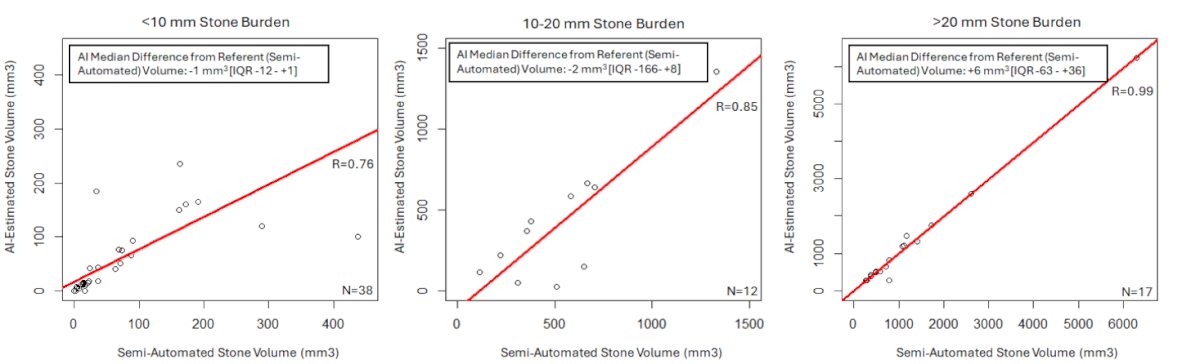
Figure 1
Interestingly, however, in ROC analysis, pre-operative cumulative maximal stone diameter (AUC 0.871) outperformed both AI (AUC 0.776) and SA (AUC 0.751) volumes in predicting SFR-4 outcomes in small stones. However, Dr. Cabo mentions that for larger sized stones, the difference in predictive power was less apparent between all three measurement methods (Figure 2).
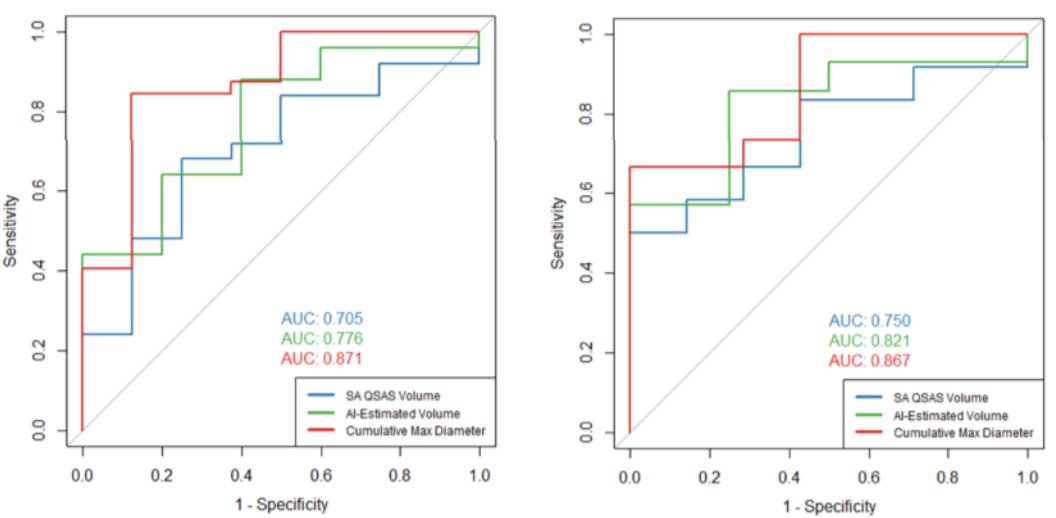
Figure 2
These findings highlight that while AI offers a scalable, efficient, and accurate solution for quantifying stone volume—particularly for larger stones—cumulative diameter remains a better predictor of post-op stone-free status in the context of augmented ureteroscopy. As such, AI-driven tools may be especially valuable for large-scale retrospective studies, multicenter datasets, or clinical trials requiring volumetric analysis, while simple diameter measurements may still hold greater predictive utility in individual patient counseling and operative planning. Dr. Cabo concluded his presentation with the statement that the Mayo Clinic is currently phasing the use of this AI model into its routine CT stone protocols.
During the Question-and-Answer segment, a member of the audience inquired which AI model was used to calculate the volumes reported in the study. Dr. Cabo revealed that the Mayo Clinic worked in collaboration with their AI Core to develop a proprietary model that was trained on a separate dataset and that their study was a means of validating its efficacy. Another member of the audience was interested in learning more about the specific differences between the AI and SA volumetric methods of volume calculation. Dr. Cabo further explained that the SA method requires a clinician to annotate each DICOM file, specifying the kidney as a region of interest, then running a calculation that will then count the number of stones present in the ROI and their individual volumes. The AI method, on the other hand, does not require any clinician input, allowing for a much more time-efficient and equally effective approach to calculating volumetric stone burden.
Presented by: Jackson Cabo, MD, Mayo Clinic, Arizona
Written by: Tom No, BA, Department of Urology, University of California, Irvine, World Congress of Endourology and Uro-Technology (WCET) Annual Meeting, September 8 – September 12, 2025, Phoenix, Arizona.
References:- Chiou T, Meagher MF, Berger JH, Chen TT, Sur RL, Bechis SK. Software-Estimated Stone Volume Is Better Predictor of Spontaneous Passage for Acute Nephrolithiasis. J Endourol. 2023 Jan;37(1):85-92. doi: 10.1089/end.2022.0475. Epub 2022 Dec 7. PMID: 36106604; PMCID: PMC10024069.
- Jain R, Maskal S, Milk J, Kahn L, Fedrigon D 3rd, Sivalingam S. Utility of stone volume estimated by software algorithm in predicting success of medical expulsive therapy. Can Urol Assoc J. 2021 Mar;15(3):E144- E147. doi: 10.5489/cuaj.6491. PMID: 32807279; PMCID: PMC7943234.