

(UroToday.com) The 2025 World Congress of Endourology and Uro-Technology kicked off with an oncological session featuring work from Declan Carr and colleagues at Mayo Clinic, who presented their study titled “No Difference in Renal Mass Growth on Immunosuppression.”
With the growing number of patients undergoing solid organ transplantation, many of whom develop incidental or known renal masses, there is increasing uncertainty about whether immunosuppression influences renal mass growth. Patients and providers may question whether active surveillance (AS) is safe in this setting, fearing accelerated tumor growth. This study sought to address that gap by directly comparing renal mass kinetics before versus after the initiation of immunosuppression for solid-organ transplant.
Table 1: Demographics for the groups before and after immunosuppression.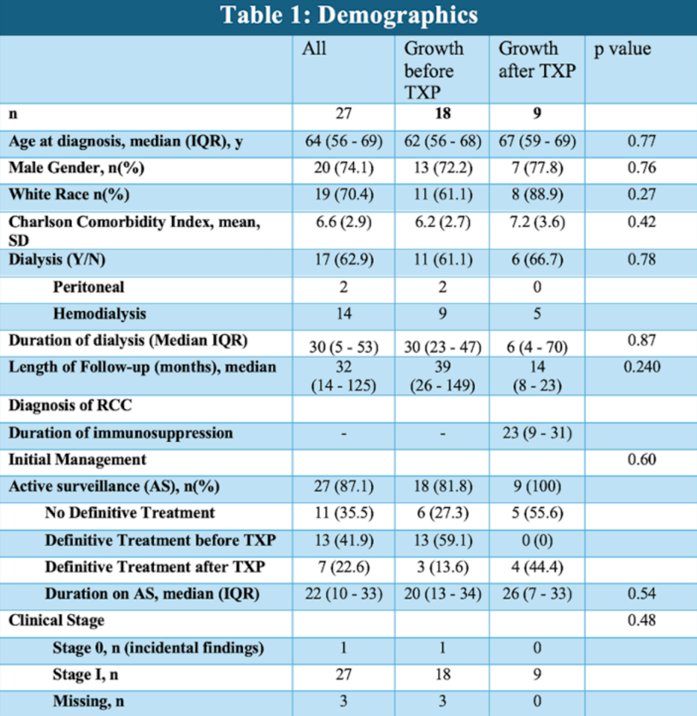
The investigators conducted a retrospective review of solid organ transplant recipients at Mayo Clinic sites since 1992. Eligible patients required at least two imaging scans separated by two or more months to calculate tumor growth rates. Demographics, cancer characteristics, and follow-up outcomes were assessed. A total of 27 patients met criteria, with a median age of 64 years, the majority being male (74%) and White (70%). Median follow-up was 32 months. Of these, 18 patients had growth data prior to transplantation, and 9 had data available only after transplant initiation.
Table 2: Outcomes such as staging, subsequent renal mass, recurrence, progression, mortality and growth rate.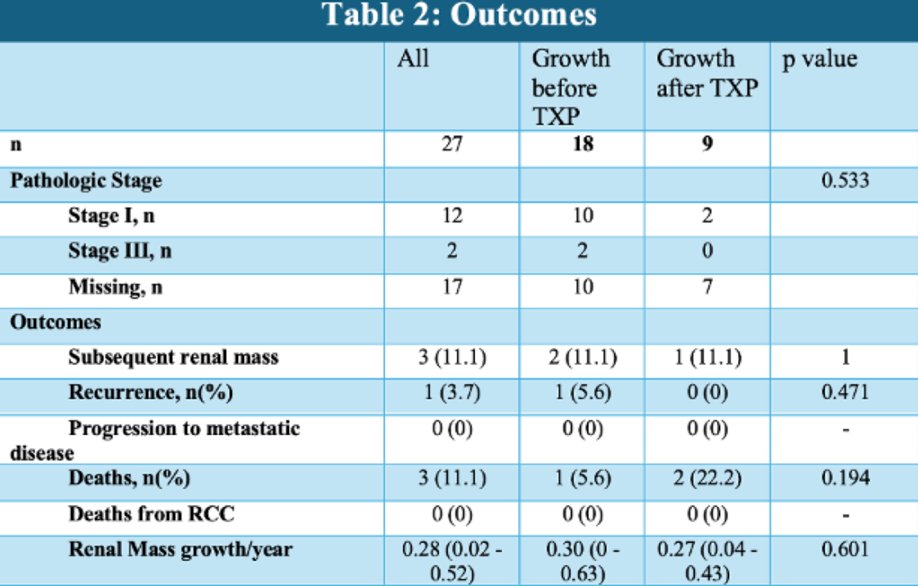
Results demonstrated no significant differences in renal mass growth rates before versus after immunosuppression (0.30 cm/year vs. 0.27 cm/year, p=0.60). Outcomes were similarly reassuring; there was only one recurrence observed pre-transplant, and no cases of metastatic progression or RCC-specific mortality in either cohort. Univariate analysis revealed no clinical or demographic predictors of accelerated tumor growth ≥0.5 cm/year, including age, sex, race, dialysis duration, or duration of immunosuppressive therapy.
To close, Mr. Carr emphasized that these findings lend supportive evidence for the role of active surveillance in immunosuppressed patients with RCC. Rather than assuming immunosuppression inherently increases tumor aggressiveness, clinicians may feel more confident offering surveillance to carefully selected transplant recipients.
During the post-presentation discussion, an audience member asked what types of organ transplants were represented in the study population. The presenter’s colleague clarified that a variety of solid organ transplants at Mayo Clinic were included, except for lung transplants. The moderator added an important perspective, noting that these findings may also be extrapolated to other cancers in the future, supporting the consideration of less aggressive management approaches in selected immunosuppressed patients.
Presented by: Declan Carr, BS, Research Assistant, Mayo Clinic
Written by: Kriselle Madamba, Department of Urology, University of California, Irvine, during the World Congress of Endourology and Uro-Technology (WCET) Annual Meeting, September 8 – September 12, 2025, Phoenix, Arizona.
References:
- Declan Carr, Logan Briggs, Mouneeb Choudry, Umar Ghaffar, JennaKay Colquitt, Jaxson Jeffery, Kainat Warraich, Aneeta Channar, Alex Nica. No Difference in Renal Mass Growth on Immunosuppression [abstract]. In: World Congress of Endourology and Uro-Technology Annual Meeting, September 8-12, 2025, Phoenix, Arizona