

(UroToday.com) The 2022 WCET annual meeting included a clinical stones: equipment and medical management session featuring work from Rohit Bhatt and colleagues presenting the outcomes of a study evaluating long-term resonance stent placement. In the majority of cases, a resonance stent is used by clinicians to relieve patients of chronic obstruction due to malignancy. A malignant ureteral obstruction compresses the ureter externally and stenting is usually required to preserve renal function. The same metallic resonance stent is sometimes used for benign ureteral obstruction. The focus of the researchers’ study was to test the manufacturer’s specifications and to evaluate how these stents perform longitudinally in patients with benign ureteral obstructions.
In this retrospective study, Rohit and colleagues investigated 43 patients from 2010 – 2020 with benign ureteral obstruction that had a resonance stent placed. Renal function was the primary outcome measured after stent placement, and metrics such as serum creatinine, GFR, renal scans, and renal parenchymal volume were used to identify renal function before and after chronic stent placement. Parenchymal volume was identified using CT-scans and a 3D-rendering software, 3D SlicerTM. Stent placement characteristics such as number of exchanges, presence or lack of encrustation, and average indwelling time were also monitored.
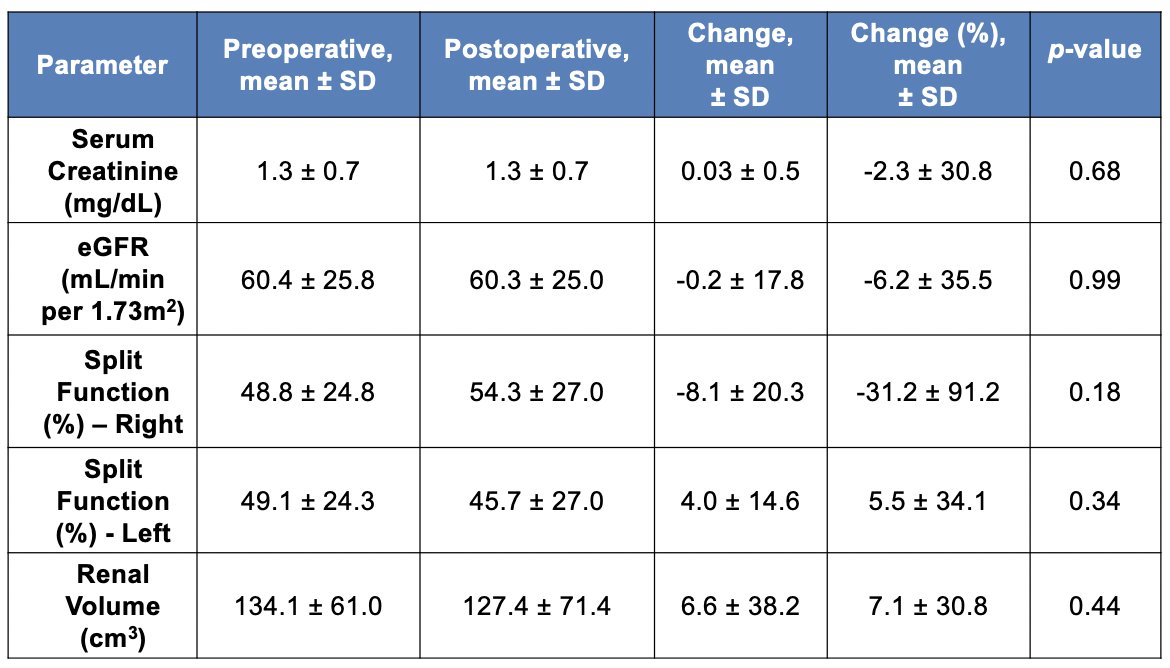
In the 43 patients studied, the team found no changes in GFR or parenchymal volume after 26 months of stent placement. The mean indwelling time of stent placement was 9.7 months across the population studied. 11 patients had their stent replaced or removed within 6 months of placement due to obstruction, colic, or the decision to pursue surgery. 9 of the 47 patients had encrustation of their stents at the time of replacement or removal, and 4 of them required laser lithotripsy as treatment for this.
The patient outcomes showing no changes in renal function, parenchymal volume, or split renal function are displayed below:
Rohit Bhatt concluded his presentation with the following statements:
- Resonance stent deployment for benign ureteral obstruction preserves renal function and parenchymal volume at a mean follow-up of 2 years.
- Only 28% of patients fulfilled the one-year criterion for stent duration.
- To avoid significant encrustation, we recommend stent exchange at 1 year.
Presented by: Rohit Bhatt, MD, Department of Urology – University of California, Irvine
Written by: Allen Rojhani, BS - MD Candidate at the Drexel University College of Medicine and 2022-2023 LIFT Research Fellow at the University of California, Irvine Department of Urology during the 39th World Congress of Endo urology and Uro-Technology (WCET), Oct 1 - 4, 2022, San Diego, California.