

(UroToday.com) The 2026 USPCC annual meeting featured a treatment of metastatic androgen pathway modulation-resistant (APMR) prostate cancer session and a point-counterpoint presentation by Dr. Heather Cheng discussing that in the new APMR after prior androgen receptor pathway inhibitor (ARPI) and docetaxel therapy, isolated foci of neuroendocrine histology do not warrant treatment with taxane + carboplatin therapy. Dr. Cheng emphasized that the existing literature evaluating carboplatin-containing regimens has largely focused on patients meeting clinical criteria for aggressive variant prostate cancer rather than those with isolated focal neuroendocrine differentiation.
She also discussed the recently proposed Haffner framework for structured reporting of metastatic prostate cancer histologic subtypes, noting that while this represents an important advance for pathology standardization, histologic classification alone captures only one component of the overall clinical picture. Consequently, focal neuroendocrine differentiation should not automatically trigger platinum-based treatment without additional supporting evidence.
The presentation then reviewed the landmark prospective studies establishing the clinical concept of aggressive variant prostate cancer. Dr. Cheng first summarized the phase II study by Aparicio et al.1-2 evaluating carboplatin + docetaxel followed by cisplatin and etoposide in patients meeting predefined advanced variant prostate cancer criteria. These clinical criteria include:
- Histologic small-cell carcinoma
- Predominant visceral metastases
- Bulky or high-grade primary tumors
- Low PSA relative to disease burden
- Rapid development of androgen receptor independence within six months of ADT
- Presence of neuroendocrine markers such as neuron-specific enolase or synaptophysin in tissue or elevated serum lactate dehydrogenase or carcinoembryonic antigen
Among available tumor samples, 29 of 51 demonstrated positive neuron-specific enolase or synaptophysin staining. Subsequent molecular analyses further demonstrated that many tumors harbored combined alterations involving TP53, RB1, and PTEN, leading to development of the aggressive variant molecular signature. Patients with the neuroendocrine signature had worse survival outcomes:
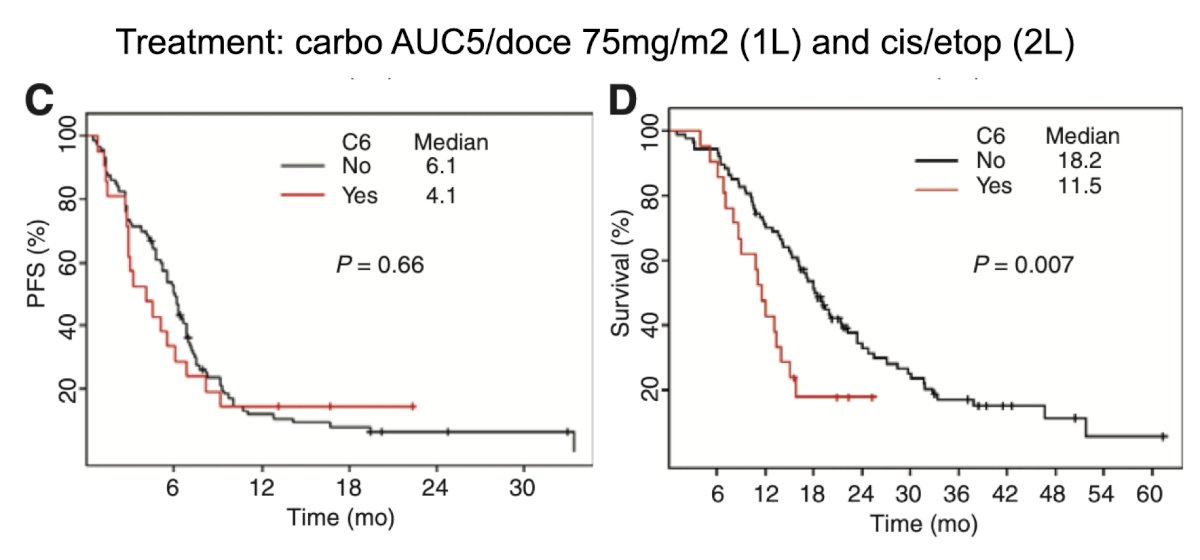
Dr. Cheng emphasized that neuroendocrine differentiation represents only one element within a much broader constellation of aggressive clinical and molecular features.
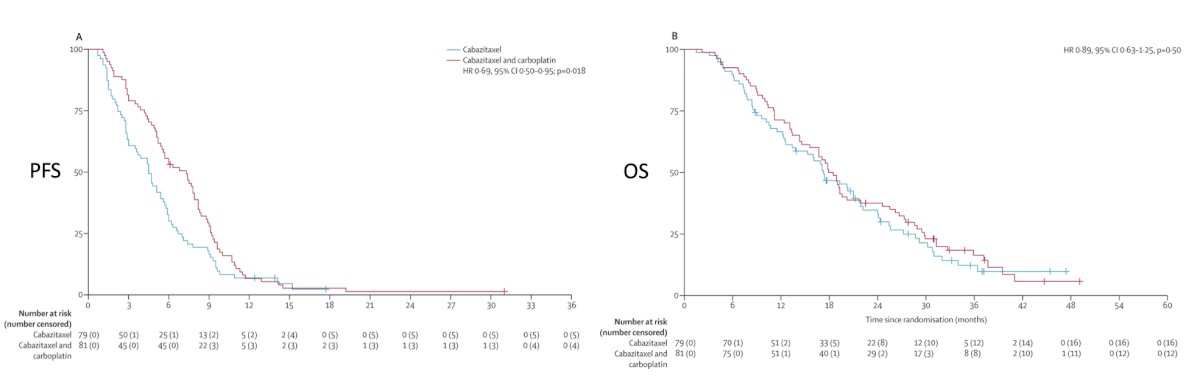
In 2019, Corn et al.3 reported a randomized phase I/II trial comparing cabazitaxel with or without carboplatin in metastatic APMR. Importantly, eligibility was based upon aggressive variant clinical criteria rather than isolated neuroendocrine staining. These criteria included histologic small-cell carcinoma, exclusive visceral metastases, predominantly lytic bone metastases, bulky lymphadenopathy or bulky high-grade primary tumors, low PSA despite extensive osseous disease, elevated lactate dehydrogenase or carcinoembryonic antigen, and rapid progression to castration-resistant disease. Notably, neuroendocrine immunohistochemistry was not itself a required criterion. In this trial, the addition of carboplatin resulted in improved progression-free survival compared with cabazitaxel alone (HR 0.69, 95% CI 0.50-0.95). Although there was no overall survival benefit (HR 0.89, 95% CI 0.63-1.25), there is support for platinum intensification in biologically aggressive disease:
One key trial in progress is the ongoing phase III SWOG 2312 CARAVAN trial, which is designed to answer many of these unanswered questions prospectively. This study randomizes patients with metastatic APMR to cabazitaxel with or without carboplatin after stratification according to the aggressive variant molecular signature. Immunohistochemical assessment of TP53, RB1, and PTEN forms the basis for biomarker evaluation, representing a more biologically driven approach than relying upon focal neuroendocrine staining alone.
Dr. Cheng discussed standardized immunohistochemical definitions of biomarker positivity,4 emphasizing that androgen receptor-positive tumors may demonstrate either androgen receptor or NKX3.1 reactivity, whereas neuroendocrine-positive tumors require synaptophysin or INSM1 staining involving at least 20% of tumor cells with a staining intensity of at least 1+. These standardized Haffner criteria help distinguish clinically meaningful neuroendocrine differentiation from isolated focal staining:
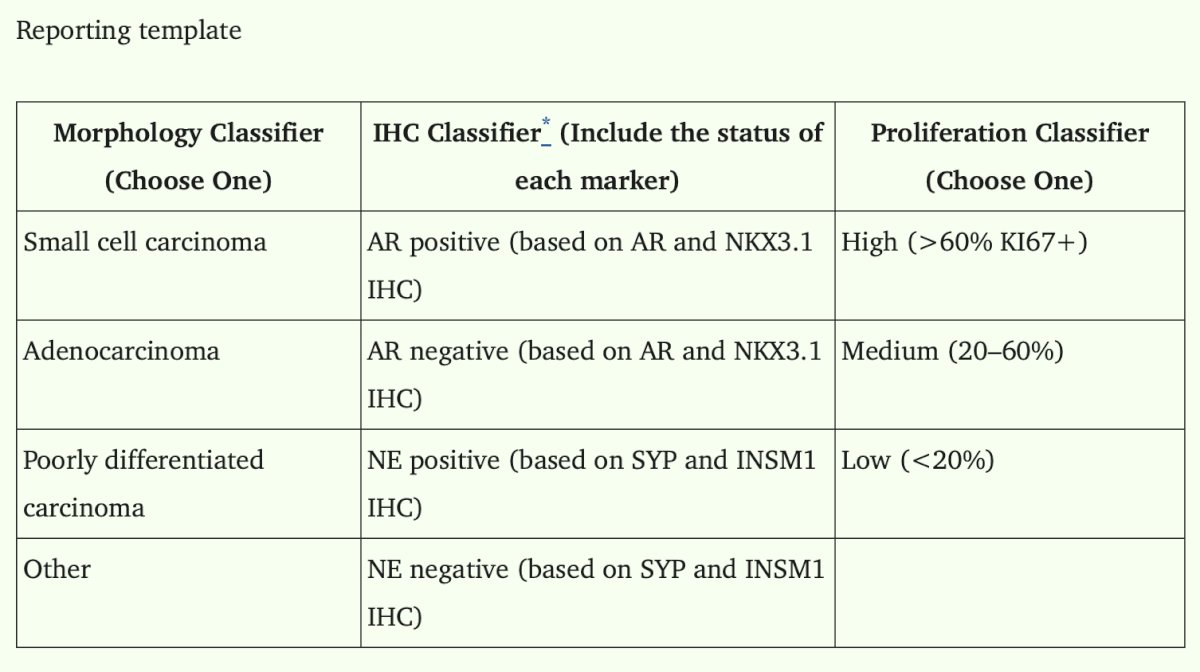
Dr. Cheng emphasized that focal neuroendocrine staining should not be equated with aggressive variant prostate cancer biology. In routine pathology practice, focal neuroendocrine differentiation generally refers to tiny clusters measuring approximately 1–2 mm or involving no more than 5% of a single biopsy core. In contrast, true aggressive variant prostate cancer is defined by the integration of clinical behavior, histo-morphology, immunohistochemistry, and genomic alterations. Over-calling focal neuroendocrine differentiation risks overtreatment while potentially diverting patients away from other highly effective therapies.
Dr. Cheng then proposed a practical framework for evaluating patients with focal neuroendocrine differentiation. Rather than immediately selecting taxane-platinum chemotherapy, clinicians should first determine whether the patient demonstrates rapidly progressive disease, early development of castration resistance, disproportionately low PSA relative to tumor burden, liver metastases, or genomic alterations involving TP53, RB1, and PTEN. These additional features collectively increase the likelihood that focal neuroendocrine differentiation truly reflects aggressive variant biology rather than incidental histologic findings.
An additional consideration involves treatment opportunity cost. Patients with metastatic APMR lacking true aggressive variant features remain eligible for numerous highly active therapies, including 177Lu-PSMA-617, docetaxel, cabazitaxel, radium-223, and other systemic treatments. Introducing platinum-containing chemotherapy prematurely may expose patients to greater toxicity, while delaying access to alternative therapies that may offer equal or greater clinical benefit. She noted that platinum-containing regimens remain clearly justified for patients with small-cell prostate cancer, aggressive variant prostate cancer, or homologous recombination repair deficiency involving BRCA2, BRCA1, or PALB2. However, these regimens are also associated with increased alopecia, myelosuppression, and fatigue compared with standard taxane therapy.
Dr. Cheng concluded her presentation by discussing that in the new APMR after prior ARPI and docetaxel therapy, isolated foci of neuroendocrine histology do not warrant treatment with taxane + carboplatin therapy, with the following take-home points:
- Taxane + carboplatin has a role in aggressive variant prostate cancer, and biomarker refinement is being actively studied prospectively – we should strongly consider enrolling our patients to the phase 3 SWOG 2312 trial
- The Haffner framework is important for pathology standardization (with parallels to our PSMA discussion), but is just one piece
- Focal neuroendocrine differentiation is not independently sufficient to justify added toxicity if there is uncertain benefit due to availability of other treatment options
Presented by: Heather Cheng, MD, PhD, Director, Prostate Cancer Genetics Clinic, Fred Hutchinson Cancer Center, Seattle, WA
Written by: Zachary Klaassen, MD, MSc – Urologic Oncologist, Associate Professor of Urology, Georgia Cancer Center, Wellstar MCG Health, @zklaassen_md on Twitter during the United States Prostate Cancer Consensus (USPCC) 2026 Annual Meeting, Deer Valley, UT, Thurs, July 30 – Sat, Aug 1, 2026.
References:
- Aparicio AM, Harzstark AL, Corn PG, et al. Platinum-based chemotherapy for variant castrate-resistant prostate cancer. Clin Cancer Res. 2013 Jul 1;19(13):3621-3630.
- Aparicio AM, Shen L, Tapia ELN, et al. Combined tumor suppressor defects characterize clinically defined aggressive variant prostate cancers. Clin Cancer Res. 2016 Mar 15;22(6):1520-1530.
- Corn PG, Heath EI, Zurita A, et al. Cabazitaxel plus carboplatin for the treatment of men with metastatic castration-resistant prostate cancers: A randomized, open-label, phase 1-2 trial. Lancet Oncol. 2019 Oct;20(10):1432-1443.
- Haffner MC, Morris MJ, Ding CKC, et al. Framework for the pathology workup of metastatic castration-resistant prostate cancer biopsies. Clin Cancer Res. 2025 Feb 3;31(3):466-478.