

(UroToday.com) The 2025 Society of Urologic Oncology (SUO) annual meeting held in Phoenix between December 2 and December 5, 2025, was host to the Poster Session. Dr. Rana McKay presented poster #174: IDeate-Prostate01: A phase 3, randomized, open-label study of ifinatamab deruxtecan versus docetaxel in participants with previously treated metastatic castration-resistant prostate cancer (mCRPC).
Dr. McKay began by outlining the current treatment landscape for metastatic castration-resistant prostate cancer, which includes androgen deprivation therapy combined with androgen receptor pathway inhibitors, taxanes, radiopharmaceuticals, and targeted agents. Despite these available therapies, progression remains inevitable for most patients, underscoring the need for novel approaches that provide deeper and more durable disease control.1
One emerging target of interest is B7-H3, a type I transmembrane protein that is highly expressed in prostate cancer and associated with poor prognosis and resistance to standard treatments. Ifinatamab deruxtecan (I-DXd; MK-2400/DS-7300a) is an antibody–drug conjugate directed against B7-H3, incorporating a plasma-stable cleavable linker and a topoisomerase I inhibitor payload (DXd).2 Preclinical studies have shown potent antitumor activity in B7-H3–expressing models, along with favorable pharmacokinetics and safety signals.
Early clinical data from the first-in-human phase 1/2 IDeate-PanTumor01 trial demonstrated encouraging antitumor activity and manageable safety across multiple solid tumors, including heavily pretreated patients with mCRPC. These findings support further development of I-DXd as a potential therapeutic option in this difficult-to-treat population. (3)
IDeate-Prostate01 (NCT06925737) is a global, phase 3, randomized, open-label study evaluating I-DXd versus docetaxel in men with mCRPC. Eligible participants must have histologically or cytologically confirmed mCRPC, documented PSA or radiologic progression, and prior exposure to one or two ARPIs. Approximately 1,440 patients will be randomized 1:1 to I-DXd or docetaxel, as depicted in the study schema below. Randomization is stratified by metastatic pattern (liver vs bone-only vs other), geographic region, B7-H3 expression level, and prior receipt of PSMA-targeted radionuclide therapy.
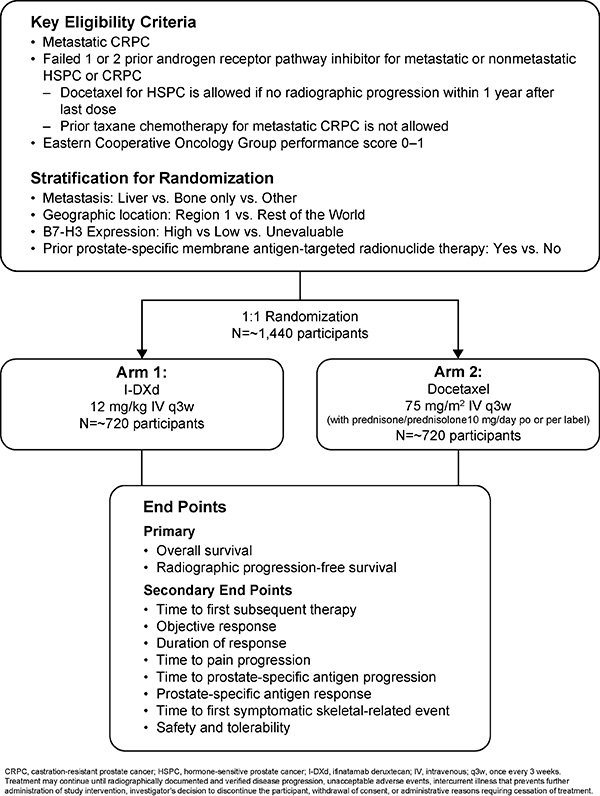
Notably, the trial’s dual primary endpoints are overall survival and radiographic progression-free survival. Secondary endpoints include time to first subsequent therapy, objective response, duration of response, time to pain progression, time to PSA progression, PSA decline, time to first symptomatic skeletal-related event, and safety and tolerability. Dr McKay noted that recruitment is currently ongoing and results are eagerly awaited.
Presented by: Rana McKay, MD, Medical Oncologist, Associate Professor of Medicine, UC San Diego School of Medicine, San Diego, CA
Written by: Julian Chavarriaga, MD, Urologic Oncologist at Penn State Health, @chavarriagaj on Twitter during the 2025 Society of Urologic Oncology (SUO) annual meeting held in Phoenix, AZ, between the 2nd and 5th of December 2025.
References:- Grisay G, Lavaud P, Fizazi K. Current Systemic Therapy in Men with Metastatic Castration-Sensitive Prostate Cancer. Curr Oncol Rep. 2024 May;26(5):488-495. doi: 10.1007/s11912-024-01509-6. Epub 2024 Apr 9. PMID: 38592590.
- A clinical study of ifinatamab deruxtecan (I-DXd) in people with metastatic prostate cancer (MK-2400-001). ClinicalTrials.gov. Accessed December 3rd, 2025.
- Wespiser M, Gille R, Pérol M. Clinical progress of B7-H3 targeted antibody drug conjugate ifinatamab deruxtecan for small-cell lung cancer. Expert Opin Investig Drugs. 2025 Jun;34(6):463-471. doi: 10.1080/13543784.2025.2512566. Epub 2025 May 29. PMID: 40418751.