

(UroToday.com) The 2025 Society of Urologic Oncology (SUO) Annual Meeting was host to a testicular cancer poster session. Dr. Julian Chavarriaga presented the results of a multi-center propensity score matched analysis comparing open versus robotic post-chemotherapy retroperitoneal lymph node dissection (PC-RPLND).
PC-RPLND plays a well-established role in managing residual masses larger than 1 cm for non-seminomatous germ cell tumors (NSGCTs), and, less commonly, for men with seminomas and residual masses larger than 3 cm.1-3
PC-RPLND is technically challenging, with a complication rate of 22% in this setting.1-3 Robotic RPLND has gained popularity for the following potential advantages, compared to open techniques:3,4
- Lower estimated blood loss (EBL)
- Shorter length of stay (LOS)
- Less postoperative pain
- Lower incisional hernia rates
- Faster recovery and superior cosmesis
The objective of this study was to compare the perioperative and survival outcomes of patients undergoing robotic versus open PC-RPLNDs for testicular cancer.
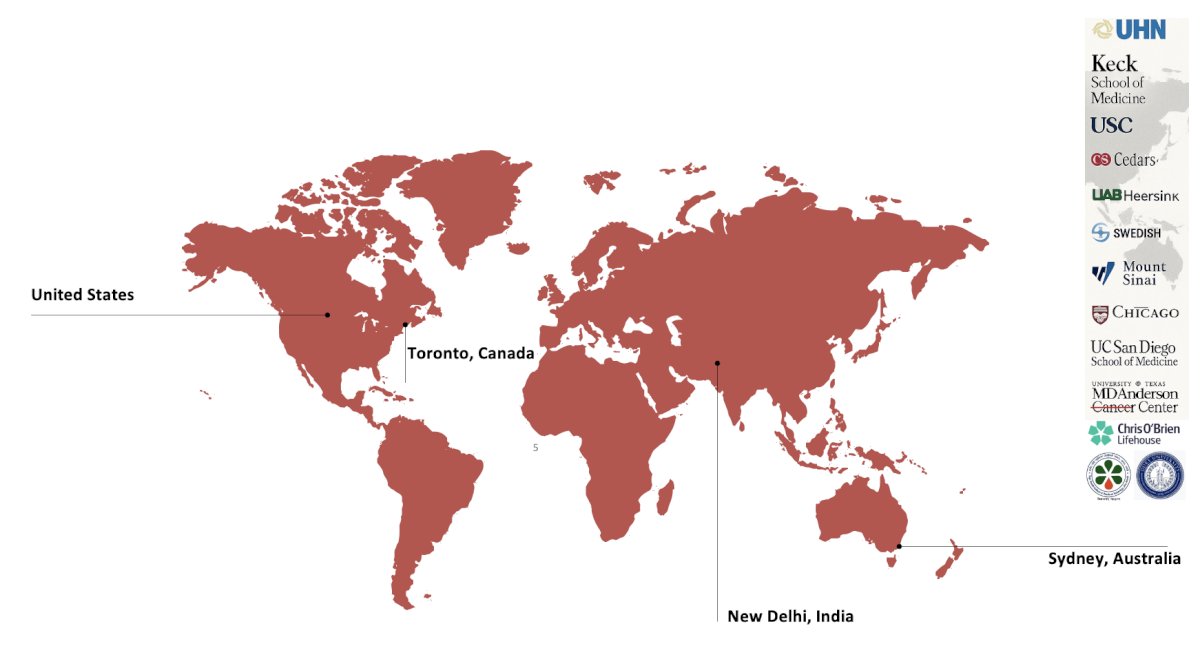
The study cohort included consecutive patients who underwent robotic PC-RPLND at 11 academic centers from the United States (n = 8), Canada (n=1), India (n=1), and Australia (n=1), in addition to patients who underwent an open PC-RPLND at the Princess Margaret Cancer Centre in Toronto, Canada.
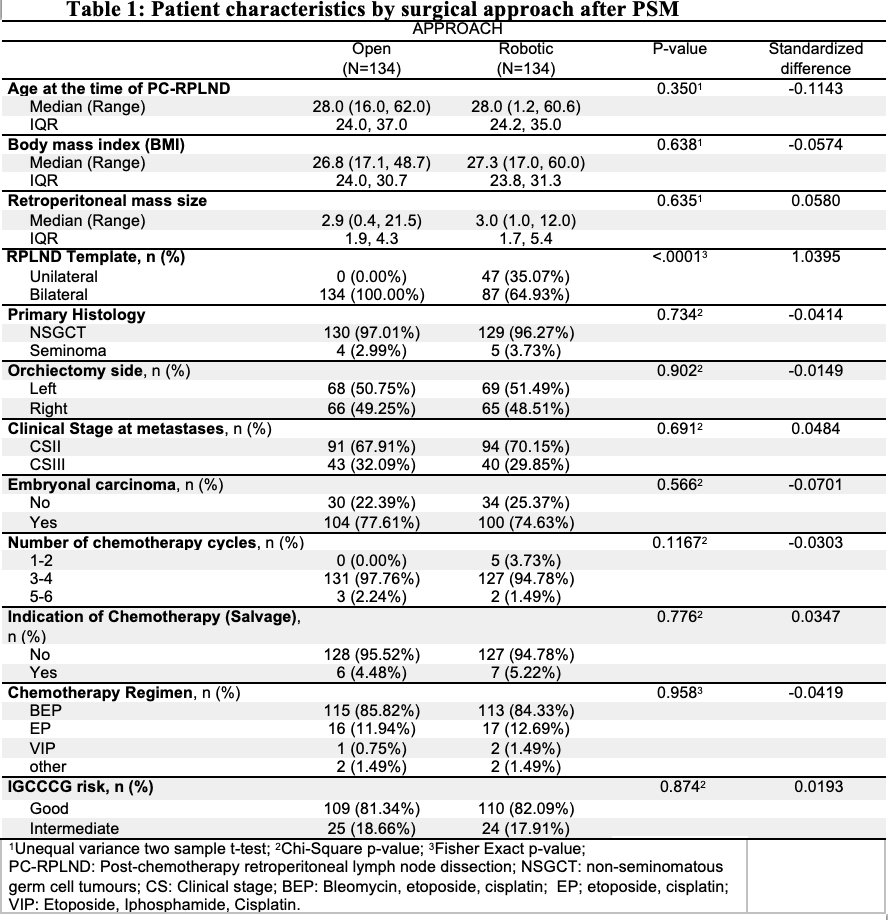
Propensity score matching (1:1), with a caliper width of 0.2, was performed using the following variables: age, BMI, primary orchiectomy histology, orchiectomy side, presence of embryonal carcinoma, clinical stage (CS) at the time of metastases, retroperitoneal mass size, chemotherapy regimen, salvage versus primary chemotherapy indication, and IGCCCG risk group.
The primary endpoint was relapse-free survival (RFS). The secondary endpoints were:
- Operative time
- Length of stay (LOS)
- Estimated blood loss (EBL)
- Surgical complications (Clavien-Dindo classification)
The Student’s t-test and Chi-square or Fisher’s exact tests (as appropriate) were used to compare the statistical significance of differences in averages and proportions. The RFS rates were calculated using the Kaplan-Meier product-limit method, with between-group comparisons performed using the log-rank test.
A total of 594 patients underwent a PC-RPLND. Of these, 426 and 168 underwent open and robotic PC-RPLNDs, respectively. Following propensity score matching, 134 patients were assigned to each group. The median follow-up was 2.2 years (IQR: 0.6–5.5). The baseline patient characteristics following propensity score matching are summarized in the table below. The median retroperitoneal mass size was 3 cm. A bilateral template was performed in all patients in the open group, compared to 65% of robotic PC-RPLNDs. The primary histology was an NSGCT in 97% of cases. The clinical stages were II and III in 70% and 30% of cases, respectively.
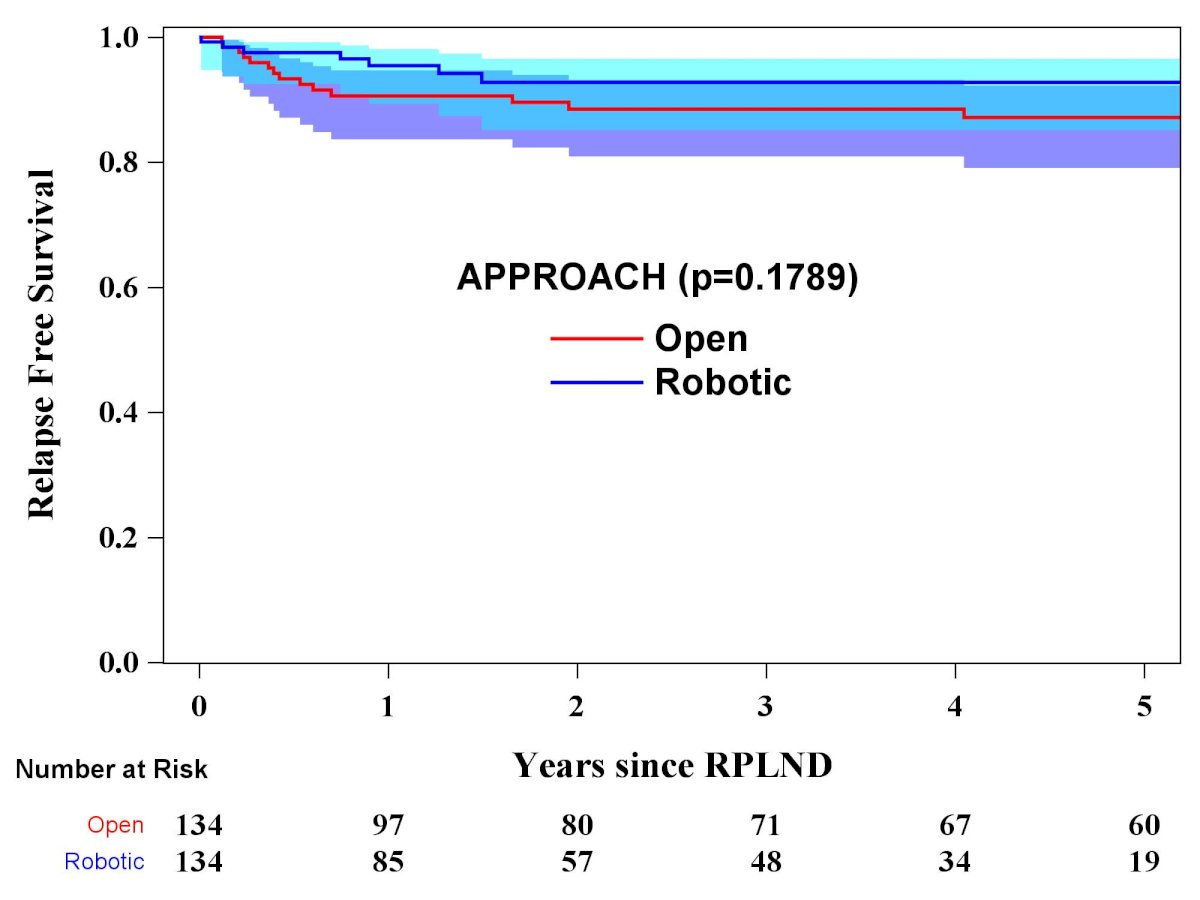
Overall, seven patients (5.2%) in the robotic group experienced a relapse, compared to 17 patients (12.3%) in the open group (log-rank test p-value=0.18). Out-of-field relapses were observed in 58% and 82% of patients in the robotic and open groups, respectively.
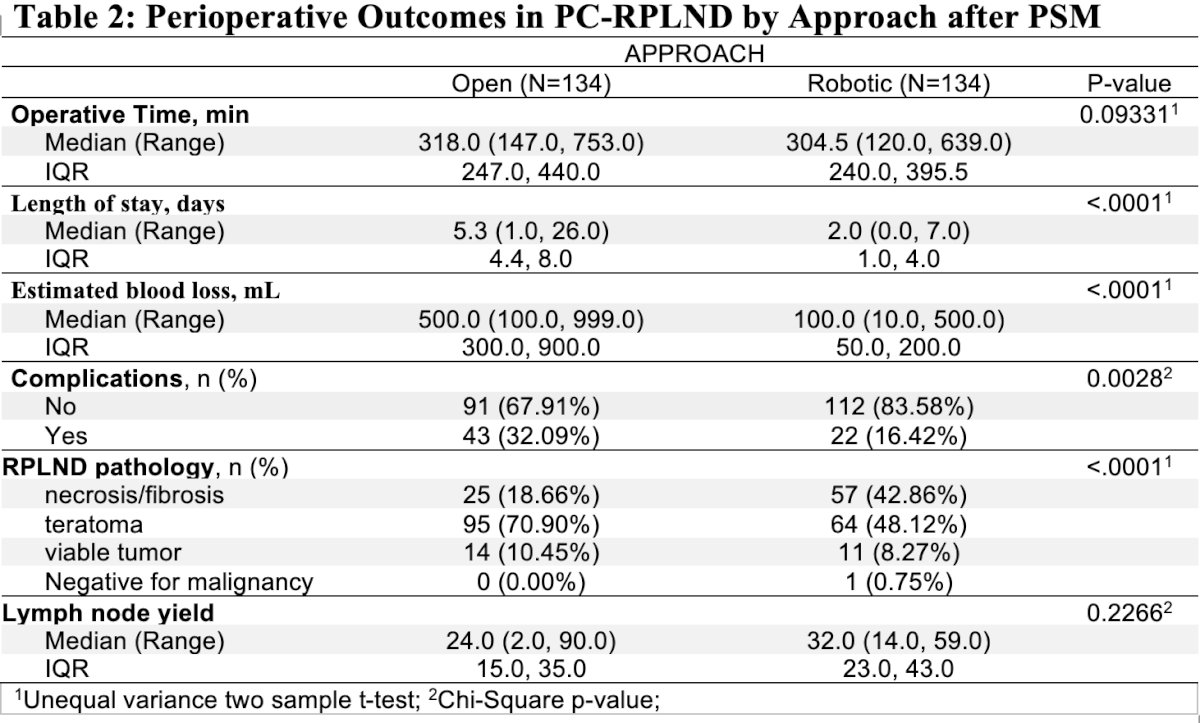
The robotic approach was associated with a lower median EBL (100 versus 500 mL, p<0.0001) and a reduced median hospital LOS (2 versus 5.3 days, p<0.001).
Dr. Chavarriaga concluded as follows:
- This multinational, multi-institutional study, drawing data from 11 academic centers, is the first to compare open and robotic PC-RPLND using propensity score matching
- These findings provide compelling evidence that robotic PC-RPLND is not only a feasible and safe approach but may also confer advantages in select patients.
Presented by: Julian Chavarriaga, MD, Urologic Oncologist at Cancer Treatment and Research Center (CTIC), Bogota, Colombia
Written by: Rashid K. Sayyid, MD, MSc, Assistant Professor, Urologic Oncologist, Department of Urology at The University of Arizona and Banner University Medical Center – Tucson, AZ, @rksayyid on X during the 2025 Society of Urologic Oncology (SUO) Annual Meeting, Phoenix, AZ, December 2nd–5th, 2025
References:- Williams SB, McDermott DW, Winston D, et al. Morbidity of open retroperitoneal lymph node dissection for testicular cancer: Contemporary perioperative data. BJU Int. 2010; 105:918-921.
- Klaassen Z, Hamilton RJ. The role of robotic retroperitoneal lymph node dissection for testis cancer. Urol Clin N Am. 2019; 46:409-417.
- Pearce SM, Golan S, Gorin MA, et al. Safety and early oncologic effectiveness of primary robotic retroperitoneal lymph node dissection for nonseminomatous germ cell testicular cancer. Eur Urol. 2017; 71:476-482.
- Nason GJ, Hamilton RJ. Robotic RPLND for stage IIA/B nonseminoma: The Princess Margaret experience. World J Urol. 2022; 40:335-342.