

(UroToday.com) The 2025 Society of Urologic Oncology (SUO) Annual Meeting featured a bladder cancer poster session. Dr. Yair Lotan presented updated results from a prospective, open-label clinical study evaluating NDV-01, a sustained-release intravesical formulation of gemcitabine and docetaxel (Gem/Doce), in patients with high-risk non–muscle invasive bladder cancer (NMIBC). NDV-01 is an investigational intravesical agent designed to release Gem/Doce continuously over a 10-day period. This approach may reduce the treatment burden for both patients and providers, particularly by mitigating the time toxicity associated with traditional sequential Gem/Doce instillations. Additionally, NDV-01 does not require a specialized pharmacy or hood.
The objective of this study was to evaluate the safety and efficacy of NDV-01 in patients with high-risk NMIBC, including those who were BCG-naïve, BCG-exposed, or BCG-unresponsive.
This prospective, single-arm, open-label trial enrolled subjects with high-risk NMIBC. Patients received six bi-weekly instillations of NDV-01 (induction), followed by monthly maintenance instillations through month 12. Complete response (CR) was defined using cystoscopy, cytology, and biopsy (when indicated). The first efficacy assessment occurred at 3 months. Patients with a non-CR at 3 months were eligible for re-induction with six additional bi-weekly instillations. Further disease assessments were conducted at 6, 9, and 12 months.
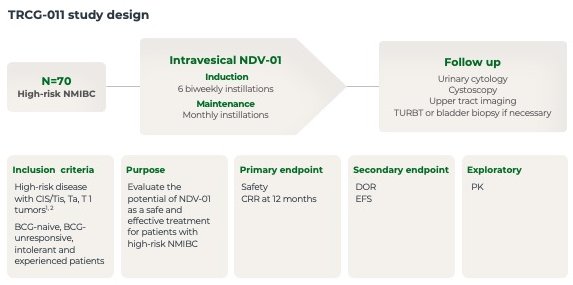
Among the 36 enrolled subjects, 29 were included in the efficacy analysis. All patients had ECOG 0. Of the 36 patients who received at least one dose of NDV-01, 22 (61%) experienced a treatment-related adverse event (TRAE), most of which were grade 1–2 (62% dysuria, 9% asymptomatic positive urine culture, 7% hematuria). No patients developed a grade 3 TRAE, no patients discontinued treatment due to toxicity, and no patients progressed to muscle-invasive disease. No patient underwent radical cystectomy during the observation period.
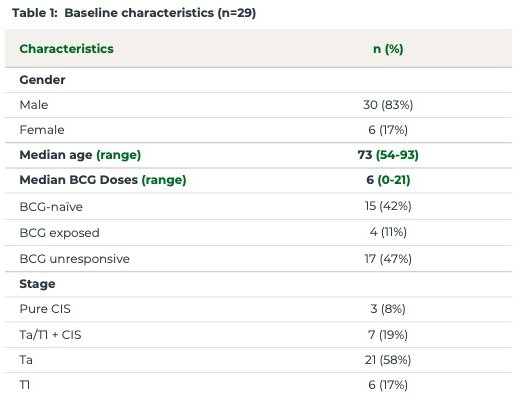
Among the 29 evaluable patients, the median age was 73 years (range 54–93). Fifteen patients (42%) were BCG-naïve, four (11%) were BCG-exposed, and ten (47%) were BCG-unresponsive. The distribution of disease stage included pure CIS (8%), Ta/T1 with concurrent CIS (9%), Ta alone (59%), and T1 disease (17%).
The complete response rates were as follows:
- Any time: 92% (23/25)
- 3 months: 84% (21/25)
- 6 months: 87% (20/23)
- 9 months: 85% (17/20)*
- *This included patients who achieved a CR following re-induction. Sixty percent of non-CR patients at 3 months subsequently achieved a CR after re-induction.
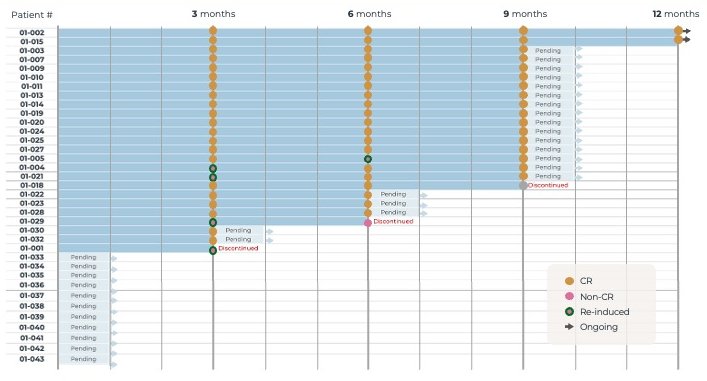
Across the first 12 months of follow-up, the consistency of response and absence of progression signal suggest an encouraging early efficacy profile. Notably, no safety concerns emerged with sustained-release exposure, and no patients developed muscle-invasive progression during the study period.
Dr. Lotan concluded as follows:
- NDV-01 is a novel sustained formulation of Gem/Doce for intravesical use
- NDV-01 demonstrates an excellent 9-month safety and efficacy profile in patients with high-risk NMIBC
- The study supports effectiveness in BCG-naïve, BCG-exposed, and BCG-unresponsive patients
- The study is ongoing, including 2-year follow-up
- The sponsor is engaged with regulators in preparation for a potential registrational program
- Pivotal studies in both intermediate- and high-risk BCG-unresponsive NMIBC populations are planned for 2026
Presented by: Yair Lotan, MD, Professor, Chief of Urologic Oncology, University of Texas Southwestern Medical Center, Dallas, TX
Written by: Rashid K. Sayyid, MD, MSc, Assistant Professor, Urologic Oncologist, Department of Urology at The University of Arizona and Banner University Medical Center – Tucson, AZ, @rksayyid on X during the 2025 Society of Urologic Oncology (SUO) annual meeting held in Phoenix, AZ, between the 2nd and 5th of December 2025.