

(UroToday.com) The 2025 Society of Urologic Oncology (SUO) Annual Meeting featured a bladder cancer poster session during which Dr. Max Kates presented updated results from the ongoing first-in-human phase 1/2a study evaluating Belzupacap Sarotalocan (bel-sar; AU-011), a novel virus-like particle bioconjugate therapy activated by near-infrared light, in adults with non–muscle-invasive bladder cancer (NMIBC).
Current standard-of-care with TURBT and adjuvant intravesical therapy for NMIBC leaves a significant unmet need due to high recurrence rates and the need for repeat surgeries and adjuvant treatment. Bel-sar is a focally administered virus-like drug conjugate (VDC), coupling tumor-specific necrosis with robust immune activation.
Bel-sar selectively targets heparan-sulfate–rich tumor cells and, upon light activation, induces potent, localized cytotoxicity with minimal systemic exposure. This approach is designed to achieve tumor destruction while preserving normal bladder tissue and avoiding the limitations of conventional intravesical therapies.
Preclinical models and clinical ocular melanoma studies demonstrated durable anti-tumor responses with minimal toxicity.
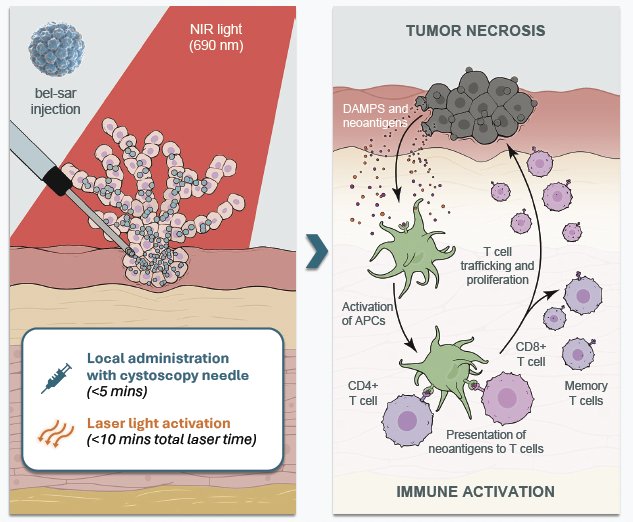
Bel-sar is currently under investigation in a phase 1b/2 clinical trial in participants with intermediate-risk (IR) and high-risk (HR) NMIBC (NCT05483868). In the Phase 1 safety and feasibility portion of the study, 17 participants with NMIBC received a single low dose of intratumoral bel-sar with light activation (n=12) or without light activation (n=5). Bel-sar was injected on Day 1, laser application was performed on Day 2, followed by standard-of-care TURBT 7–12 (+7) days later. The response was assessed histologically by a central pathologist.
As previously reported at the EAU 2025 Congress, among 16 safety-evaluable participants (56-day follow-up) receiving a single dose of AU-011 ± light activation, no drug-related grade 2+ adverse events (AEs), serious AEs, or dose-limiting toxicities (DLTs) were reported. Among 10 efficacy-evaluable participants who received both drug and light activation, 5 had low-grade (LG) and 5 high-grade (HG) disease. Clinical Complete Response (cCR), defined as no tumor cells on TURBT histopathology, was seen in 4/5 participants with LG treated tumors, with 3/5 LG participants also achieving cCR in remote, non-treated tumors. Visual tumor shrinkage was observed in 3/5 HG participants, and 1/5 HG participants demonstrated a cCR in both the treated tumor and a non-treated tumor. Immune activation was noted in all efficacy-evaluable participants in both target and non-target bladder tumors. 4/7 patients with multiple tumors demonstrated a cCR in at least one non-target tumor with infiltration of effector CD8+ and CD4+ T-cells. This data provided evidence of a urothelial field effect.
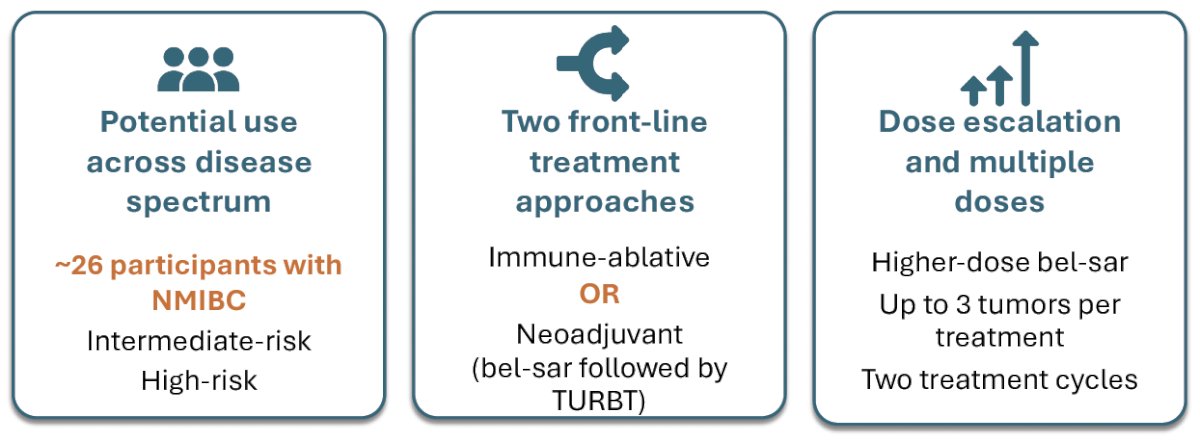
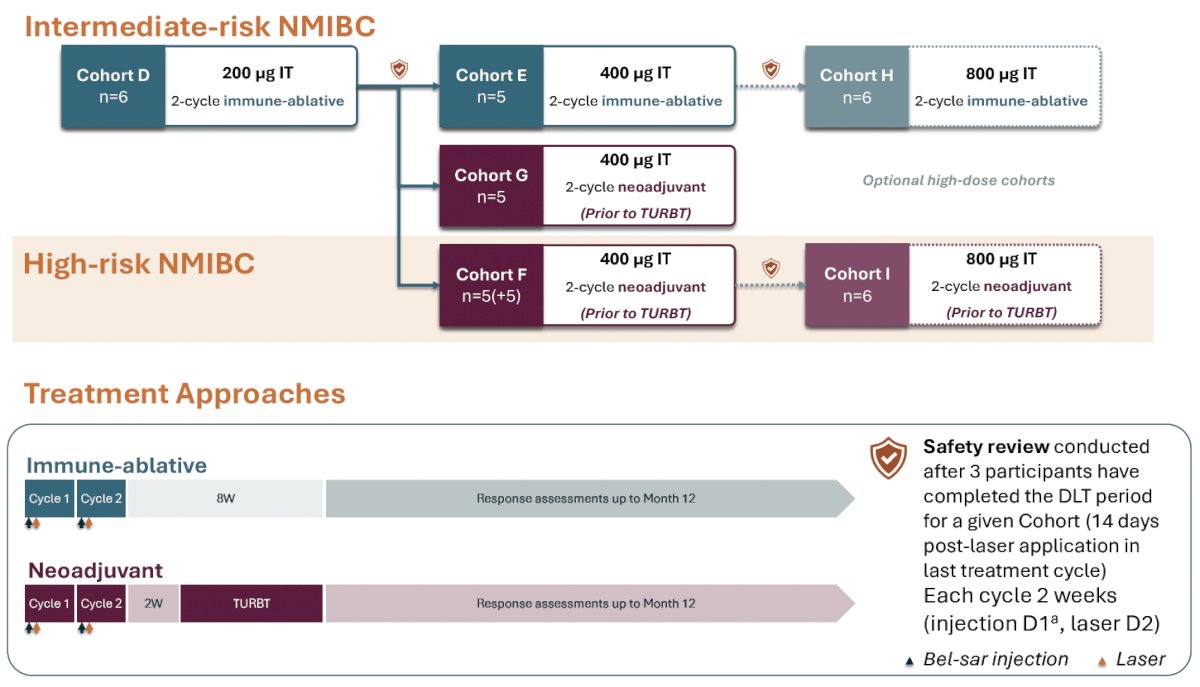
Given these encouraging early signs of drug activity, Aura is evaluating in the Phase 1b/2 trial multiple dosing schedules across two dose levels (200-400 µg), and two distinct treatment paradigms—immune-ablative and neoadjuvant—in participants with NMIBC. Approximately 26 participants across intermediate- and high-risk NMIBC will receive two cycles of focally administered AU-011 followed by laser activation approximately 24-hour post injection. In the immune-ablative cohorts, TURBT is not mandated, allowing for assessment of AU-011’s potential to achieve complete tumor ablation and generate systemic immune memory. In the neoadjuvant cohorts, participants receive two cycles of AU-011 prior to a TURBT approximately four weeks after treatment. For both approaches, patients will be monitored for response assessments and recurrence at 3, 6, 9, and 12 months. Endpoints of this trial include multiple efficacy assessments, such as complete response rate at 3 months and durability of response up to 12 months in the immune ablative cohorts and recurrence-free survival in the neoadjuvant cohorts. Patients will also be monitored for safety.
The preliminary efficacy results were as follows:
- Intermediate risk (n=5):
- 4/5 treated tumors achieved cCR, while the fifth showed visual tumor shrinkage
- 3/5 participants demonstrated cCR in at least 1 untreated tumor
- Visual changes on cystoscopy were identified in 4/5 participants
- 100% of treated and untreated tumors demonstrated an immune response
- High risk (n=5)
- 3/5 treated tumors demonstrated visual tumor shrinkage
- 1/5 participants achieved a cCR in both the treated tumor and an untreated tumor
- Visual changes on cystoscopy were identified in 4/5 participants
- 100% of treated and untreated tumors demonstrated an immune response
- Favorable safety profile (n=17)
- <10% of participants experienced Grade 1 treatment-emergent AEs related to study drug
- No Grade 2/3 treatment-emergent AEs related to study drug
- No serios AEs or DLTs
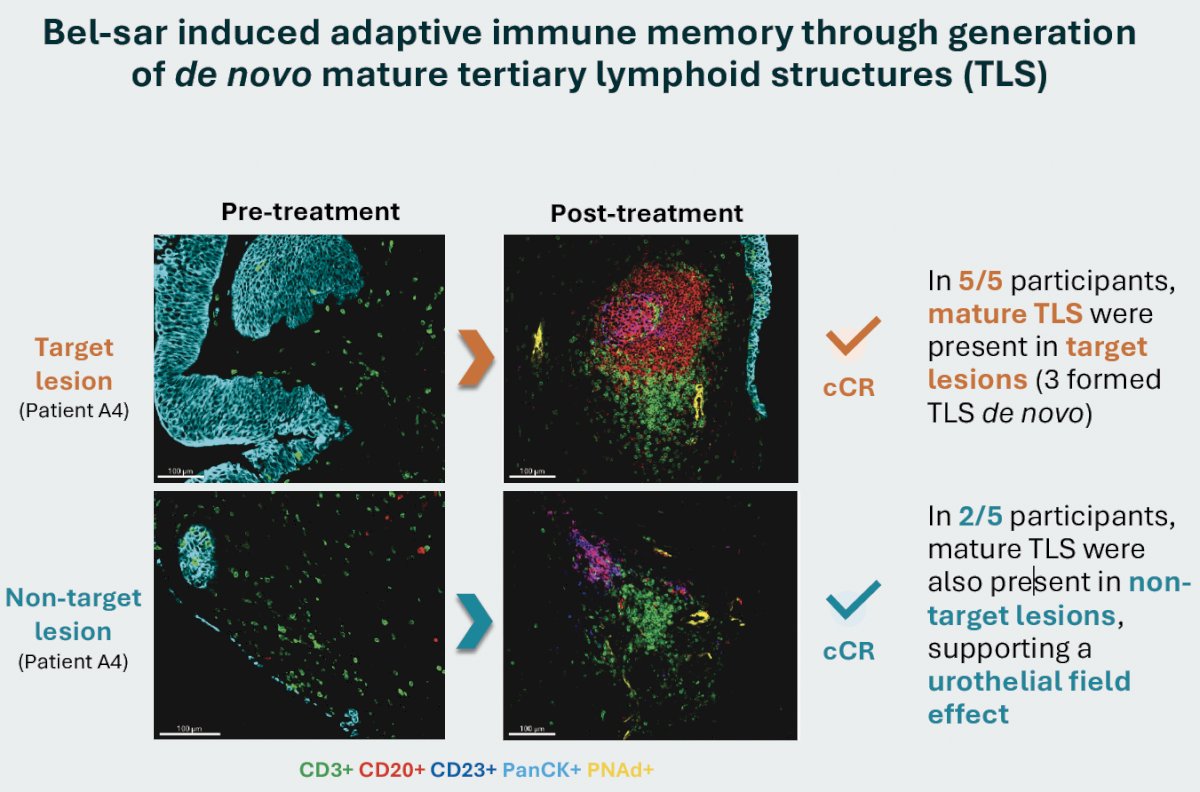
Dr. Kates concluded that in both IR and HR NMIBC patients, focal administration of a single, low-dose of bel-sar (AU-011) induced cCRs through rapid tumor necrosis, effector cell infiltration, localized immune memory, and a urothelial field effect. The following was observed:
- Grade 1 drug-related adverse events only
- Bel-sar induced adaptive immune memory through generation of de novo mature tertiary lymphpoid structures
- Bel-sar generated innate and adaptive effectors regardless of immune environment, converted “cold” to “hot” tumors, and reversed dysfunction in exhausted tumors
- These results support evaluation of additional bel-sar doses and cycles in participants with NMIBC in the ongoing Phase 1b/2 study.
Presented by: Max Kates, MD, Associate Professor, Department of Urology, Johns Hopkins University, Baltimore, MD
Written by: Rashid K. Sayyid, MD, MSc, Assistant Professor, Urologic Oncologist, Department of Urology at The University of Arizona and Banner University Medical Center – Tucson, AZ, @rksayyid on X during the 2025 Society of Urologic Oncology (SUO) annual meeting held in Phoenix, AZ, between the 2nd and 5th of December 2025.