

(UroToday.com) The 2025 SUO annual meeting featured a urothelial carcinoma session and a presentation by Matthew Kirschenbaum discussing preliminary findings from the prospective University of Washington Bounceback cohort study assessing heterogeneity in early postoperative recovery trajectories after radical cystectomy.
Postoperative functional decline is common among older adults undergoing radical cystectomy for bladder cancer. However, early recovery trajectories vary widely, with some patients maintaining unchanged function despite the impact of surgery. As such, the investigators aimed to characterize this unchanged functional recovery subgroup and identify associated psychosocial and quality of life traits.
This report was an analysis of a prospective cohort of patients aged ≥60 years undergoing radical cystectomy at a tertiary academic center. Frailty was assessed using the Cancer and Aging Resilience Evaluation Frailty Index (CARE-FI; range 0 [robust] - 1 [frail]) at baseline, 2-weeks, and 3-months postoperatively:
![This report was an analysis of a prospective cohort of patients aged ≥60 years undergoing radical cystectomy at a tertiary academic center. Frailty was assessed using the Cancer and Aging Resilience Evaluation Frailty Index (CARE-FI; range 0 [robust] - 1 [frail]) at baseline, 2-weeks, and 3-months postoperatively:](/images/com-doc-importer/243-suo-2025/suo-2025-heterogeneity-in-early-postoperative-recovery-trajectories-after-radical-cystectomy-preliminary-findings-from-the-prospective-university-of-washington-bounceback-cohort-study/image-0.jpg)
The primary outcome was early change in frailty, defined as: ΔCARE-FI = 2-week minus baseline score. Patients with ΔCARE-FI between -0.05 and +0.05 were defined as having unchanged function, encompassing minimal improvement to minimal decline. Those with ΔCARE-FI ≥ +0.05 were classified as having declined function. Health-related quality of life was assessed preoperatively using the EORTC QLQ-C30. Baseline characteristics and outcomes were compared between recovery groups using Wilcoxon rank sum tests for continuous variables and Fisher’s exact or chi-square tests for categorical variables, as appropriate. To account for potential regression to the mean, a baseline-adjusted analyses was performed using linear regression with baseline CARE-FI as a covariate.
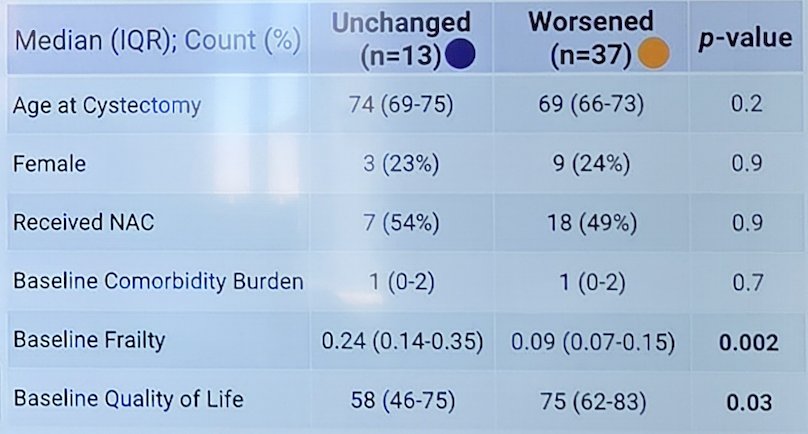
Among the 50 of 74 patients with complete pre-/post-radical cystectomy data, 13 (26.5%) demonstrated unchanged function at 2 weeks post-radical cystectomy. This subgroup was not significantly older (median age 74 versus 69 years, p = 0.2), but significantly more frail at baseline (CARE-FI: 0.24 versus 0.09, p = 0.002), had lower baseline global health-related quality of life (58 versus 75, p = 0.03), and reported higher baseline nausea and pain (median scores: 17 versus 0, p = 0.021 and p = 0.027, respectively):
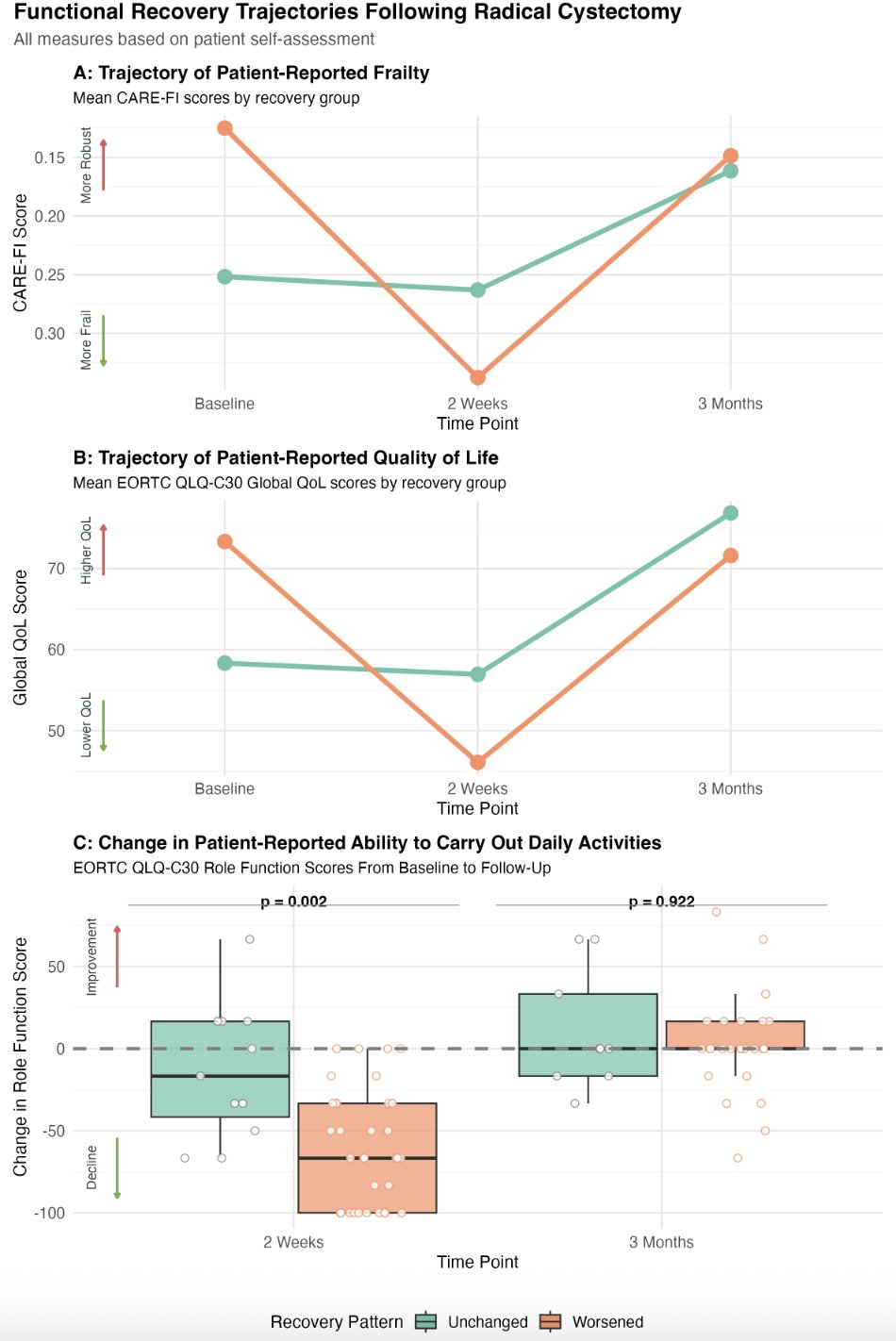
At 2 weeks post-operatively, patients with unchanged function demonstrated a smaller decline in role function (-13.6- versus -59.6-point decline, p = 0.002), however, at 3 months, relative to baseline, both groups demonstrated similar improvements (+11.1 versus +11.9-point increase, p = 0.922):
Median hospital stay was longer in the group with unchanged function at 2 weeks (8 versus 5 days, p = 0.02), even after adjusting for baseline frailty (β = 0.184, p < 0.001).
Matthew Kirschenbaum concluded his presentation discussing preliminary findings from the prospective University of Washington Bounceback cohort study with the following take-home points:
- Approximately one in four patients maintained unchanged function post-radical cystectomy, as measured by ΔCARE-FI. These patients endorsed higher baseline frailty and symptom burden
- Conversely, patients with better baseline function demonstrated greater initial deterioration in function with subsequent recovery by three months
- These findings raise the question of whether there is a floor effect in our assessment tools, such that those starting with impaired function may be more resistant to decline induced by radical cystectomy
- This phenomenon may reflect adaptive mechanisms or realistic expectations not captured by traditional clinical metrics
- Further investigation is warranted to understand the protective factors underlying this functional preservation pattern and its implications for perioperative care strategies
Presented by: Matthew P. Kirschenbaum, MD candidate, University of Washington School of Medicine, Seattle, WA
Written by: Zachary Klaassen, MD, MSc – Urologic Oncologist, Associate Professor of Urology, Georgia Cancer Center, Wellstar MCG Health, @zklaassen_md on Twitter during the 2025 Society of Urologic Oncology (SUO) Annual Meeting, Phoenix, AZ, Wed, Dec 3 – Fri, Dec 5, 2025.