

(UroToday.com) The 2025 SUO annual meeting featured a urothelial carcinoma trials in progress session and a presentation by Dr. Eugene Pietzak discussing the GAIN trial assessing gemcitabine alternating with intravesical BCG randomization against BCG alone for patients with recurrent “BCG-exposed” high-grade non-muscle invasive bladder cancer.
Patients with BCG-exposed non-muscle invasive bladder cancer comprise a large population with a critical need for more effective treatments. The current standard of care is re-treatment with BCG alone, but only ~50% of patients derive clinical benefit. Although intravesical gemcitabine + docetaxel is sometimes used, studies have found that gemcitabine + docetaxel is no better than re-treatment with BCG alone for BCG-exposed non-muscle invasive bladder cancer.
A chemoimmunotherapy strategy of intravesical gemcitabine with BCG combines the two most effective, inexpensive, and commonly used non-muscle invasive bladder cancer treatments. A phase I/II (n = 52) trial was initiated of gemcitabine with BCG in BCG-exposed non-muscle invasive bladder cancer (NCT04179162). Gemcitabine with BCG has minimal side effects, an outstanding early efficacy signal (6-month complete response of 97% [28/29] in patients with CIS compared with expected ~50% with BCG alone for BCG exposed CIS), and promising preliminary longer-term efficacy: 18-month high-grade recurrence free survival of 76% compared with ~45-55% with BCG alone, gemcitabine + docetaxel, and recombinant BCG in BCG-exposed non muscle invasive bladder cancer.
Dr. Pietzak and colleagues initiated the “GAIN” trial (A032303), a prospective, multicenter, open-label phase III study of patients with BCG-exposed non-muscle invasive bladder cancer randomized to re-treatment with BCG only or gemcitabine with BCG. The primary objective is to determine whether gemcitabine with BCG improves high-grade recurrence-free survival compared with BCG alone. Secondary objectives include:
- The proportion free of high-grade cancer on initial post-treatment cystoscopic biopsies/TURBT at week 13/month 3 for all patients
- Complete response rate at week 25/month 6 in patients with pre-treatment CIS
- Time to recurrence of any grade bladder cancer
- Progression-free survival
- Cystectomy free survival
BCG-exposed non-muscle invasive bladder cancer is defined as a high-grade non-muscle invasive bladder cancer (Ta, T1, Tis/CIS) that has recurred within 24 months of prior BCG but does not meet BCG unresponsive non-muscle invasive bladder cancer criteria.
Inclusion is liberal, allowing for:
- More than one prior BCG induction course/prior maintenance BCG
- Any prior systemic or intravesical agents for non-muscle invasive bladder cancer (including gemcitabine)
- Non-invasive urothelial carcinoma of the prostatic urethra and treated upper tract urothelial carcinoma
Patients with current/prior muscle-invasive bladder cancer and prior intolerance of any intravesical therapies are excluded. Other notable aspects include: (i) the NCI’s new streamlined data initiative, (ii) pragmatic design to improve generalizability, and (iii) week-13 cystoscopic biopsies in all participants for earlier detection of BCG unresponsive disease and objective “benchmarking” of urinary biomarkers. The full GAIN trial design is as follows:
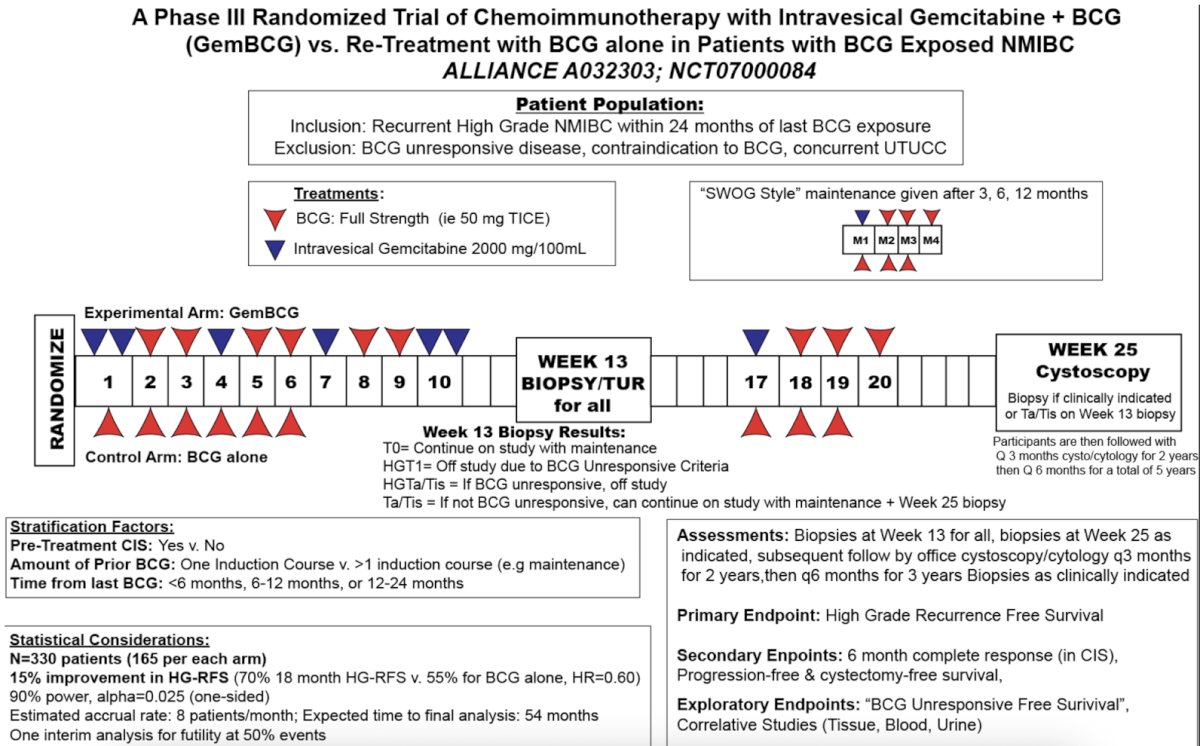
This trial is currently opening new sites through the National Clinical Trials Network.
Presented by: Eugene Pietzak, MD, Urologic Surgeon, Clinical Investigator, Department of Surgery, Memorial Sloan Kettering Cancer Center, Urology Service Assistant Professor, Weill Cornell Medicine, NY
Written by: Zachary Klaassen, MD, MSc – Urologic Oncologist, Associate Professor of Urology, Georgia Cancer Center, Wellstar MCG Health, @zklaassen_md on Twitter during the 2025 Society of Urologic Oncology (SUO) Annual Meeting, Phoenix, AZ, Wed, Dec 3 – Fri, Dec 5, 2025.