

(UroToday.com) The 2025 SUO annual meeting featured a urothelial carcinoma session and a presentation by Dr. Shreyas Joshi discussing real-world clinical experience using a commercial artificial intelligence histologic assay in non-muscle invasive bladder cancer care.
Management for non-muscle invasive bladder cancer relies on risk assessment. For many cases, intravesical BCG is the standard of care; however, failure rates remain high, and drug shortages create challenges with therapy allocation. Artificial intelligence-based pathology assays have been developed, offering a promising opportunity to inform personalized treatment planning through individualized risk assessments and novel BCG response biomarker analysis. Dr. Joshi and colleagues conducted a retrospective study of non-muscle invasive bladder cancer patients undergoing commercially available artificial intelligence-powered histologic testing as part of standard clinical management to explore clinical experience and implementation.
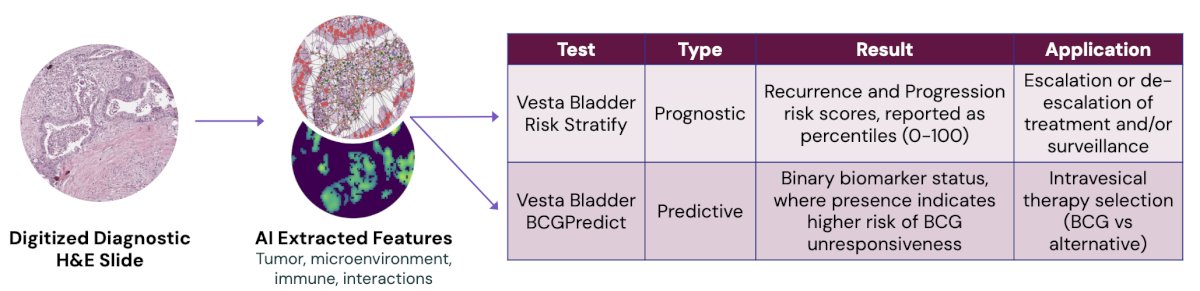
A retrospective chart review was conducted for patients with high-grade non-muscle invasive bladder cancer treated at Emory Winship Cancer Center from February 2025 to May 2025 for whom clinical Vesta testing (Vesta Bladder BCGPredict and Vesta Bladder Risk Stratify HG) was obtained from a CLIA- and CAP-accredited laboratory through the course of routine clinical care. In brief, H&E-stained slides are digitized at 40x magnification and analyzed with an artificial intelligence platform to extract, quantify, and algorithmically assess relevant features related to tumor morphology, immune infiltrate, and stromal microenvironment. Patient characteristics, test results, and treatment decisions were collected, and descriptive statistics were calculated.
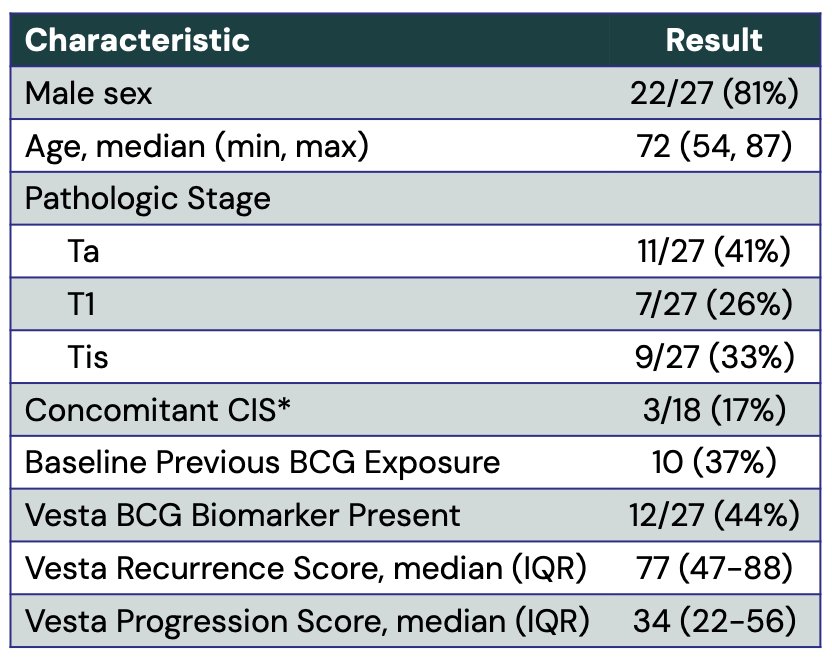
There were 27 eligible patients identified, including 22 (81%) males with a median age of 72 years (range: 54-87). Stage included 11 (41%) pTa, 7 (26%) pT1, and 9 (33%) pTis. Overall, 10 (37%) patients previously received BCG. There were 12 (44%) patients whose results showed the presence of the Vesta BCGPredict biomarker, indicating poor response to BCG. Percentile-based Vesta Risk Stratify HG prognostic scores showed a median of 77 (IQR 47-88) for recurrence and 34 (IQR 22-56) for progression:
The median testing turnaround time was 2 days from specimen receipt, and all patients received both Vesta tests:
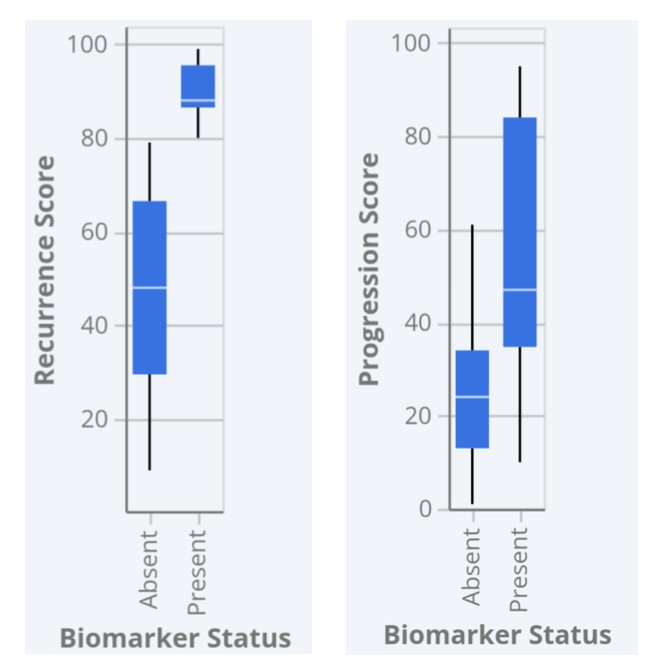
BCGPredict biomarker-present cases had higher recurrence scores, but overlap existed in progression scores for biomarker-present and -absent disease:
Of patients receiving intravesical therapy, 9/11 (82%) biomarker-present patients received gemcitabine + docetaxel and 2/11 (18%) received BCG, whereas 10/13 biomarker-absent patients received BCG and 3/13 (23%) received gemcitabine + docetaxel (due to BCG unavailability). One patient refused treatment, and 2 underwent cystectomy, one due to aggressive recurrence, another after recurrent disease showed 95th percentile progression and recurrence risk scores:

Dr. Joshi concluded his presentation discussing real-world clinical experience using a commercial artificial intelligence histologic assay in non-muscle invasive bladder cancer care with the following take-home points:
- This study demonstrates that integration of commercially available artificial intelligence-powered pathology assays into routine clinical care is feasible for patients with non-muscle invasive bladder cancer, both in the treatment naïve and BCG-exposed settings, where a range of biomarker and risk results were observed
- Clinical testing was processed quickly and provided a wide range of personalized risk and drug response information to inform precision management, including the allocation of limited BCG to patients who were more likely to benefit in times of shortage
- Such clinical tools are likely to increase in value to support treatment planning as additional therapeutic options become available in non-muscle invasive bladder cancer
Presented by: Shreyas Joshi, MD, MPH, Emory University, Atlanta, GA
Written by: Zachary Klaassen, MD, MSc – Urologic Oncologist, Associate Professor of Urology, Georgia Cancer Center, Wellstar MCG Health, @zklaassen_md on Twitter during the 2025 Society of Urologic Oncology (SUO) Annual Meeting, Phoenix, AZ, Wed, Dec 3 – Fri, Dec 5, 2025.