

(UroToday.com) The 2025 SUO annual meeting featured a urothelial carcinoma session and a presentation by Dr. David Nusbaum discussing the feasibility and safety of intravesical therapy with autologous tumor-infiltrating lymphocytes in BCG-exposed non-muscle invasive bladder cancer.
The use of adoptive cell transfer with tumor-infiltrating lymphocytes as a form of immunotherapy is well-established in melanoma, and emerging evidence suggests a potential role for this strategy in other malignancies, including bladder cancer. Novel treatment approaches are needed for patients with high-risk non-muscle invasive bladder cancer, due to high rates of recurrence despite first-line therapy with intravesical BCG. Accrual and 3-month follow-up has been completed of a phase I clinical trial (NCT05768347) of intravesical autologous tumor-infiltrating lymphocytes therapy in patients with BCG-exposed non-muscle invasive bladder. At the 2025 SUO annual meeting, Dr. Nusbaum and colleagues reported on the primary objectives of safety and feasibility, and presented short-term data for secondary efficacy endpoints.
Patients with recurrent high-risk BCG-exposed non-muscle invasive bladder cancer were enrolled in this phase I trial prior to TURBT. Tumor-infiltrating lymphocytes were harvested from the TURBT specimen and expanded ex vivo. Total viable cells and viability were measured, and autologous tumor-infiltrating lymphocytes were administered by intravesical instillation once weekly for four weeks. The primary objective was to assess the safety and feasibility of autologous intravesical tumor-infiltrating lymphocytes therapy for non-muscle invasive bladder cancer. Feasibility was defined as successful harvesting and rapid expansion of the tumor-infiltrating lymphocytes product followed by intravesical delivery. Adverse events were recorded to assess toxicity, and cystoscopy was performed approximately 6 weeks after the last treatment to assess for recurrence.
There were 9 patients enrolled in the trial, which met the pre-determined accrual goal. Tumor infiltrating lymphocytes harvest and expansion were successful in all 9 patients (mean pre-rapid expansion protocol total viable cells viability 92.4%, SD 2.7%), despite a low mean tumor specimen weight of 0.49 (SD 0.47) grams. The mean time to first tumor-infiltrating lymphocytes instillation after index TURBT was 60.3 (SD 10.7) days. Across all doses, the median percentage of cells delivered (defined as the proportion of total cells infused minus the number of cells recovered in the post-void urine) was 93.4%.
All patients completed treatment, no serious adverse events have been observed, and all adverse events were grade 1 or 2. The most common treatment adverse events were dysuria (44%), urinary frequency (44%), fatigue (33%), and urinary retention (33%). All patients have had at least one surveillance cystoscopy after completing treatment:
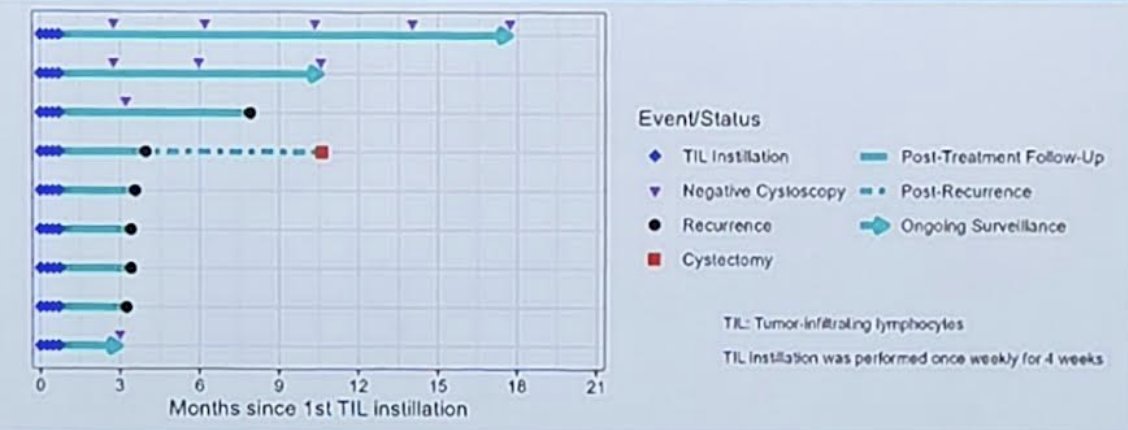
The 3-month complete response rate was 44%, and recurrence has been observed in 6 (67%) of patients during follow-up. One patient elected to undergo radical cystectomy after recurrence and was found to have stage pTa disease. No patient experienced progression to muscle-invasive disease. Two patients have had no evidence of recurrence during a mean follow-up time of 14.1 (SD 5.0) months.
Dr. Nusbaum concluded his presentation discussing the feasibility and safety of intravesical therapy with autologous tumor-infiltrating lymphocytes in BCG-exposed non-muscle invasive bladder cancer with the following take-home points:
- This phase I clinical trial of autologous intravesical tumor-infiltrating lymphocytes therapy in patients with BCG-exposed high-risk non-muscle invasive bladder cancer achieved its accrual goal, and tumor-infiltrating lymphocytes harvest, expansion, and intravesical administration have been completed in all nine participants, supporting the feasibility of this approach
- No significant toxicity has been observed, suggesting a favorable safety profile
- The 3-month complete response rate was 44% and a durable response has been observed for two participants, suggesting that a subset of patients may benefit from this therapy
- Longer-term follow-up data will be helpful in assessing potential clinical efficacy
Presented by: David J. Nusbaum, MD, Moffitt Cancer Center, Tampa, FL
Written by: Zachary Klaassen, MD, MSc – Urologic Oncologist, Associate Professor of Urology, Georgia Cancer Center, Wellstar MCG Health, @zklaassen_md on Twitter during the 2025 Society of Urologic Oncology (SUO) Annual Meeting, Phoenix, AZ, Wed, Dec 3 – Fri, Dec 5, 2025.