

(UroToday.com) The 2025 SUO annual meeting featured a urothelial carcinoma trials in progress session and a presentation by Dr. Fady Ghali discussing CONSOLIdaTE-01, a phase II trial of consolidative surgery following enfortumab vedotin + pembrolizumab in patients with locally advanced/oligometastatic urothelial carcinoma.
Recent advances in systemic therapy have redefined the treatment landscape for locally advanced and metastatic urothelial carcinoma,1 yet durable responses remain limited and progression inevitable for the majority of patients. Retrospective and translational evidence suggests a role for consolidative local therapy—such as radical cystectomy and metastasectomy, or radiation therapy—following disease control on enfortumab vedotin + pembrolizumab, particularly in the setting of limited metastatic burden. However, prospective validation in locally advanced and metastatic urothelial carcinoma is lacking.
CONSOLIdaTE-01 is a prospective single-arm phase II trial designed to assess the safety, feasibility, and oncologic outcomes of consolidative extirpative surgery following initial response or stable disease on enfortumab vedotin + pembrolizumab in patients with either locally advanced or oligometastatic urothelial carcinoma. Correlative studies including spatial transcriptomic and tumor microenvironment analysis of primary and metastatic surgical specimens. Additionally, longitudinal analysis of circulating tumor DNA (ctDNA) as a marker of residual disease and predictor of recurrence will be performed.
This is a single-arm, phase II prospective trial (NCT07048457) enrolling patients with either locally advanced unresectable (T4 and/or cN+) or oligometastatic (≤5 sites) urothelial carcinoma who demonstrate non-progression following ≥3 months enfortumab vedotin + pembrolizumab-based therapy. Eligible patients are consenting adults that are surgical candidates. Metastatic sites are either treated with SBRT or deemed surgically resectable. Enrolled patients will undergo consolidative radical surgery (cystectomy or nephroureterectomy, with metastasectomy of untreated sites):
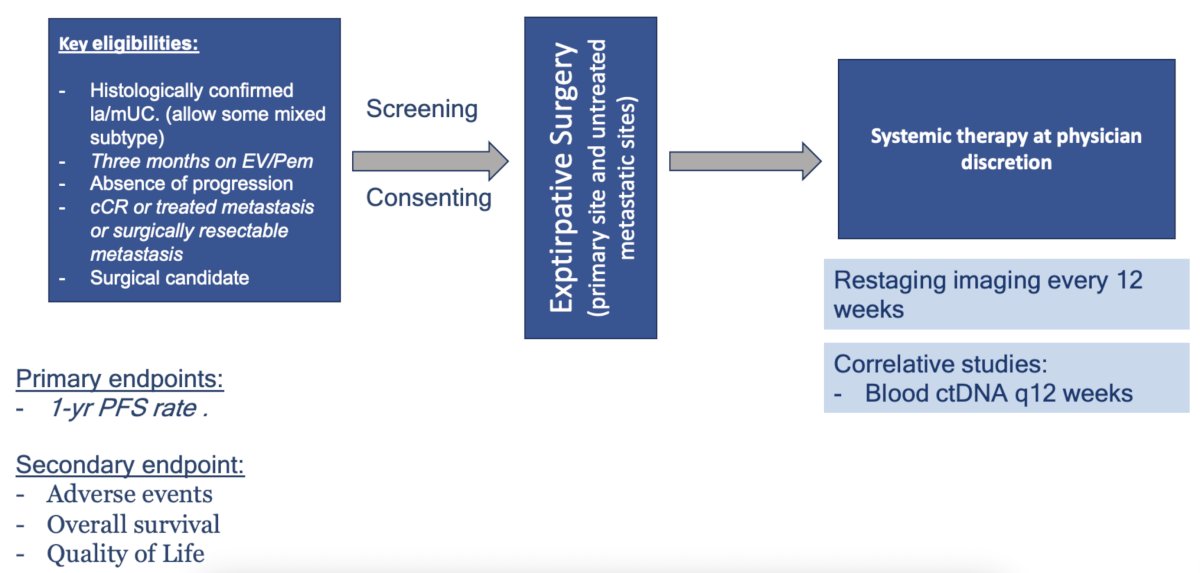
The primary endpoint is 1-year progression-free survival, and key secondary endpoints include overall survival, treatment-related adverse events, quality of life, and ctDNA dynamics. The trial is currently open and enrolling patients.
Presented by: Fady Ghali, MD, Yale School of Medicine, New Haven, CT
References: