

(UroToday.com) The 2025 Society of Urologic Oncology (SUO) Annual Meeting was host to a bladder cancer poster session. Dr. Fady Ghali presented a simulation study evaluating the potential clinical outcomes of the control arm patients in the EV-302 trial had they received maintenance avelumab following gemcitabine + cisplatin or carboplatin.
EV-302 established the combination of enfortumab vedotin + pembrolizumab (EV+P) as the 1st line treatment option for the treatment of urothelial carcinoma patients with locally advanced or metastatic disease.1 One potential limitation of this trial was the limited use of maintenance avelumab in the control arm patients who did not experience disease progression following systemic treatment with gemcitabine + cisplatin or carboplatin.2 In this study, Dr. Ghali and colleagues sought to investigate the overall survival (OS) outcomes of EV+P when compared with chemotherapy plus maintenance avelumab.
In this study, the study investigators used gated counterfactual simulation (GCS), a technique that utilizes published Kaplan-Meier (KM) curves to reconstruct individual patient-level data, estimate treatment-associated survival benefits, and crosswalk this treatment in order to simulate EV-302 with an altered control arm. This approach simulates a comparison of EV+P with standard chemotherapy plus maintenance avelumab.
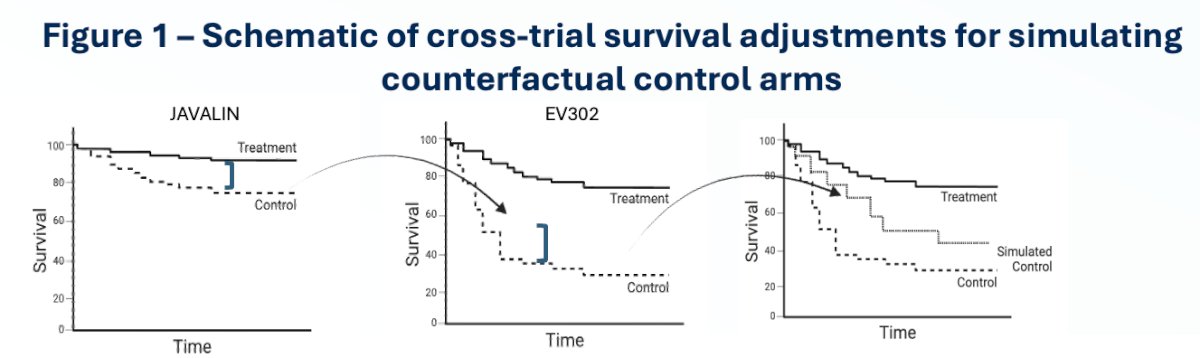
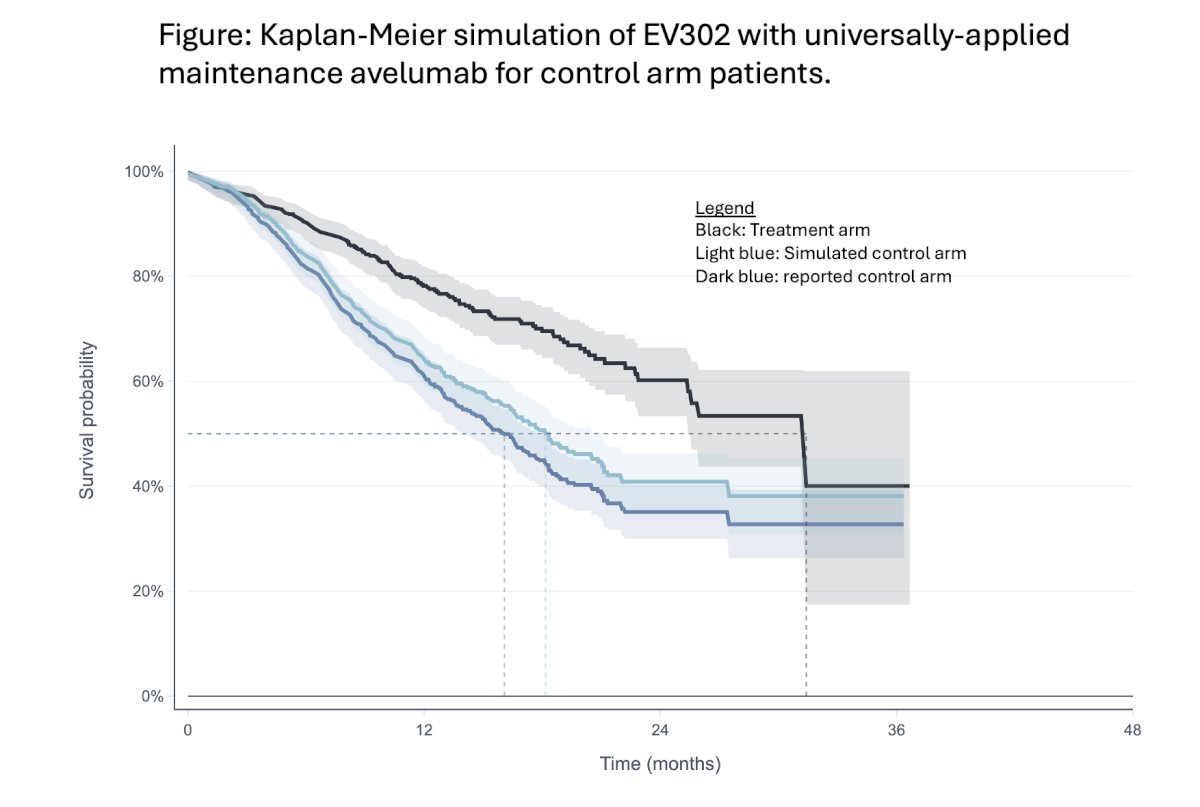
The relative survival benefit attributable to maintenance avelumab was determined to be appropriate for an additional 47.8% of the EV-302 control arm patients. The simulated comparison of EV-302 with the control arm receiving maintenance avelumab demonstrated a hazard ratio (HR) of 0.56 (95% CI 0:.46–0.70; p<0.001).
Dr. Ghali concluded as follows:
- Using a simulation approach, the EV-302 outcomes are maintained after adjusting for universal maintenance avelumab use in the control arm
- This proposed limitation does not ‘fundamentally’ alter the superior efficacy of EV+P in untreated, locally advanced or metastatic urothelial carcinoma
- This study demonstrates how gated counterfactual simulation (GCS) can be used to re-interpret and re-contextualize clinical trial outcomes in a rapidly evolving landscape
Presented by: Fady Ghali, MD, Assistant Professor, Department of Urology, Yale New Haven Hospital, New Haven, CT
Written by: Rashid K. Sayyid, MD, MSc, Assistant Professor, Urologic Oncologist, Department of Urology at The University of Arizona and Banner University Medical Center – Tucson, AZ, @rksayyid on X during the 2025 Society of Urologic Oncology (SUO) annual meeting held in Phoenix, AZ, between the 2nd and 5th of December 2025.
References:
- Powles T, Valderrama BP, Gupta S, et al. Enfortumab Vedotin and Pembrolizumab in Untreated Advanced Urothelial Cancer. N Engl J Med.2024; 390:875-88.
- Grivas P, Sternberg CN, Powles T, et al. Updated analysis from the phase 3 study of avelumab first-line maintenance therapy in patients with advanced urothelial carcinoma (JAVELIN Bladder 100). J Clin Oncol. 2024;42(12):1415-1425.