

(UroToday.com) The 2026 SNMMI annual meeting featured a genitourinary radiotherapeutics session and a presentation by Dr. Molly Roseland discussing the prediction of early PSA response to 177Lu-PSMA therapy using baseline PET imaging biomarkers and cycle 1 dosimetry. 177Lu-PSMA radioligand therapy is a promising treatment option for metastatic prostate cancer, but clinical response is variable among patients who meet treatment criteria, and there is a need for better response prediction tools to improve patient selection. As all patients have a standardized pre-treatment workup including PSMA PET, imaging biomarkers offer unique opportunities to assess associations with response, particularly given new, efficient techniques for segmentation of complete tumor burden from PET and SPECT/CT. Image-based dosimetry using post-treatment SPECT/CT can also reveal potential dose-response relationships. The goal of this study presented at SNMMI 2026 was to investigate associations among PSA change, whole body tumor absorbed dose, and baseline PET metrics.
Dr. Roseland and colleagues retrospectively assessed 28 patients with metastatic prostate cancer receiving standard 177Lu-PSMA therapy who underwent multi-timepoint dosimetry during cycle 1 (either clinically requested by treating physician or as part of an exploratory dosimetry study). Pre-treatment and follow-up PSA values after cycle 1, cycle 2, and ~3 months after therapy completion were extracted from the medical record. Pretreatment PSMA PET was analyzed using automated segmentation software to obtain whole body tumor volume, with subsequent contour verification by a radiologist and calculation of tumor PET metrics (SUVmean):
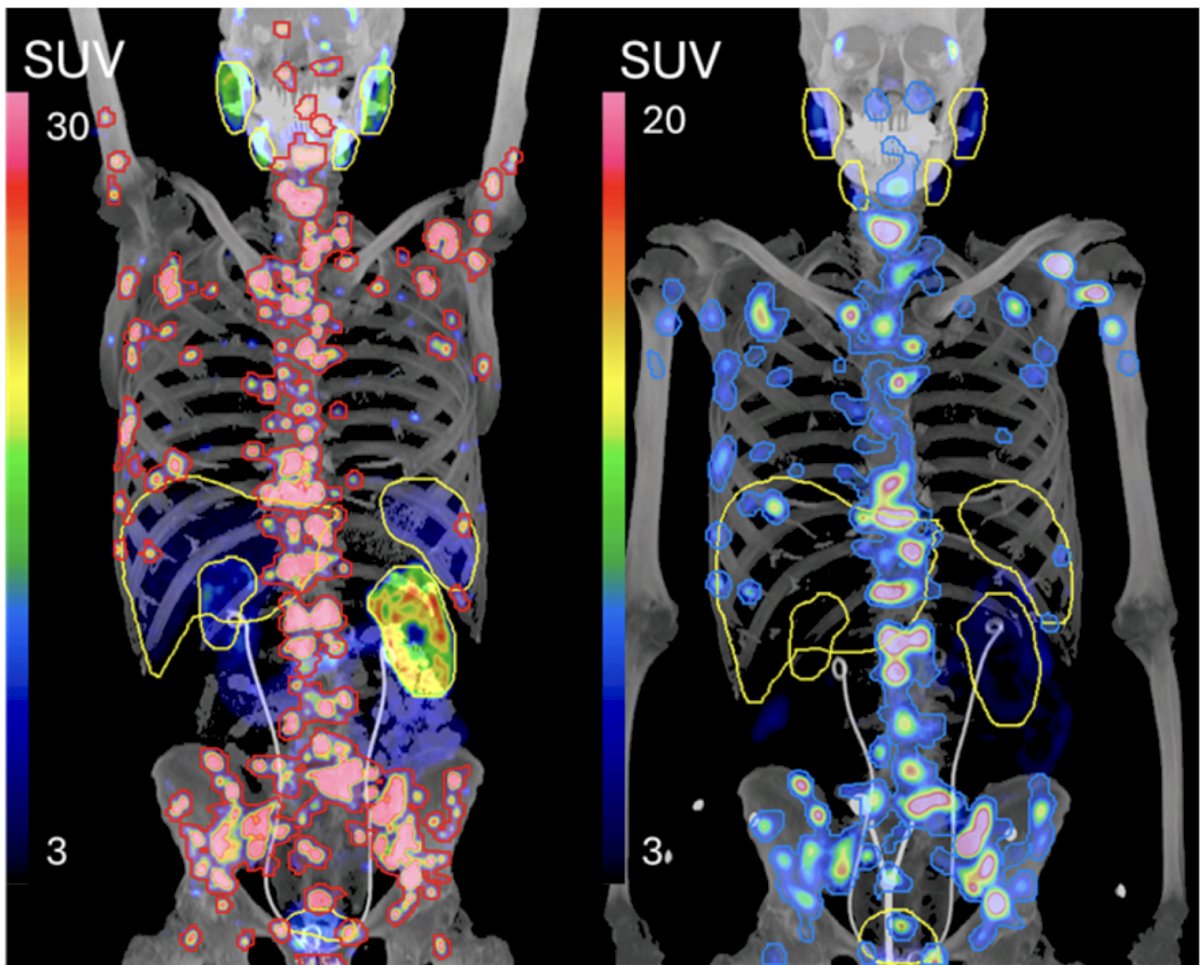
Cycle 1 dosimetry was performed using post-therapy SPECT/CT obtained at 3-4 time points (1-6 days following infusion). Tumor contours were obtained via automated whole-body tumor volume segmentation on SPECT and used in a standardized semi-automated dosimetry workflow to calculate whole-body tumor volume absorbed dose (in Gy). Spearman rank correlations and logistic regression analyses were performed using continuous and binary classification of PSA change (responders: PSA drop >=30%; non-responders: <30%) to evaluate its relationship with whole body tumor volume absorbed dose and PET metrics (significance level p < 0.05).
Mean PSA change after cycle 1 was +21.7% (range -99.2% to +329.7%), after cycle 2 was +56.1% (range -99.2% to +759.5%); and 3 months post-therapy was +1,039.0% (range -99.7% to +12044.7%). There were 9 of 27 patients considered PSA responders post-cycle 1, compared to 12 of 24 patients post-cycle 2 and 8 of 23 patients at 3 months post-therapy. Overall mean cycle 1 whole body tumor volume absorbed dose was 8.1 Gy (range 2.0-31.7 Gy). Logistic regression analysis showed a positive association between cycle 1 whole body tumor volume absorbed dose and PSA responder status post-cycle 1, post-cycle 2, and 3 months post-therapy, although this association was only statistically significant post-cycle 2 (p = 0.031). Among patients considered PSA responders post-cycle 2, mean absorbed dose was 12.3 Gy (range 4.9-31.7 Gy), whereas mean absorbed dose in non-responders was 4.5 Gy (range 2-14 Gy). Spearman’s rank correlations between PSA change and whole body tumor volume absorbed dose were statistically significant at all time points (p < 0.001). With regard to PET metrics, overall average SUVmean for whole-body tumor volume on baseline PET was 8.5 (range 4.0-17.6). A significant positive association was observed between SUVmean and PSA responder status at all time points, with higher SUVmean associated with PSA response for post-cycle 1 (p = 0.018), post-cycle 2 (p = 0.017), and at 3 months post-therapy (p = 0.048):
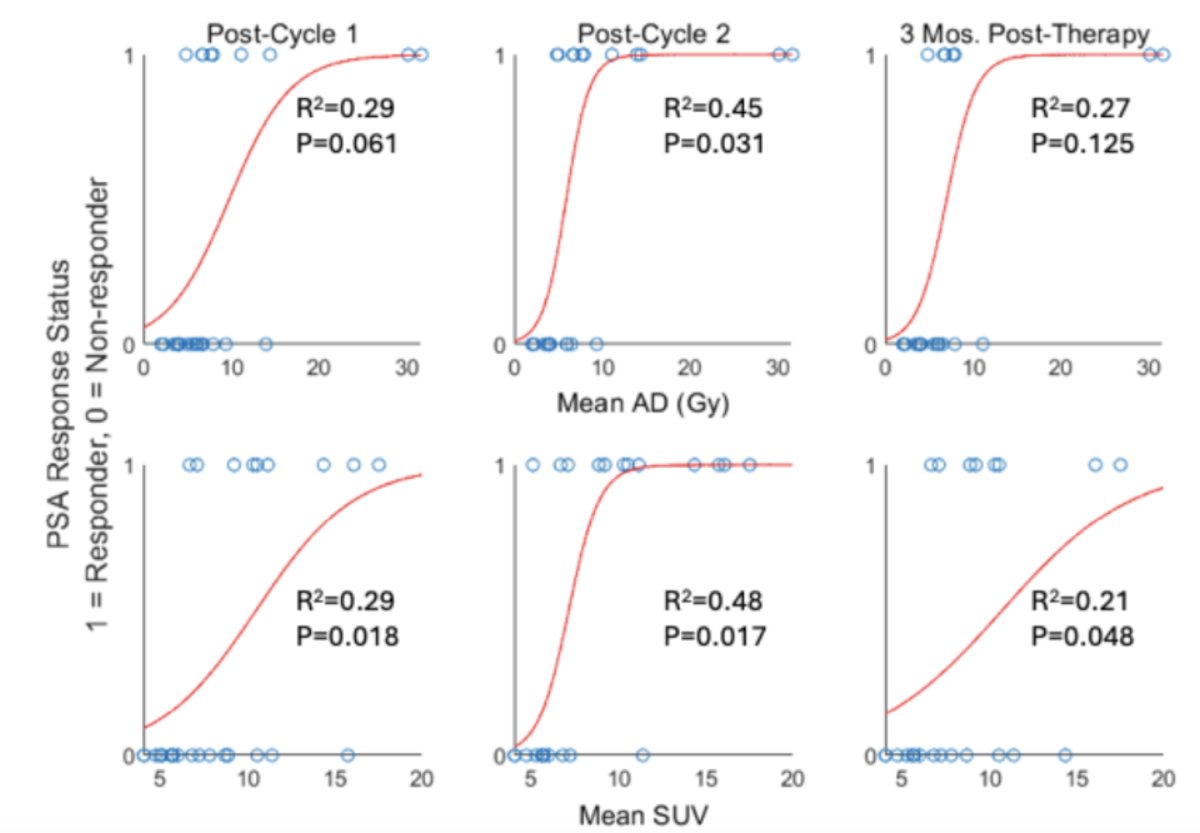
Average SUVmean in responders after cycle 2 was 11.1 (range 5.1-17.6), while SUV mean in non-responders was 6.0 (range 4.0-11.4). Spearman’s rank correlations between PSA change and PET SUVmean were also statistically significant at all time points (p < 0.001).
Dr. Roseland concluded her presentation discussing the prediction of early PSA response to 177Lu-PSMA therapy using baseline PET imaging biomarkers and cycle 1 dosimetry with the following take-home points:
- Higher baseline PET SUVmean and cycle 1 whole body tumor volume absorbed dose are associated with a more favorable PSA response following early cycles of 177Lu-PSMA, as well as after therapy completion
- This affirms results of prior individual PET and dosimetry studies (minimum SUVmean ~10 absorbed ~10 Gy for response)
- This suggests a routine assessment of whole body tumor volume SUVmean on readily available baseline PSMA PET could help inform patient prognosis prior to therapy initiation, and dosimetry may supplement this information during treatment
- However, additional variables and larger datasets are clearly needed to develop more robust models for predicting 177Lu-PSMA therapy outcomes
Presented by: Molly E. Roseland, MD, University of Michigan, Ann Arbor, MI
Written by: Zachary Klaassen, MD, MSc – Urologic Oncologist, Associate Professor of Urology, Georgia Cancer Center, Wellstar MCG Health, @zklaassen_md on Twitter, during the Society of Nuclear Medicine and Molecular Imaging (SNMMI) 2026 Annual Meeting, Los Angeles, CA, Sat, May 30 – Tues, Jun 2, 2026.