

(UroToday.com) The 2026 SNMMI annual meeting featured a genitourinary diagnosis and imaging session and a presentation by Dr. Theo Lorenzini discussing the REFINE study, a prospective clinical trial assessing biochemical recurrence with 18F-fluciclovine after a negative PSMA PET. In 2019, Fendler and colleagues1 assessed 68Ga-PSMA-11 PET/CT accuracy in a prospective multicenter trial among 635 patients with biochemically recurrent prostate cancer after prostatectomy (n = 262, 41%), radiation therapy (n = 169, 27%), or both (n = 204, 32%). On a per-patient basis, positive predictive value was 0.84 (95% CI, 0.75-0.90) by histopathologic validation and 0.92 (95% CI, 0.88-0.95) by the composite reference standard (n = 217), with 68Ga-PSMA-11 PET/CT localizing recurrent prostate cancer in 475 of 635 (75%) patients:

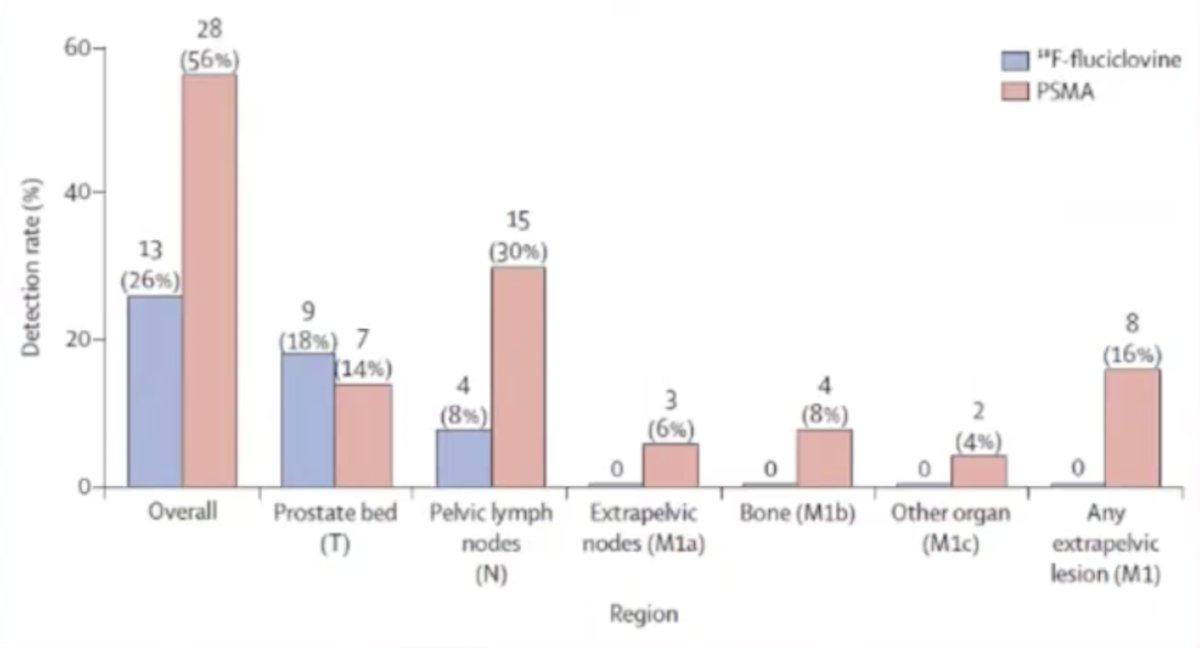
Also in 2019, Dr. Calais and colleagues performed a head-to-head comparison trial from UCLA comparing 18F-fluciclovine and 68Ga-PSMA-11 PET/CT scans for localizing early biochemical recurrence of prostate cancer after radical prostatectomy2. This study had 50 consecutive patients with biochemical recurrence and PSA levels ranging from ≥0.2 to ≤2.0 ng/mL without any prior salvage therapy. All patients underwent 18F-fluciclovine and 68Ga-PSMA-11 PET/CT scans within ≤15 days. PET/CT scans were each interpreted by three independent, blinded expert readers not involved in study design and data acquisition. Region consensus interpretation (T, N, M1a, M1b, and M1c) was generated based on majority rule in cases of reader disagreement (2 versus 1). PET/CT scans were considered as positive if any region was rated as positive. Detection rates per-patient and per-region served as primary study endpoint. This study found that the detection rates were significantly lower with 18F-fluciclovine PET/CT than with 68Ga-PSMA-11 PET/CT per-patient (26% vs 56%; p = 0.003) and per-region for pelvic nodes (8% vs 30%; p = 0.003) or any extra-pelvic lesions (0% vs 16%; p = 0.008):
Although PSMA PET is the preferred imaging modality for biochemical recurrence of prostate cancer, a proportion of patients, especially at low PSA, have negative or equivocal findings. 18F-fluciclovine exploits increased amino acid transport in prostate cancer cells and has the potential to detect tumor lesions not visualized on PSMA PET. In the REFINE trial, Dr. Lorenzini and colleagues prospectively evaluated 18F-fluciclovine PET performed after a negative or inconclusive PSMA PET. At the SNMMI 2026 annual meeting they reported preliminary data from the first 12 patients.
This was a prospective, single-arm cohort (single-center preliminary data) from the REFINE trial. Eligible patients had biochemical recurrence after radical prostatectomy (PSA 0.2–2.0 ng/mL), a prior negative or equivocal PSMA PET/CT, and underwent 18F-fluciclovine PET/CT within one month of the PSMA scan. The pre-specified primary endpoint was the per-patient detection rate, and secondary outcome measures were region detection rate and the proportion of patients with a management change.
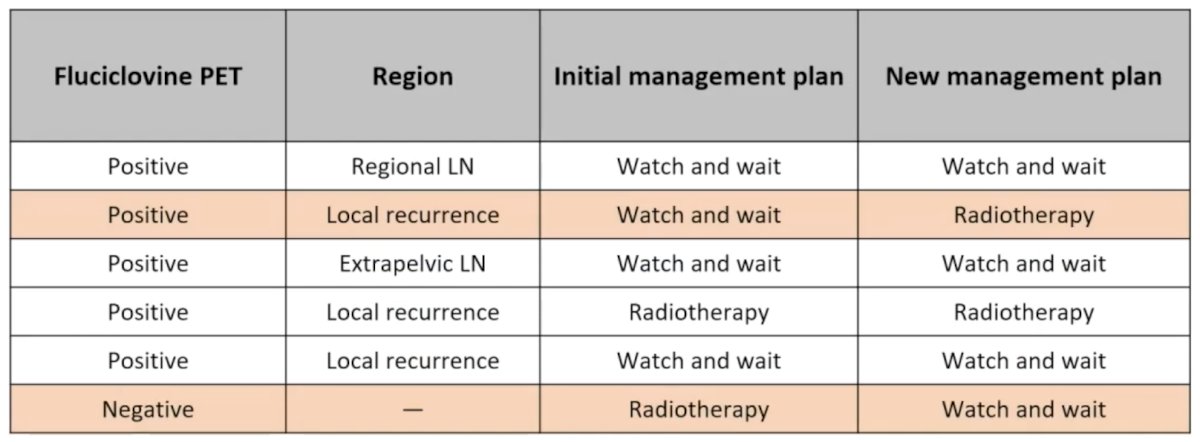
Twelve patients were enrolled, of which 5/12 had received prior salvage therapy, and none had prior systemic therapy. The median PSA at the time of the 18F-fluciclovine PET was 0.66 ng/mL (range 0.27–1.55), and the median injected activity was 363 MBq (range: 232–389). No serious adverse events were observed. 18F-Fluciclovine PET was positive in 5/12 patients (42%): local recurrence in three patients, regional lymph node in one patient, and extrapelvic lymph node in one patient. 18F-Fluciclovine PET/CT resulted in a documented change in management in 2/12 patients (17%):
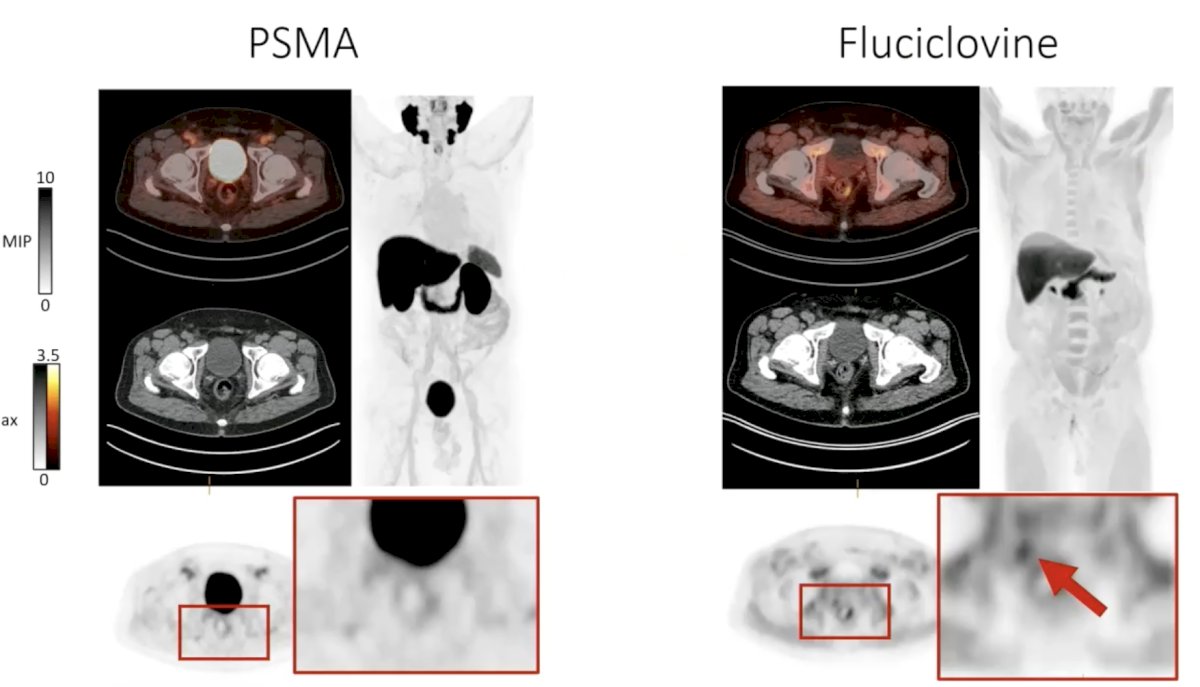
Dr. Lorenzini provided a case presentation of a 76-year-old male with a PSA of 0.6 ng/mL enrolled in the trial. The patient had a completely negative 68Ga-PSMA-11 PET/CT, but 18F-Fluciclovine PET demonstrated a positive lesion in the pelvis:
Dr. Lorenzini concluded his presentation discussing the REFINE study with the following take-home points:
- In this preliminary analysis of the REFINE trial, 18F-fluciclovine PET detected recurrence in 42% of patients with low-range PSA and prior negative/equivocal PSMA PET and altered management in a small subset
- These early results support the role of 18F-fluciclovine PET as a complementary imaging modality in selected patients with biochemical recurrence
- Further enrollment in the trial is ongoing (goal accrual: n = 29)
Presented by: Theo Lorenzini, School of Medicine and Health, Technical University of Munich, Munich, Germany
Written by: Zachary Klaassen, MD, MSc – Urologic Oncologist, Associate Professor of Urology, Georgia Cancer Center, Wellstar MCG Health, @zklaassen_md on Twitter during the Society of Nuclear Medicine and Molecular Imaging (SNMMI) 2026 Annual Meeting, Los Angeles, CA, Sat, May 30 – Tues, Jun 2, 2026.
References:
- Fendler WP, Calais J, Eiber M, et al. Assessment of 68Ga-PSMA-11 PET Accuracy in Localizing Recurrent Prostate Cancer: A Prospective Single-Arm Clinical Trial. JAMA Oncol 2019 Jun 1;5(6):856-863.
- Calais J, Ceci F, Eiber M, et al. 18F-fluciclovine PET-CT and 68Ga-PSMA-11 PET-CT in patients with early biochemical recurrence after prostatectomy: A prospective, single-centre, single-arm, comparative trial. Lancet Oncol 2019 Sep;20(9):1286-1294.